Sunday, August 12, 2012

Reflections of a First Time Kitchen Gardener


I remember the excitement of planting and harvesting string beans, chives and tomatoes as a child.   My favorite was the chives.  I’d snip them with a small scissor, take them to the kitchen, and my Mom would mix them into cream cheese sandwiches and scrambled eggs.

Yet, when I grew up and bought my own home, somehow, that nurturing gene seemed to recede.   I would attempt to garden with disastrous results.   My sunflowers were only two feet tall, the clematis never took, and the daffodils mysteriously vanished after one season.   Forget a “green thumb.”  Mine was black and blue.  

As I increased my culinary skills, I coveted a vegetable garden, but I was decidedly gun shy.   With a track record of flowers that withered, any attempt at vegetables was a clear path to starvation.  So I chose the next best alternative.  I outsourced.

For five seasons now, I’ve reaped the incredible harvest of community-sponsored agriculture.   I trust my farmers Dan Holmes and Caroline Fanning implicitly and I know there will always be food on my table, despite the unpredictability of Mother Nature.   But, after participating in seeding and harvesting at Restoration Farm for some years now, I begin to think that perhaps I’ve learned just enough to be dangerous.  While I would never forsake Restoration Farm, I might attempt a small kitchen garden, just for the sublime pleasure of having a selection of fresh herbs ready for snipping just outside my back door.  
So, in early May I take the plunge, or perhaps it’s more appropriate to say I plunge my hands into the soil.  I choose an area of the yard that’s already cleared and has an irrigation system, so the plants are not reliant solely on me for survival.  I’ve done my research, and I know that certain herbs and greens will do well in my partially shaded plot.  Of course, the simple vision of a small herb garden immediately begins to morph and grow.
I purchase parsley and basil at the Restoration Farm spring plant sale.   Next, I head to Martin Viette Nurseries on the North Shore of Long Island where I purchased chives, mint, oregano and rosemary.   Here’s where I start to get a little cocky, and throw two varieties of Swiss chard and six Red Russian kale plants into the mix.   That afternoon, I dig and I plant.  Two weeks later I add several marigolds for a dash of color, and one small head of red lettuce that Caroline was giving away at the farm.  The basil, rosemary and oregano, which need more sun, are planted in pots on the deck. 

It’s fair to say I’ve already learned a few things in my first season as a suburban farmer:  
Mint Has a Reputation:  Everyone, and I mean EVERYONE who hears I planted mint in my garden has said, “You know, it tends to take over.”  For the record, I get it.  Mint is a pushy land grabber.  I’m keeping the clippers handy and planning a heck of a mint julep cocktail party.
Swiss chard is the Lazarus Plant:  After several weeks, I was convinced the Swiss chard crop would fail.  The large shiny leaves were quickly turning to fragile parchment.  But, then the plants staged a revival.  And I’ve managed to harvest a good number of healthy leaves for salads and steamed and stir-fried greens.
Choose Flower Pots for Drainage, Not Fashion:  In the back of my head, I knew it was a mistake when I did it, but the pots I picked for my deck herbs did not have drainage holes.   But, I liked the fact that they were Robin Egg Blue and I thought they’d look really perky on the back deck.   Now, after every rainstorm, I’ve got to drain the water that’s pooling in the pots.  Despite this boneheaded move, I’ve been able to liberally sprinkle fragrant basil leaves over all types of salads and sliced tomatoes.   The rosemary looks healthy and is poised for the first potato harvest. 
Aphids May Love Kale More than Humans:  First a word about the fecund nature of kale.   One kale plant can feed a family of two.  Six kale plants can feed a developing nation.  The leaves are the size of Cleopatra fans, and they just keep coming.  Unfortunately, the kale is under attack by little white aphids that seem to be gorging themselves on the nutritious leaves.  I’ve lost some, and the leaves that I have harvested need a good cleaning.  Unless I get really inventive, there’s no way I’m going to be able to consume all this.  Next year, one or two plants should do it.    
When in Doubt, Pick Flowers:  Perhaps my most successful “crop” to date has been the marigolds.   They’re tall and healthy.   Too bad you can’t eat them.  

July is Weed Month on Long Island:  I turn my back for a minute, and the weeds are suddenly everywhere.   That's what happens in July.  But I can't wish it will go away.  Like everything in life, you've got to take the time to kneel down, and start tugging out those weeds if you want the garden to prosper.  

Lovely Lettuce:  The small head of red lettuce, which was really an afterthought, performed remarkably well and resulted in several fresh and colorful salads.  Note to self – less kale and more lettuce next year. 
I Still Love Chives:  That burst of slightly oniony chlorophyll still pleases, and the three chive plantings each resemble an unruly Mohawk haircut.  I need to get better at harvesting the chives so they don’t go to waste.  I managed to pull enough from the garden for this savory chive and smoked cheddar cheese bread created by Dorie Greenspan and recently baked by Mary at the blog “One Perfect Bite.”
Is my thumb any greener?  Perhaps it’s now a faint shade of teal if you catch it in the right sunlight.  It’s unlikely that I’ll ever grow all my own food, but what’s more important to me, is that my garden and I have grown exponentially.  And what’s really sprouted is the idea that it’s important and healthy to tend your own garden and reap the rewards.   
©2012 T.W. Barritt All Rights Reserved 

Sunday, August 05, 2012

“A Taste of Long Island” Food Market and Commercial Kitchen Opens for Business


Long Island’s first specialty market devoted to local products of the region is now welcoming customers with its grand opening weekend happening right now, and culminating in a ribbon cutting ceremony on the evening of Monday, August 6, 2012.  
Owners Courtney and Jim Thompson – a Daughter and Dad team – created A Taste of Long Island with a dual purpose.   The Farmingdale, Long Island business is both a commercial kitchen for local entrepreneurs looking to produce batches of  “made on Long Island” branded food products.   The specialty food market at the front of the store offers clients who use the kitchen – as well as other Long Island food artisans – the chance to sell their products to retail customers.   
The shelves are now stocked with all manner of diverse and delectable products springing from the hearts, minds, hands and soil of Long Island food artisans.  Colorful labels list places of origin such as Huntington, Bellmore and Peconic.  
The commercial kitchen has been up and running since early July, and clients have been lining up to schedule shifts. Bobby Tomatoes fresh spreads, “Tomato Delight” and “Parsley Delight” were produced in the Taste of Long Island kitchen and are now available in the food market.  
Catapano Goat Cheese - produced on Long Island’s North Fork, and a Culinary Types favorite – is available, along with a selection of soaps and beauty products made at the Catapano Dairy.
A stunning double-layered carrot cake prepared by a pastry chef and caterer who runs the company “David’s Delights,” sells at local farmers markets, and promises “the best desserts around,” has a prominent spot in the new pastry display case. 
“We’re a small business that is helping other small businesses expand, and we’re excited about that,” says Jim.  
Throughout the grand opening weekend, there are tastings scheduled by various Long Island food artisans.  Weekly tastings of Long Island wine are planned for the future, as well. 
A Taste of Long Island is located at 211A Main Street in Farmingdale, Long Island.   The phone number is 516-694-2859.   A complete list of vendors can be found here. When you visit, you’re not likely to leave empty handed! 
©2012 T.W. Barritt All Rights Reserved   

Sunday, July 29, 2012

Heritage Meat Birds at Restoration Farm – Go You Chicken Fat Go!


When I was in elementary school, we exercised in gym class to a 45 rpm vinyl record (I’m dating myself.  It was life before CDs and iPods) called "The Chicken Fat Song."

It was a snappy workout tune written by Meredith Wilson and sung by “Music Man” actor Robert Preston.   The record was sent to hundreds of U.S. schools as part of a youth fitness initiative launched during President Kennedy's administration.   Preston shouted out moves like Touch down every morning – ten times! followed by the refrain Go you chicken fat, go away! Go you chicken fat go!   Now, some years later I still can’t that song out of my head. 

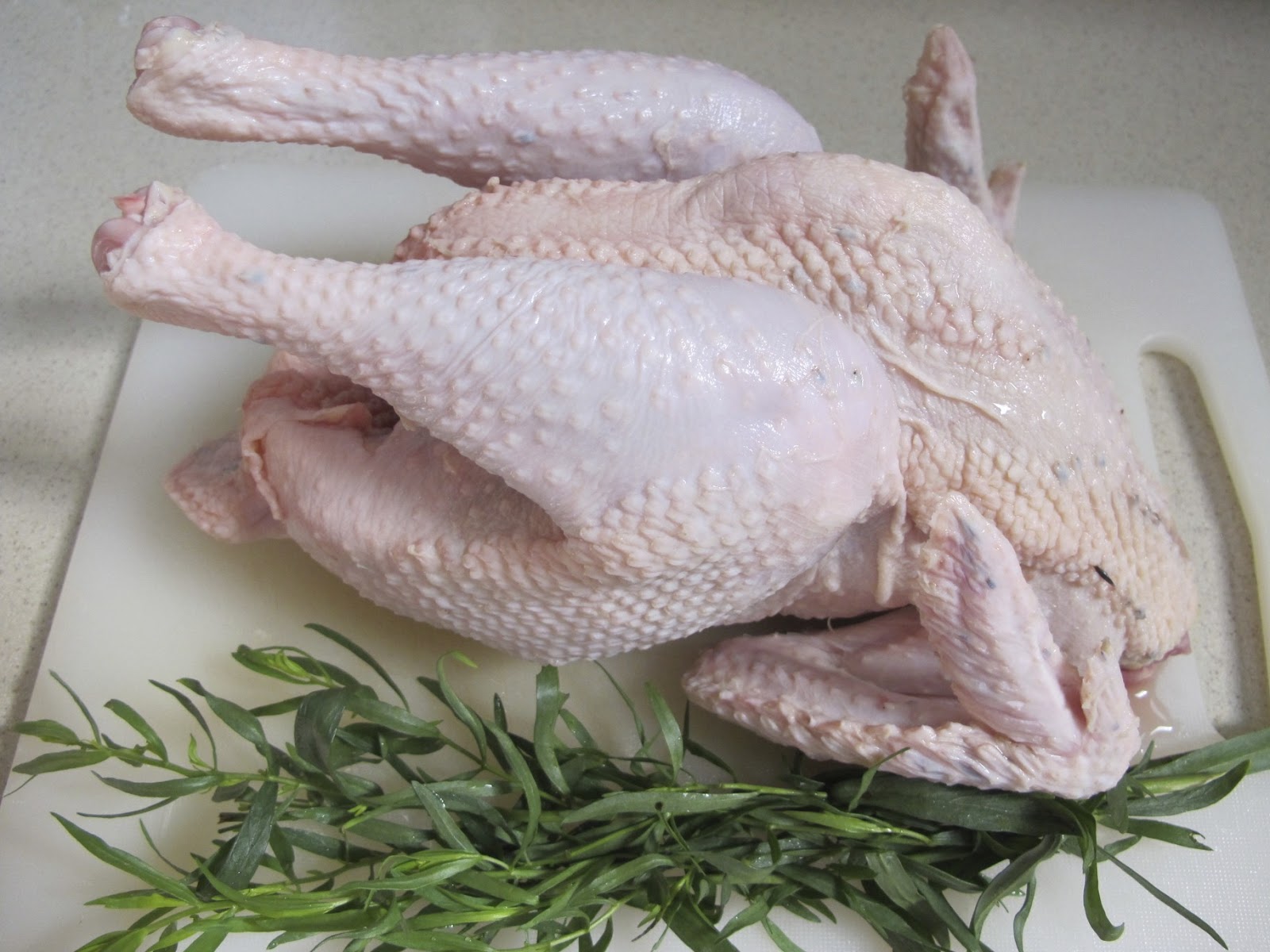
I was reminded of that catchy tune when my first heritage chicken was recently harvested at Restoration Farm.   Long and lean, the chicken is physically different than your average supermarket variety and there's almost no chicken fat at all.   I could almost hear Robert Preston’s bellowing voice in the kitchen singing, Go you chicken fat go! as I cleaned and trussed the bird.
In fact, the chicken fat was chased away in the fields of Restoration Farm.   The 2012 heritage meat birds are male free-range chickens that exercise and forage in the field.  They are breeds that once were more commonly raised, and need to be preserved – breeds that include Delaware, White Orpingtons, New Hampshires and Speckled Sussex.  They develop sleek, athletic bodies, quite unlike last season’s mostly grain-fed Cornish broilers bred to quickly put on the pounds.  They take longer to mature – up to twelve weeks versus the quick six-week maturation of a Cornish broiler.   The diet and activity of these heritage breeds is said to result in a more healthful and flavorful bird.  

One must do a bit of reading before cooking a heritage chicken.   The slim bird must be cooked at a lower temperature to assure a moist and tender breast.   At typical cooking temperatures for chicken, one could easily cook that farm fresh flavor right out of a heritage meat bird. 

I go straight to the master, Julia Child, and select a recipe from "Mastering the Art of French Cooking" called Casserole Roasted Chicken with Tarragon.  Julia’s technique of searing the bird, and then roasting it in a covered Dutch oven at a lower temperature of 325 degrees -- with lots of tarragon from the farm -- keeps the chicken moist and juicy and perfumed with the flavor of the herbs.
Did I notice a difference with my first fresh heritage chicken?   There is less meat, but the flesh did have a richness to it.  It was pronounced delicious by those who consumed it, but I'm not sure I would be able to taste a noticeable difference in a side-by-side comparison with a supermarket chicken.   I hate to admit that it felt a little less-than-bountiful simply due to the size.  It is funny that our society will look down on one who is pleasantly plump, but celebrate thinness in humans, yet when it comes to a chicken we feel a little deprived if the bird is not zaftig.  
Maybe there was a different reason to eat this bird -- a reason that had less to do with chicken fat and plump breasts and more to do with how the chicken was raised.   It is really about a better convergence of farming practices and palette.  Head growers Dan and Caroline believe that chickens can be incorporated into the farm and lead a healthier life prior to harvest.  I was there on the day in February when the birds were first delivered and placed in the brooder. 
The heritage birds truly traversed Restoration Farm in a large open pen.   They consumed grass and flowers and exercised their limbs and became part of the life cycle of the farm.  
The careful tending continued in the kitchen with the choice of recipe, and the stories told about this bird at the table.  The entire process was all more thoughtful and involved than a supermarket purchase.   
Perhaps cooking a heritage chicken is not about filling the belly, but about supporting the cycle of community agriculture and being filled with the total experience, from farm to table.   

©2012 T.W. Barritt All Rights Reserved

Sunday, July 22, 2012

Some Zany Good Luck, a Cavalcade of Crustaceans and Lunch at the Library


My pal Zany pings me one weekend in early July:   "Good morning!  Who said Friday the 13th brought bad luck?  Turns out I'll be in town and available for lunch/a food adventure if you're around and available..."

I couldn't be more thrilled.  Lunch has been a little lackluster lately and it’s been months since our last food adventure in Chicago.  I immerse myself in research and start monitoring Twitter hourly for the latest and greatest food trucks crisscrossing Manhattan. Zany would expect nothing less.  I’m not finding an obvious choice.  Many of our favorites still haunt midtown, but I’d like to try something different and most of the tasty new options are clustering downtown in the Financial District these days.    I'm also a little nervous.  In recent months, Zany has become quite the international gourmet.

Friday the 13th arrives and I am feeling lucky.  Luke’s Lobster Truck is in position on 46th and Vanderbilt, but I’ve also got an eclectic list of backup options ranging from Mediterranean to Greek.   Zany arrives at my office at the appointed time and she's already on the case.   She hasn’t lost her food truck mojo.  Walking across town, she’s spotted the Urban Lobster Shack Truck, parked near Luke’s as well as the Bistro Truck, which features a crab cake sandwich.    “Let’s visit them all,” she suggests gamely.  “It will be like a New England seafood sampler.”

Zany hasn’t lost her mojo, or her appetite. 

As we’re hoofing it over to the East Side, we run into a VIP on the street – my boss.   We chat for a minute before Zany serves up her big news.  “I’m eating for two!” she announces.   Yes, she and Luigi the Baker are expecting in December!    It’s very exciting, and she’s happy to break the news on Culinary Types.  

We zero in on the Urban Lobster Shack Truck, an arresting fire engine red vehicle, with a giant lobster mascot sitting in the drivers seat.  Our kind of joint.
The truck’s slogan is “On a roll since 2006.”   Wish I’d been on a roll since 2006.  
After a quick perusal of the menu, Zany decides we should kick off our seafood smorgasbord with the “Famous Lobster Roll” and a side of “Homemade Old Bay Pasta Salad.”  
We also get two servings of Maine Blueberry Virgin Sangria. 
Perfect for Zany’s current state, and perfect for an afternoon of dining at the shore.
Next we head a block or so over to Luke’s Lobster Truck.   Luke’s truck looks a bit like it might have weathered a Nor’easter, but it does profess some genuine New England hospitality.
Here we decide to go for the Shrimp Roll – a split bun, heaped with pink, curly shrimp and drizzled with warm butter.   Zany nearly hyperventilates as the guy in the truck drizzles the butter using a giant baster.  We find a spot for our little seafood feast at an outdoor promenade on Park Avenue.  
Zany picks up the lobster roll, and pries it in half with her hands.   She hands me my portion.  “From Me to You,” she says, and takes a bite of her half.  “I love lobster when you don’t have to work for it.”

It is an exquisite creation – big, succulent chunks of lobster on a toasted potato roll.   The pasta salad is light and refreshing, with just a hint of the Old Bay. 
I always admire Zany’s ability to revel in the moment.   “It’s almost like you can hear the sound of ocean waves and seagulls,” she says referring to the din of traffic and pigeons on Park Avenue.

The shrimp are lightly seasoned and nestled in a toasted bun, spread lightly with mayonnaise.  The bun is not soggy, which Zany notes is the mark of a true seafood chef. “When I saw that butter baster, I knew it was love at first site,” she says.
Next, we head for the Bistro Truck, which features a variety of Moroccan style fare.   Park Avenue in the 40s has become the new food truck haven.  Zany counts 12 trucks as we are strolling along the avenue.  The lines are long, with many smartly dressed financial types anxiously awaiting nourishment.  “It’s a friggin food truck circus out here,” she says.   
As we’re waiting for the crab cake at the Bistro Truck, Zany points out, “Remember for my farewell tour how we had three food adventures in one day?   Notice how this time we’ve managed to squeeze three food adventures into one lunch hour?” 

“Clearly, we’re getting more efficient,” I reply.
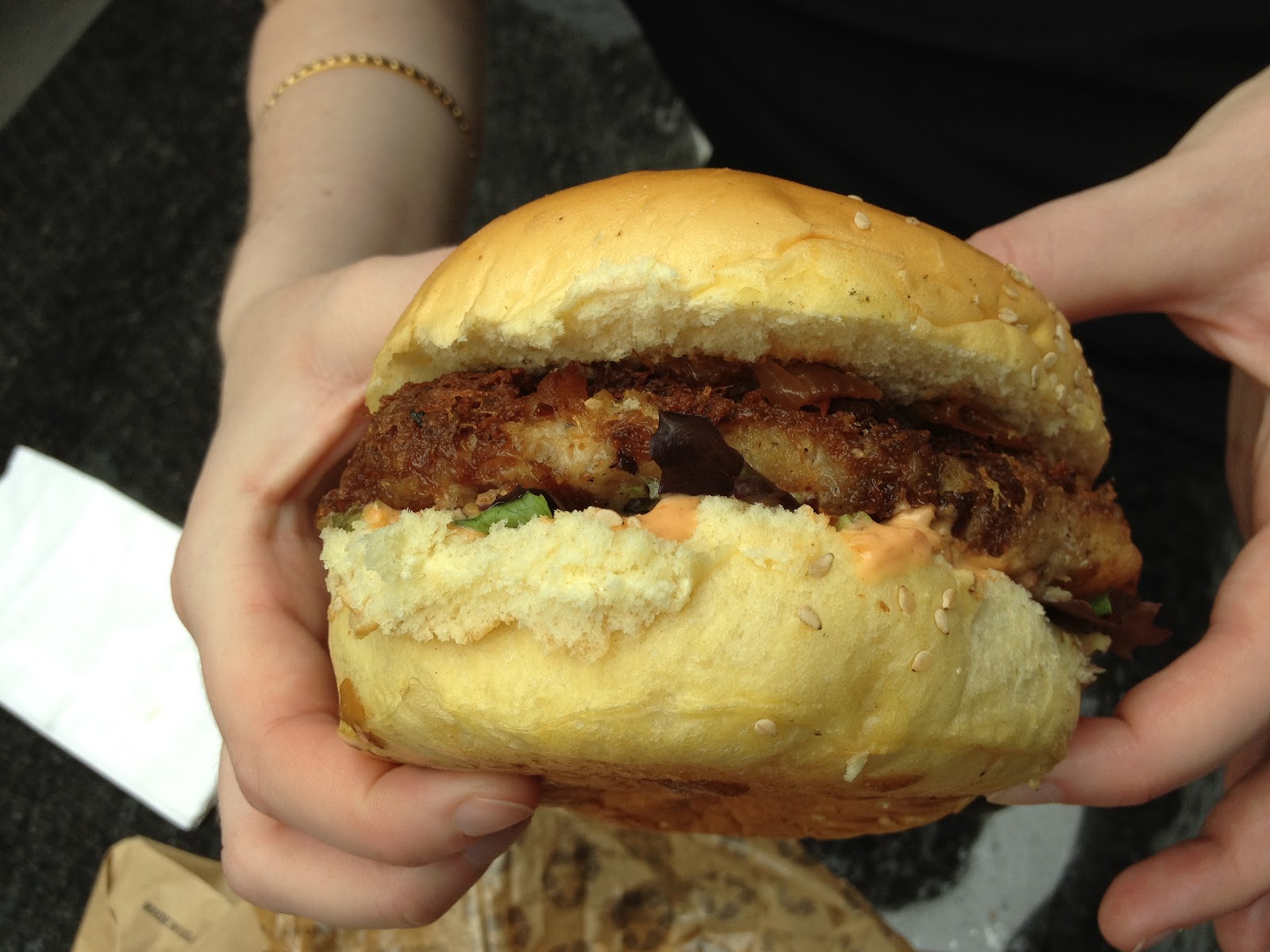
The crab cake sandwich completes our seafood triple threat.  The cake is massive, and stuffed with all kinds of yummy things.  We can see shrimp mixed into the crab cake, and the whole thing is seasoned with Moroccan spices and topped with some meltingly good caramelized onions.  It’s the perfect finale to our seaside buffet. 

“I think I’ve fulfilled my shellfish requirement for the day,” says Zany, primly folding her napkin and collecting the trash.  She pauses for a second.  “Let’s see.  We’ve had lobster, shrimp and crab – that’s all the major seafood groups.  Well done!”  She adds, "Do you know what Mad Me-Shell would like least about this menu?  No red meat!"

Before dessert, we decide to make a quick side trip to the New York Public Library where the exhibit “Lunch Hour NYC” is currently on display.   I believe a little side dish of education is always good, and it’s important that we have a better understanding of our place in New York lunch hour history.
In the exhibit, we learn about school lunches, street carts, power lunches and the world famous Horn & Hardart's Automat, once the height of lunchtime chic in New York City.
There’s even a singing coffee spigot, which Zany finds a bit perplexing.
As we wrap up our tour, I say, “I think we need something sweet for the walk back.”

“Look through the door,” says Zany in a hushed tone. (It is a library after all.) Perfectly framed in the library entrance is a vision of a Mister Softee Truck – the original food truck – bathed in a golden light and parked on the other side of Fifth Avenue.     

I pause for a second on the steps of the library.   “You know, I don’t think that’s actually a Mister Softee,” I begin.  “I think it’s one of those knockoff trucks.”

“Oh, let’s do it,” says Zany.  “New York is full of knockoffs.”    We order two vanilla/chocolate swirl cones and make an ice cream toast to our lucky day.
Cheers, Zany on your blessed event and your triumphant return to New York street food!  It was nice to have you back where you belong!  
 ©2012 T.W. Barritt All Rights Reserved

Sunday, July 15, 2012

Growing to Give – The Garden at St. Mark’s Bellmore


Just moments away from a busy Long Island main road is a place of sanctuary and nourishment.  It is like entering an Eden, of sorts.  Step through an arched entryway, and a visitor discovers neatly cultivated rows of vegetables and raised beds stretching across the property of St. Mark’s Episcopal Church in North Bellmore. There are root vegetables, greens, summer squash and colorful flowers bursting from the earth.    It is a peaceful place and one with a purpose.  
Susan Salem and Annie McPartlin are Co-Chairs of the Garden at St. Mark's in Bellmore, Long Island
St. Mark’s member Susan Salem – a longtime local farming advocate – founded the Garden at St. Mark’s a year ago with co-chair Annie McPartlin.  Susan is also the Saturday distribution manager at Restoration Farm.   She felt the church property could be put to more productive use to address a real need in the community, that of feeding the hungry.   
Most assume that Long Island is made up of affluent communities and carefully manicured lawns, but a 2010 study on Hunger in America by the organizations Feeding America, Long Island Cares and Island Harvest estimated that 1 in 10 Long Islanders seek relief from hunger each year at food pantries, soup kitchens and shelters. 
The Garden at St. Mark’s seeks to address the problem.  According to its informational materials, “The mission of the Garden is to have the church and community working together to enhance the environment through organic farming.  The connection of soil and spirit, and the reverence for God’s earth will serve as an outreach ministry to bring healthy and nutritious food to those less fortunate.”  A grant from Episcopal Charities helped to get the project started.  

The Garden at St. Mark’s has already reaped an abundant harvest of results.  “We were able to donate more than 1200 pounds of fresh organic produce to the Long Island Council of Churches Emergency Food Pantry in Freeport in our first season in 2011,” says Annie, a retired English teacher and avid gardener.  “It's wonderful to know that we have been able to provide healthy, fresh food to those less fortunate.”
“The Garden has brought a great deal of recognition to St. Mark's,” says Annie. “There were many people in the Bellmores that thought the church was closed, and even more who had no idea of the beautiful grounds on which the church sits.”  She explains that parish members have responded positively, although at first some were skeptical.  But, they've seen what a great ministry The Garden at St. Mark's is and how its impact has reached far beyond the walls and grounds of the church itself.  

Like any living garden, it continues to grow and evolve.  “One of the things that I love about The Garden at St. Mark's is that we are still in the process of becoming,” says Susan, “And, that in itself, has become part of our identity and has brought many wonderful things to our door.” 

This year, two different agencies that work with developmentally challenged adults reached out to the garden offering teams of volunteers who have taken charge of one of the raised beds. 
“They are so excited to be growing food and were thrilled to learn that they were capable of starting everything from seed, rather than buying transplants from the store,” say Susan. “Their joy is contagious!”

Annie adds that they also have school groups and Girl and Boy Scouts coming to the Garden to learn about sustainability and the joy and serenity of digging in the dirt and producing something healthy, tasty, and beautiful. 
Susan and Annie continue to hone their farming talents.  Both are Master Gardener Interns having completed a 12-week course through Nassau County's Cornell Cooperative Extension in the Fall of 2011.  Susan has also become a bit of a farming evangelist, and has advised other area churches on how to start their own gardens for the hungry.

“Our goal for The Garden at St. Mark's in our second season is to educate people about their ability to grow fresh produce right at their own homes – edible landscaping if you will – no matter how big or small their spaces are,” says Annie. “We also hope to make people aware that hunger in America isn't somewhere else – it’s right here among us on Long Island.”
The Garden at St. Mark’s aims to be self-sufficient.  A farm stand offering produce from the garden is open every Sunday from 11:30 AM to 1:30 up until October 28 to help cover basic expenses for the charitable efforts.  

“We are always looking for volunteers,” says Annie.  “No experience is necessary, and any age is appropriate.  We would really like to have a regular core of individuals we can count on.  As the Garden grows, so does its reach and popularity.  We need folks not only interested in gardening itself, but in fund-raising, publicity, farm stand work, and so many more things that go into keeping this Garden a place of enrichment, comfort, and peace.”
The Garden at St. Mark’s is located on the property of St. Mark The Evangelist Episcopal Church, 1692 Bellmore Avenue, North Bellmore, Long Island.   Those interested in visiting or volunteering can contact Annie at anniemcp@verizon.net     

©2012 T.W. Barritt All Rights Reserved