Showing posts with label Apicius The Culinary Institute of Florence. Show all posts

Thursday, September 21, 2006

Gastronomic Walking Tour of Florence

The Cappella dei Principi is the mausoleum for the Medici family of Florence. Much of it is now supported with scaffolding, because the polished blue, green and gold marble had begun to fall from the walls. I accept the potential risk of a head injury and make a morning visit to the site, which is regal even with the scaffolding. Again, Florence’s finest Michelangelo is present with several sculptures that decorate the stone caskets of the family.

At 10:00 a.m., I am back at Apicius, the Culinary Institute of Florence, and meet Massimo Coppetti, my guide for a gastronomic walking tour of the city. Among other things, Massimo is the wine expert at the institute. He is about my height, with dark hair and an olive complexion. He was born in Florence some 40 years ago and for a time operated several restaurants before devoting himself full-time to culinary teaching. He learned to cook out of necessity, because his mother worked as an elementary school teacher.

We head out onto Guelfa, and Massimo starts with a brief overview of the Italian kitchen, reminding me that the cuisine is comprised of three distinct regions, North, Central and South and the Islands. He explains that each of these regions was also influenced by the ingredients of the area, the weather of the region and the countries closest to them, resulting in a number of distinct dishes and variations.

We make a brief stop at Mercato Centrale, the major food market of Florence, where I sample three regions of olive oil all noticeably different in flavor. I taste different cheeses, and we pause at the tripe vendor where Massimo outlines the different selections of Tuscan tripe and entrails that are sometimes served in panini. I take a pass on the tripe.

Next, we head towards the historic center of the city, and Massimo discusses how coffee and wine are extremely important elements of the Italian culture. We visit Caffe Giacosa where shiny attractive people are lined up at the bar to order coffee. Massimo and I order Completo Marocchino, or Moroccan coffee, made with chocolate syrup and served in a shapely glass tumbler (I learn that Italians are loathe to drink coffee out of a paper cup). Massimo explains that coffee and wine are similar in that you need to taste them for their distinctive flavors and essences.

In the different establishments and on the street Massimo sees different people he knows and greets them warmly. As we walk, he talks about how important it is to preserve the heritage of the Italian kitchen. At times, he wishes the country would provide more support. He sees himself as a culinary ambassador as he travels to different countries promoting the work of Apicius.

The next stop is Cantinetta dei Varrazzano where I bite into a large slice of salt-less Tuscan bread called Schiacciata, but known as Focaccia in other parts. It is dimpled, golden and tangy. In several shops he points to a seasonal variety of Tuscan bread studded with wine grapes and only available during the autumn harvest.

We continue along the streets of Florence and Massimo tells me how much he enjoys cooking with his wife. “It’s good for the marriage,” he says.

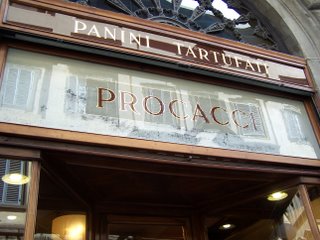
We visit a wine store where he outlines the four appellations established in Italy and explains the origin of super Tuscan wine. Then, he takes me to an establishment close to his heart, Procacci, established in 1885. It is all polished wood, marble floors and charming café tables. Procacci is a Florence-style delicatessen famous for its aperitivo – a glass of prosecco and a finger sandwich filled with truffle cream. Massimo orders me semi-dry bubbly prosecco which tastes of peach and the finger sandwich which he says is a secret recipe. He then tells me that he had his first aperitivo at age 15 with his father at Procacci. “I love this place,” he says.

The bell tower of the Duomo is heralding the noon hour as we approach our final destination, Gelateria Grom. There, he buys me three different kinds of gelato in a cup – fig, because it is in season, pistachio and something packed with bits of chocolate and biscuit, which is probably the Italian version of cookies and cream, but tastes far superior.

In two hours, he has done his work as an ambassador, and must hurry to an afternoon class. I am richer for it. We shake hands, and Massimo vanishes into the crowd of tourists.

In the afternoon, I cross the Arno River via the Ponte Vecchio and hike high up into the hills for expansive views of the old city wall and the domes and bell towers of Florence. I visit San Miniato al Monte, a Romanesque church build in 1018 that is reached by climbing hundreds of stone steps. It is dark, cool, and silent, and the crypt beneath the altar has a mysterious, age-old ambiance.

Returning to the city, I stop at the Museo di Storia della Scienza, where Galileo’s telescopes are kept, and have an early supper at Rititrare on Piazza della Signoria of ravioli stuffed with spinach and a dessert called a Fedora which is a bit like a chocolate beret filled with whipped cream.

© 2006 T.W. Barritt All Rights Reserved

Wednesday, September 20, 2006

Renaissance Pasta Chef

It is dark inside Santa Trinita as Florence begins another day. Only small votive candles illuminate the small chapels and frescos that grace the walls of the 11th century abbey. Outside, I can hear the buzz of motorbikes as the morning paces accelerates. But, inside Santa Trinita, I am blessed with a few moments of quiet reflection.

Later, I return to Apicius, the Culinary Institute of Florence for a class on the art of pasta making. Chef Roberto is back as my instructor and we get right down to the business of a bevy of pastas, Tagliatelle, Gnochhi di Patate, and Ravioli di Ricotta e Spinaci.

Once again, Roberto moves like a soccer player through the kitchen, as he sprinkles the lesson with food history anecdotes. I learn that pasta originated in the region of Emilia-Romagna and the traditional tomato meat sauce that now has many variations was created in Bologna and is the Sauce Bolognese.

The preparation of the sauce prompts a brief chopping competition. The base of any Italian sauce is carrot, onion, celery and olive oil. I prepare what looks to be a reasonably fine dice of the vegetables. Roberto then chops his vegetables twice as fine. I am appropriately humbled, but he explains that the vegetable base is now the same size and consistency as the ground pork and beef used in the sauce and it will cook more evenly.

We start the sauce to simmer and Roberto adds a sprig of rosemary. We measure out durum wheat flour – which has a sandy texture – into a bowl, add two eggs and begin to assemble the first pasta dough. Roberto tells me the rule of thumb for pasta is 1 egg for every 100 grams of flour. That’s all it takes – the rest is in the handling of the dough. We take turns kneading the dough gently, so as not to overwork it, and I am told to mix with only one hand. Soon, the dough is golden yellow and springy to the touch.

After the dough takes a brief rest in the refrigerator, we set up a pasta roller with a hand crank which clamps to the side of the marble counter. He teaches me how to roll the pasta sheet through the machine, draping the long end over the back of my left hand as I feed it through the rollers to get the desired thinness. It’s a bit like handling the old rolls of music for player pianos. Once the pasta is paper thin, I feed it into the blades and gather long, lovely stands of tagliatelle out the other end.

The stove burners are temperamental and Roberto is annoyed as nothing is heating properly. Still he manages to boil gold potatoes for the gnocchi, and then puts them in a low heat oven to extract as much moisture as possible. He explains that moisture will require more flour, and that would make the gnocchi tougher.

In between preparing bright green pesto sauce, he quickly demonstrates techniques for making little “ear shaped” pasta from a dough that consists only of flour and water. Using two fingers of his left hand to apply even pressure against a knife, he sweeps the knife over a tab of pasta dough and curls the circular shape over his thumb to get the distinctive ear shape. We roll out even thinner sheets of pasta for ravioli and space out dollops of ricotta and spinach along the sheet, blanketing the filling with a second pasta sheet to create the little pillows. Gnocchi dough is rolled into long ropes and cut into small, even rectangles.

Roberto is clearly passionate about pasta. The exercise seems to invigorate him. “I hope you’re going to make this at home, and not just forget about it after this class,” he says.

In the final assembly, he teaches me a trick to assure perfectly cooked pasta that takes on the flavor of the sauce. Rather than simply dumping hot sauce onto cooked pasta, he cooks the pasta partially, and then adds it to the simmering sauce with a bit of the pasta water. As the water boils off, the sauce thickens, and the pasta continues to cook. He assures me it will be perfectly done.

The table is set and the wine is poured. The ravioli is dressed in a delicate butter and sage sauce, the gnocchi infused with emerald green pesto, and the tagliatelle folded into sharp, meaty Bolognese sauce. The pasta, as promised, is perfectly cooked and the texture is firm but tender. The gnocchi is as light as a cloud. “You made this,” Roberto reminds me.

As I prepare to leave, Roberto again makes an appeal that I continue to practice my pasta. “Don’t let me down!” he orders.

Not to worry, Roberto. Pasta is at the top of my list.

In the afternoon, I seek out another classic – Michelangelo’s David at the Galleria dell’Accademia. No matter how many times you have seen a photo, it is no preparation for the real thing. The statue of the biblical hero stands 17 feet tall and is awe inspiring. A masterpiece, indeed.

© 2006 T.W. Barritt All Rights Reserved

Tuesday, September 19, 2006

The Cuisine of Florence and Tuscany


The heavy wooden door to the Dominican monastery San Marco opens at precisely 8:15 a.m. Founded in the 13th century, the Friars’ dormitories, or cell rooms, catapult me centuries into the past, far away from the clatter of modern day Florence. Each cell has a simple arched wooden door, a tiny window overlooking the cloister and a radiant fresco by Fra Angelico, depicting an event in the life of Christ. In all, there are 43 cells, each a rare gem of ecclesiastic art.

By 10 a.m., I arrive at Apicius (http://www.apicius.it/) for my class on the cuisine of Florence and Tuscany, and I meet my chef instructor Simone Riani. Simone is from Florence, and he began cooking as an apprentice at age 15. Today he is a chef at a restaurant near Palazzo Pitti and an instructor at the school. I will discover he is a modern Italian chef with a deep respect for tradition. Simone’s is less fluent in English, but we manage to communicate quite well, and he has a patient approach to teaching. He leads me back to the same galley kitchen where I worked on Monday and dons a tall paper toque.

We start preparation for dessert, Zuppa Inglese, translated as English Trifle, but it is different from the sherry and custard dessert I’ve prepared in the past. We mix a pastry cream on the stove, infused with vanilla bean, and soak crisp Italian biscuits in a clear cherry liqueur and Alchermes, a red liqueur with the aroma of nutmeg and cinnamon. The lady fingers are placed in the bottom of the serving dish and covered with the pastry cream, which is then sprinkled with shaved chocolate and chilled. Simone explains that Alchermes is a very old Italian liqueur that grandfathers would often drink at the end of a meal with espresso.

Pollo Fritto alla Fiorentina is actually fried chicken tenders, Florentine style, which means that sliced chicken breasts are marinated in fresh lemon juice, garlic and the best extra virgin olive oil. Simone tells me that salt, pepper and olive oil are the key ingredients in the Tuscan kitchen. In November, when the new olive oil is available, he says the food is soaked in it.

We assemble Minestra di Farro, which is a bean soup made with Farro wheat. This is a very old grain grown and used in Tuscan dishes. The grains plump fat as they are simmered with pinto beans, and the broth is scented with garlic, onion and sage.

Finally, we bread and deep fry the chicken, and assemble Fettunta o Bruschetta with bright summer tomatoes and basil, which Simone advises should be torn to avoid discoloring. Once again, the ingredients are seasoned with salt, pepper and an abundance of olive oil.

As we prepare to eat, Simone tells me there is a bit of a rivalry between French and Italian chefs. He says some Italians take offense that the French claim to have developed the recipes for béchamel sauce and onion soup when both actually originated in Italy. I decide to stay neutral on the issue. He explains his commitment to seasonal cooking, and how important he believes it is to cook the types of food that would logically be available in each season.

During the meal, Simone shows me a recently released cookbook that he and another chef at the school have collaborated on. The book is titled Innovations: New Appetites in the Tuscan Kitchen. It offers a series of trios – the traditional Tuscan recipe followed by his and his colleague’s modern variations on the classics. The photos are stunning, and the concept intrigues me, so I purchase a copy and ask Simone to inscribe it, which he does in Italian. I look forward to taking Simone’s new culinary interpretations back to my kitchen.

In the afternoon, Florence is jammed with tourists, professionals zipping through the streets on motor bikes, and shoppers crowding the high fashion shops. I squeeze into the Baptistry at Piazza di San Gionanni to admire the gold mosaic ceiling, and visit Orsanmichele, a small chapel that was once a grain market and now honors the 14 mercantile guilds of Florence. Winding through the narrow back streets of the eastern part of the city, I stop at Casa di Dante, a restored 13th century tower house which tradition says was the home of the poet Dante, author of The Divine Comedy.

© 2006 T.W. Barritt All Rights Reserved

Monday, September 18, 2006

Apicius: The Culinary Institute of Florence


The entrance to Apicius, via Guelfa 85 in Florence, is slightly recessed from the street. I check in ahead of schedule and I am issued a pack of recipes for my classes and an apron with the name of the institution and a crown of fruits and vegetables printed across the top.

Apicius was an ancient Roman chef and the Culinary Institute of Florence is dedicated to his tradition. The décor is soft colors, light sandstone brick walls and modern modular seating. I am introduced to Roberto, my chef instructor who leads me to a bright galley kitchen that opens up onto a small patio. Our subject is Regional Italian Cuisine and we will be covering dishes from Milan, Lombardia, Rome and Sicily. I quickly learn that Roberto was born in Australia, but his parents were both from Sicily. He looks a bit like a pirate, with bearded stubble, hair in a pony tail and chef’s hat slung back over his head. He is friendly, athletic and full of information.

We begin by preparing a beef stock to use with several of the dishes. I dice the onions too small and they brown too quickly. Roberto is quick to remind me that vegetables should be cut evenly to cook evenly.

While the stock is simmering, we turn to Crostini di Polenta. Roberto teaches me different ways to flavor the yellow grain which will serve as the base for our crostini appetizer. Along the way, he peppers the conversation with Italian food lore. In “the old days,” polenta was used as the base for many savory meat dishes because it was portable, and easily cooked with water. It comes from the Northern regions like Milan that grow maize, while dishes like risotto became prevalent in regions that were favorable to rice. I clean chubby porcini mushrooms and learn to cut cap and stem lengthwise with the grain so they will not disintegrate. We peel tomatoes and sauté them with the mushrooms and olive oil for a topping for the polenta. The corn mash is pressed into a loaf pan and left to cool.

Saltimbocca in Roman Style is tender veal pounded thin, topped with fresh sage and layered with prosciutto. It is assembled quickly and put in the refrigerator for final preparation. Roberto has spent years working in professional kitchens and offers advice on ingredient preparation and timing the elements of a meal in phases, to assure final presentation of hot food.

Roberto simmers onions, oil and just a touch of wine for a saffron risotto. I notice that he’s not vigorously stirring the broth as I’ve always assumed one should do. In fact, he’s just letting it simmer off to the side, and explains that after the initial combination of ingredients, it is better to let risotto simmer gently so as not to release too much starch from the rice. He promises me it will be creamier, and that I’ll notice the difference.

Cannoli Siciliani is a southern Italian confection. We mix together dough that is moistened with Marsala wine and lard. It doesn’t quite hold together at first, but after a bit of rhythmic kneading from Roberto, it becomes smooth and pliable. I roll the dough into thin disks that are wrapped around metal tubes and dropped into hot oil. We remove the metal forms. For the filling, ricotta cheese is whisked together with shaved chocolate, candied orange peel, crushed pistachio nuts and just a hint of cinnamon. I pipe the filling into the golden pastry tunnels which now look remarkably like what I’ve seen in the top Italian bakeries.

For the final steps, the veal is sautéed briefly in oil and wine. The polenta is sliced into rectangles and deep fried in oil until it is bronze and crisp. We top the rectangles with the mushrooms and tomatoes and eat the crostini as the rest of the meal is completed. The taste is like the sun caressing the earth.

The food is plated and we sit down to eat in the dining area with a glass of red wine. The salt and sage of the veal indeed pops on the tongue, which is the translation for the name of the recipe. The risotto is creamy gold, you can taste the layers of cheese, wine and broth, and each tender pearl of rice is evident on the palate. The cannoli completes our cook’s tour of Italy – crisp pastry complements cheese and cinnamon for a sweet Sicilian holiday.

The meal is “buono” but I need exercise after such a feast. For the afternoon, I visit San Lorenzo, which was the parish church of the Medici family, Santa Maria Novella, with its mysterious Green Cloister painted with ancient biblical frescos, and Palazzo Medici Riccardi, the flamboyant palace home of the Medici for 100 years.

© 2006 T.W. Barritt All Rights Reserved