Showing posts with label The Food of Italy. Show all posts

Sunday, March 01, 2009

Orange-Scented Olive Oil Cake and Remembering

Rarely a day goes by that I don’t think of my 2006 culinary tour of Italy. I was on sabbatical with no business pressures, and had weeks to immerse myself in the culture, history and ingredients of Bologna, Tuscany and Florence.

It was certainly a life-affirming and life-changing experience, particularly in my understanding of how history, ingredients, agriculture, locale and family all influence the nature of what we cook and eat.

Memory is also a key part of the culinary experience. When I make pasta by hand, I remember Chef Roberto’s energetic guidance, and when I taste fine balsamic vinegar, I recall Mary Beth’s exquisite attention to detail as she taught us to identify flavor notes.

Exceptional ingredients can transport me back to that time. When I pick up a bottle of imported olive oil in the market, I instantly recall that hot September afternoon when I hiked through groves of olive trees from the winery at Fattoria del Colle to the medieval town of Trequanda.

There was such an abundance of simple, wonderful ingredients that found their way into dinner and dessert as we cooked each night with a glass of wine in hand and watched a fiery sun set beyond the Tuscan hills.

This bright and sunny Orange-Scented Olive Oil Cake recalls that extraordinary journey for me. There are many recipes for olive oil cake. This recipe from “The Modern Baker,” by Nick Malgieri makes two cakes, uses pure olive oil instead of extra virgin for smooth earthy flavors of the Mediterranean, and gets its sweet, bright finish from the zest of three navel oranges. It couldn’t be simpler, and the memories it evokes for me of the people and tastes of that trip couldn’t be more delicious.

I’m bringing my Orange-Scented Olive Oil Cake to Maryann and Marie’s 2nd Annual Festa Italiana, a great opportunity to share food with good friends and remember those magical nights in Tuscany when the wine tasted fresh from the vine, the food and conversation filled the soul and the lights of Trequanda looked like fireflies against the late summer night sky.


©2009 T.W. Barritt All Rights Reserved

Saturday, March 15, 2008

Torta di Ricotta (Ricotta Cake)


I’ll always have Tuscany.

I’ll never forget my culinary travels through Italy in 2006. From Emilia-Romagna to Florence, the ingredients of the land defined what we cooked and ate.

At Fattoria del Colle in Trequanda, one of the rare wineries in Tuscany owned by a woman and staffed by women, I would walk in the vineyards – bursting with dark grapes – with the sun beating on my neck. In the evening we would work with the serious and practical Italian cook in the kitchen to prepare sumptuous, rustic dishes from simple, abundant ingredients – Panzanella (Bread Salad), Zuppa di Trequanda (Swiss Chard and Cabbage Soup with Cannelini Beans), and Schiacciata All’uva (Sweet Focaccia with Wine Grapes). Recipes were effortless to assemble, fed the body and the soul, and tasted exquisite with a glass of Brunello as we dined on the patio of the Osteria and the blazing sun set over the ancient Tuscan hills.


Torta di Ricotta, a feathery Ricotta Cake, always brings back those memories. The ingredients are sheer simplicity – mounds of ricotta cheese, fruity olive oil, lemon zest and brown sugar. It takes only moments to assemble and the creamy texture and sparkling citrus will have you dreaming of a late-summer evening of wine, good food and friends.


Torta di Ricotta (Source: The Silver Spoon)

Butter for the pan
2 ¼ cups all purpose flour; extra for dusting the pan
4 eggs
½ cup light brown sugar; extra for sprinkling
1 ¾ cups ricotta cheese
Grated zest of ½ lemon
5 tablespoons olive oil
¾ cup milk
1 tablespoon baking powder

Preheat oven to 350 degrees Fahrenheit. Grease deep tart pan with butter and dust with flour. Whisk eggs and brown sugar together until light and foamy. Stir in ricotta cheese, lemon zest, olive oil and milk. Shift flour and baking powder over egg mixture, mix well and pour into cake pan. Sprinkle with additional brown sugar. Bake for 40 minutes. Remove from oven, cool and turn out. Serves 6.


I’m submitting my Torta di Ricotta to the Festa Italiana event hosted by Marie of Proud Italian Cook and Maryann of Finding La Dolce Vita.

©2008 T.W. Barritt All Rights Reserved

Monday, December 10, 2007

Chocolate Panforte – Siena Cake from Italy

If you plan to serve an 800-year-old Italian confection to guests this holiday season, you may need to take certain precautions. Cut slices thin, serve with a sharp steak knife, and be wary of morsels that fly across the table.

I usually take a couple of samples of my creations into the office, but I’m a little afraid of wrecking my boss’s dental work.

All joking aside …

I first learned of Panforte di Siena during a culinary pilgrimage to Tuscany and the medieval city of Siena, Italy in September 2006. The god Hades was in command of the late-summer day. It was hotter than hell, and difficult to find shade in the hilltop city.


It is said that there is an ancient document preserved in Siena, dated in the year 1205, which records a tax of “bread with pepper and honey” paid to a group of nuns. Panforte translates as “strong bread.” In fact, it uses only a small amount of flour and no leavening agent. There are a number of variations, but honey, strong spices, nuts and dried fruit are the common ingredients. It is incredibly dense, chewy and flavorful.

Those medieval nuns must have had powerful bicuspids.


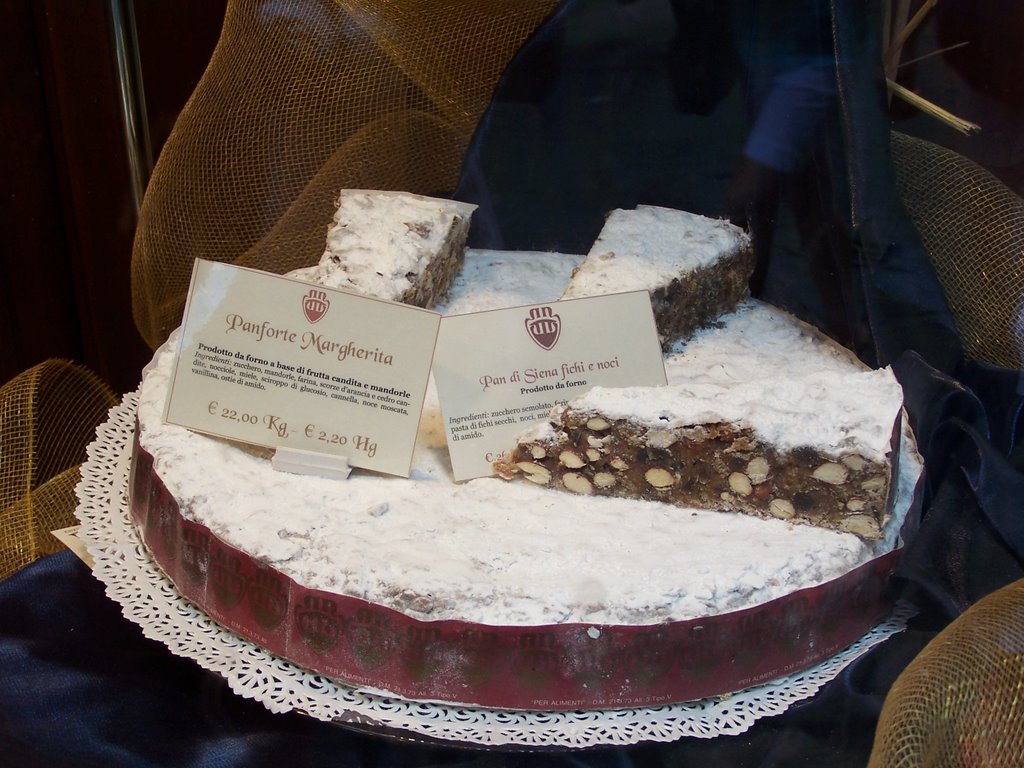
Huge rounds of panforte, studded with hazelnuts grace the windows of bakeries in Sienna. They are captivating to the eye, topped with mounds of powdered sugar and command a high price.

More affordable are the smaller cakes, wrapped in paper, available in most stores and novelty shops, with Panforte Margherita a favorite.


Panforte is one of those cakes that is steeped in legend. Another tale says it was invented around the year 1000, when Siena began to import sugar and spices from the Far East. One story says a nun miraculously devised the recipe and drove away the devil with the heavenly aromas. Another links panforte to a miracle of the Baby Jesus. While it is widely known as a traditional Christmas cake, it is available year round, and it is difficult to track the clear association to the Christmas holidays.

For my re-creation, I choose a recipe for Chocolate Panforte that was devised by the legendary goddess of home keeping. It resembles Panforte Nero, which is flavored with bittersweet chocolate. The preparation involves combining unsweetened chocolate, bittersweet chocolate, whole hazelnuts, dried cherries, flour, cinnamon and brandy with melted honey and brown sugar. The simmering honey melts the chocolate into a thick paste which is spread in a springform pan and dusted with cinnamon and cocoa powder.


The results are authentic, although the resulting cake could perhaps destroy a medieval fortification. While it does not slice easily, it is decadently dense with flavor, and it tastes subtly rich accompanied with a glass of dry sherry. A thin wedge goes a long way, but you need a powerful knife and fork to cut small bites. It is really quite wonderful, albeit, slightly inconvenient to eat.

I wrap up several slices for the gang at the office. I’m going to advise that they pick up the wedge and eat it with their fingers. The plastic forks in the pantry will never cut it with this medieval masterpiece.

©2007 T.W. Barritt All Rights Reserved

Sunday, September 02, 2007

Torta di Zucca – Pumpkin Cake


I’m feeling wistful for Italy.

Exactly one year ago, I was starting an eight week sabbatical, journeying to Italy to drink in the cuisine…and the wine. It was harvest season in Tuscany, after all. I consumed a lot of wine. One wisecracking travel agent described it as, “Italy on three bottles a day.” I did managed to learn a thing or two about the food, in spite of myself.

Things are different this year. At the moment, my most exotic destination is my kitchen on Long Island. Surprisingly, Long Island is becoming a bit of a food destination in its own right. When two dear friends, whom I’ll call “Valentine” and “Proteus” decide to accept an eight-month-old dinner invitation on the spur of the moment (Our friendship is deeply rooted in spontaneity. It keeps things fresh!), I am faced with the drama of organizing a respectable dinner with far less than my normal prep time.

I can do this. I’ve trained for these kinds of moments. It’s what developing a culinary sensibility is about.

As soon as I hang up the phone, I spring into action. I consult the Silver Spoon cookbook – The Bible of Italian Cuisine. I pull together the essentials for a late summer feast, inspired by the ingredients and culinary heritage of Italy.

Here’s an opportunity to taste the flavors of Emilia Romagna, Tuscany and Florence again without even leaving my kitchen. I strategize over bruschetta, salad, pasta with rosemary and roast pork. What I loved most about Italy was the simplicity of the cuisine. No need for a cast of thousands, just a few outstanding ingredients. The dessert will be particularly important for these guests, as they are passionate about their sweets.

What shall it be? Frosted layer cake? Homemade ice cream? Biscotti? Cannoli? I am flummoxed by the choices.


Torta di Zucca, or Pumpkin Cake jumps off the page. Simplicity at its finest. I recall the cakes we ate in Italy. Folded together in minutes, the batters consisted of a little flour, eggs, some sugar, a distinctive flavor, and perhaps an unexpected ingredient baked in a single layer to conclude a meal with understated elegance.

Torta di Zucca offers that kind of denouement. One half-cup of sweet butter is creamed with 1 cup of superfine sugar and two eggs until light and fluffy. Next add one cup of can pumpkin puree, two cups of self-rising flour, the grated zest of one lemon, 5 tablespoons of milk and the magic ingredient – eight crushed almond biscotti. The cookie crumbs give the soft ginger-colored batter dimension, crunch and the sweet aroma of almonds. Bake for 45 minutes in a single layer.


A few sunflowers, some Italian ceramics and the stage is set for dinner in Tuscany – a perfect afternoon of food and wine for a couple of gentlemen from Verona.


And, the Torta di Zucca? No theatrics – just a rich, nuanced, memorable performance.


©2007 T.W. Barritt All Rights Reserved

Tuesday, May 22, 2007

Food with Personality

From astrological signs to dating services to corporate team building exercises, we love to label personalities and deduce the psychological “type” of those around us.

We favor an endless supply of “tags” to classify character – cheerful, aloof, moody, mercurial, passive, and aggressive. Some years ago, I took the classic Myers-Briggs Type Indicator test, which neatly packaged me as ISFJ – which, translated from psychobabble, means Introversion, Sensing, Feeling and Judging.

Bogus? Maybe. To be honest, I had to look my “type” up after almost five years, but I know many people who can recite it just as easily as their SAT scores or Social Security number. There just seems to be some great degree of comfort in being able to classify, define, label and wrap things up in a neat little box.

Not so with food. Between color, texture and flavor, food offers an endless array of unpredictable combinations that consistently go against “type.” Yet, at the celebration feast this weekend, welcoming my brother and sister-in-law home from a year abroad, a fascinating collection of eclectic personalities emerged, not only around the table, but on the dinner plates.

Bell Pepper and Farro Salad

This combination of ancient wheat and a trio of multicolored bell peppers is a contradiction of a highly-traditional grain and bold, extroverted spontaneity. The black olives denote a mysterious, sensual undertone.


Tagliatelle with Mushrooms

A quick toss of fresh pasta made from scratch, sautéed onions and a mélange of wild mushrooms, epitomizes hands-on creativity and earthy, idealistic values. The sauce is adaptable and flexible to all kinds of situations.


Roast Pork with Orange

Slow-roasted boned loin of pork, basted with a rich mix of butter, orange juice, orange zest, chili powder and oregano is steady, painstakingly dependable and practical, yet imaginative with slightly exotic inclinations.


Chestnut Cake

Highly original, and non-conformist, this torte of chestnut flour, pine nuts, rosemary and olive oil eschews the tired, boring routine of sweet desserts, and its deep, nutty flavor is far from frivolous.


The meal was finished off with an effervescent Bartenura wine made from the Moscato grape, a sparkling and exuberant “life-of-the-party.”


Of course, I wouldn’t want to typecast anyone …

(Recipes from The Silver Spoon, The Bible of Authentic Italian Cooking.)

©2007 T.W. Barritt All Rights Reserved

Friday, September 22, 2006

Palazzo Pitti and Pecorino


It is my final day in Florence, and I venture to the district known as Oltrarno, which means “across Arno.” This region on the south side of the riverbank was once considered the low rent neighborhood until the Medici Grand Dukes moved here in 1550.

Their base of operation became the Palazzo Pitti, a sprawling edifice just a short walk beyond the Ponte Vecchio. It is both a palatial royal residence and a gallery that houses the Medici collections, and I spend the morning admiring works of art created by Titian, Lippi, Botticelli, Rubens and Raphael.

Behind the Palazzo Pitti is the Boboli Gardens, which the Medici family first cultivated, and is now a rambling historic garden. There are elegant fountains, Roman statues, cypress trees, citrus trees, exotic grottos and song birds, which provide a welcomed respite from the automobiles and motor bikes of central Florence.

Shortly after 5:00 p.m. I find myself, quite by accident, in front of Cantinetta dei Verrazzano, via Taolini, where Massimo bought me the Tuscan bread on Thursday. I notice there is a wine bar attached to the bakery that wasn’t open yesterday morning. I recall Massimo telling me that the bakery is owned by Castello di Verrazzano, a winery in Chianti. It seems like providence to have arrived there, so I step inside.

An affable waiter with glasses, wearing a maroon bow tie and apron, welcomes and seats me. It is a long narrow room with a small outdoor café that opens onto the cobblestone street. The tables have white marble tops and glass cabinets cover one wall. Inside are all types of dusty, aged wine bottles from Castello di Verrazzano. There is the head of a wild boar hanging on the wall and what I suspect is wild boar prosciutto curing behind the meat counter.

The waiter brings me a glass of Sassello, a vibrant ruby red wine made from the Sangiovese grape. It is lush and aromatic with a deep essence of chocolate. For the accompaniment, he presents slices of Pecorino cheese on fresh bread. He brings a large rectangular honeycomb to the table and artfully scoops crystalline amber honey on top of the cheese. He shaves orange zest across the honey, and I am mesmerized as I watch the citrus oils mist over the creation. He finishes with a sprinkling of pepper.

The sweetness of the orange and fresh honey and the tartness of the cheese melt into the chocolate flavors of the wine. It is simplicity and perfection, and a most appropriate finale to my exploration of Italian cuisine in Florence.

Buona sera, Firenze!

© 2006 T.W. Barritt All Rights Reserved

Monday, September 18, 2006

Apicius: The Culinary Institute of Florence


The entrance to Apicius, via Guelfa 85 in Florence, is slightly recessed from the street. I check in ahead of schedule and I am issued a pack of recipes for my classes and an apron with the name of the institution and a crown of fruits and vegetables printed across the top.

Apicius was an ancient Roman chef and the Culinary Institute of Florence is dedicated to his tradition. The décor is soft colors, light sandstone brick walls and modern modular seating. I am introduced to Roberto, my chef instructor who leads me to a bright galley kitchen that opens up onto a small patio. Our subject is Regional Italian Cuisine and we will be covering dishes from Milan, Lombardia, Rome and Sicily. I quickly learn that Roberto was born in Australia, but his parents were both from Sicily. He looks a bit like a pirate, with bearded stubble, hair in a pony tail and chef’s hat slung back over his head. He is friendly, athletic and full of information.

We begin by preparing a beef stock to use with several of the dishes. I dice the onions too small and they brown too quickly. Roberto is quick to remind me that vegetables should be cut evenly to cook evenly.

While the stock is simmering, we turn to Crostini di Polenta. Roberto teaches me different ways to flavor the yellow grain which will serve as the base for our crostini appetizer. Along the way, he peppers the conversation with Italian food lore. In “the old days,” polenta was used as the base for many savory meat dishes because it was portable, and easily cooked with water. It comes from the Northern regions like Milan that grow maize, while dishes like risotto became prevalent in regions that were favorable to rice. I clean chubby porcini mushrooms and learn to cut cap and stem lengthwise with the grain so they will not disintegrate. We peel tomatoes and sauté them with the mushrooms and olive oil for a topping for the polenta. The corn mash is pressed into a loaf pan and left to cool.

Saltimbocca in Roman Style is tender veal pounded thin, topped with fresh sage and layered with prosciutto. It is assembled quickly and put in the refrigerator for final preparation. Roberto has spent years working in professional kitchens and offers advice on ingredient preparation and timing the elements of a meal in phases, to assure final presentation of hot food.

Roberto simmers onions, oil and just a touch of wine for a saffron risotto. I notice that he’s not vigorously stirring the broth as I’ve always assumed one should do. In fact, he’s just letting it simmer off to the side, and explains that after the initial combination of ingredients, it is better to let risotto simmer gently so as not to release too much starch from the rice. He promises me it will be creamier, and that I’ll notice the difference.

Cannoli Siciliani is a southern Italian confection. We mix together dough that is moistened with Marsala wine and lard. It doesn’t quite hold together at first, but after a bit of rhythmic kneading from Roberto, it becomes smooth and pliable. I roll the dough into thin disks that are wrapped around metal tubes and dropped into hot oil. We remove the metal forms. For the filling, ricotta cheese is whisked together with shaved chocolate, candied orange peel, crushed pistachio nuts and just a hint of cinnamon. I pipe the filling into the golden pastry tunnels which now look remarkably like what I’ve seen in the top Italian bakeries.

For the final steps, the veal is sautéed briefly in oil and wine. The polenta is sliced into rectangles and deep fried in oil until it is bronze and crisp. We top the rectangles with the mushrooms and tomatoes and eat the crostini as the rest of the meal is completed. The taste is like the sun caressing the earth.

The food is plated and we sit down to eat in the dining area with a glass of red wine. The salt and sage of the veal indeed pops on the tongue, which is the translation for the name of the recipe. The risotto is creamy gold, you can taste the layers of cheese, wine and broth, and each tender pearl of rice is evident on the palate. The cannoli completes our cook’s tour of Italy – crisp pastry complements cheese and cinnamon for a sweet Sicilian holiday.

The meal is “buono” but I need exercise after such a feast. For the afternoon, I visit San Lorenzo, which was the parish church of the Medici family, Santa Maria Novella, with its mysterious Green Cloister painted with ancient biblical frescos, and Palazzo Medici Riccardi, the flamboyant palace home of the Medici for 100 years.

© 2006 T.W. Barritt All Rights Reserved

Saturday, September 16, 2006

Escapade in Florence

Day One in Florence is full of flavor – medieval prisons, Renaissance masters, domed cathedrals, sheltered cloisters, rustic pasta and the best ice cream in Italy.

Using my most reliable form of transportation, I set out on foot for the Bargello, built in 1255 as the town hall for Florence. In the 16th century, it became a prison, and some notorious Florentine criminals were executed in the court yard. Today, it’s been handed over to the arts and is home to a collection of Renaissance sculpture, where there are a number of pieces by Michelangelo and Donatello. There’s an outdoor sculpture garden of classic figures that makes an interesting contrast to the infamy of the court yard.

Next, I head to Bar Vivoli on Via Isola delle Stinche to investigate the rumor that one can get the best ice cream there, not only in Italy, but the world. Is it hyperbole? Is it story perpetrated by the proprietor? There is, in fact, some truth to the tale. You might almost miss Vivoli if you’re not looking for it. There is a small neon sign above the door, and inside it has the trappings of a traditional ice cream parlor like wooden paneling and marble countertops. But, behind the glass freezer cases, Vivoli does keep a Renaissance treasure. A number of tourists have ducked in to avoid a few raindrops and are placing orders. There are several rows of hotel pans hand packed with deep chocolate tones, and pink, yellow and green varieties. I notice that there is not a single ice crystal marring the velvety mounds. I select Crema gelato for 2.5 Euros which I learn is Vivoli’s most-requested flavor. I let the first spoonful dissolve on my tongue. It is cold, smooth and luxurious, with strong flavors of pure cream and fresh eggs. I make a resolution to return each day during my visit to sample a different flavor.

My next stop is the Gothic church Santa Croce, where one can find the tombs of Galileo and Michelangelo. There are two quiet cloisters and some interesting frescos. Since I’m not on my usual exercise routine, I then decide to climb the 463 steps to the top of the dome of Santa Maria del Fiore, the cathedral, or Duomo, of Florence. It is the tallest building in Florence, and the journey up is a work out. The reward is expansive views of the surrounding city and the Tuscan hills beyond.

I visit the cathedral museum. All of the key sculptures that once adorned the outside of the building are now housed here to protect them from the elements. The actual cathedral now has copies. I gaze at the Evangelists, The Virgin Mary and other Biblical luminaries who stare back at me with a slight look of detachment. There is also Michelangelo’s Pieta, which he actually intended for his tombstone, and used his self-portrait for the face of Nichodemas.

It is now dinnertime, the rain is constant and I am ravenous. Since it has been a sculpture day, I take a seat at a restaurant called Le Botteghe di Donatello, and order a serving of Tuscan Bread Soup and Spaghetti with Fresh Lobster. The soup is a thick, hearty stew of soaked bread, flavored with beans and vegetables. The pasta is brought to the table on a large platter, and there are actually pieces of whole lobster – in the crimson shell – scattered over the mound of spaghetti. There is a chucky tomato sauce which is seasoned with olive oil, garlic and red pepper, and it is a dramatic contrast to the sweet lobster meat. It looks like a challenge, but I manage to finish each strand of spaghetti and extract every piece of succulent lobster flesh from those shells.

© 2006 T.W. Barritt All Rights Reserved

Saturday, September 09, 2006

Preview of Florence

There is a brisk breeze blowing through the streets of Florence and people are everywhere. I quickly scope out the Eastern part of the city in the late afternoon, and discover that there are medieval treasures around every corner. Just steps from the hotel is the Piazza della Signoria, where a copy of Michelangelo’s David stands, and the Loggia dei Lanzi built in 1382, which is an outdoor sculpture garden filled with classic Roman statues. I walk past the Duomo, the tallest structure in the city, where the sound of steeple bells ring through the piazza.

In the evening, I dine at the Brunello Lounge at the Hotel Bernini Palace, and the food is the type of artistry typical of the Florentines, or as my server tells me, “Just like a painting.” I enjoy a white prosciutto, full of fat, which melts like butter on the tongue. Then there are quenelles of soft goat cheese flecked with briny green olives with dried tomatoes, Tagliatelle pasta with porcini mushrooms and shavings of parmesan, and a wild berry crepe for dessert.

The beauty of Florence will have to wait for another week thought, as my next destination is Chateau du Fey in the Burgundy valley of France.

© 2006 T.W. Barritt All Rights Reserved

Buon Viaggio


September 9, 2006: We visit the ceramic center of Deruta in the morning and by early afternoon have arrived in Florence, near the end of our culinary adventure. I must say goodbye to Anne who is tall and elegant, Joyce who is brimming with superlatives, Gary who stirs the pot and Jessica who is the only public relations person I’ve ever cooked with, although I've known many who like to eat. As Joyce would say, it is an “amazing” experience to meet new people and begin to cook together and I will never forget our journey through Bologna and Tuscany and the exceptional meals we shared together. I wish you all Buon Viaggio and great food for a lifetime!

Most important, we all owe a debt of gratitude to our gentleman driver Romano who took such good care of us, and of course our host and instructor, Mary Beth Clark. She has been our interpreter, our translator and our culinary guide and has given us a great gift of herself, her love of food and the regions of Emilia-Romagna and Tuscany. It has been an unforgettable experience. Grazie, Mary Beth!!

© 2006 T.W. Barritt All Rights Reserved

Baking in Siena


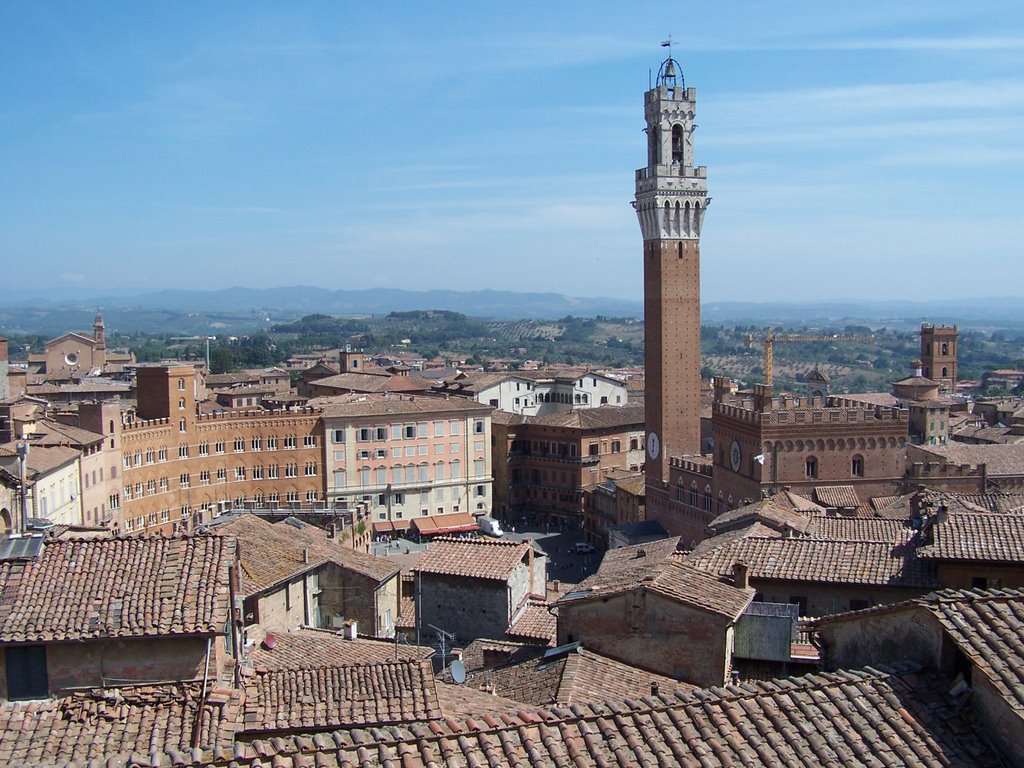
Friday, September 8, 2006: The medieval town of Siena sizzles under the bright sun. The streets resemble narrow alleyways that wind to the top of the hill. Siena experienced years of growth between 1260 and 1348. Near the center of town is Il Campo, the clam-shell shaped town square where the famous horse races are held each year.

I spend several hours exploring the Duomo, a gothic masterpiece cathedral begun in 1136. The marble floor of the Duomo is only uncovered once a year during September and October, and for once I am in the right place at the right time. The marble inlay floor is like a gold and black tapestry which depicts 56 scenes that illustrate the history of mankind. I visit the Crypt, only discovered in 1999, where there are beautifully colored frescos that might have remained a secret for eternity.

I move on to investigate two foods that are special to Siena. In a small shop near the Duomo, I find Panforte Margherita a thin, flat torte of golden paste enriched with molasses, nuts, citron and spices. The confection dates to the middle ages. It is chewy and spicy, similar to dense fruit cake or date bread. I walk back beyond the Duomo and stop at Nannini, a famous bakery in Siena. Tourists have lined up to sip afternoon espresso. A gentleman ahead of me on line purchases more than 60 Euro worth of pastries, that are wrapped carefully in cream-colored paper and tied with a red ribbon. There, I sample Ricciarrelli, a clam-shaped golden cookie, slightly larger than the French Madeleine, soft and cake-like and dusted with powered sugar. It is tender, crumbly and sweet – a perfect treat to top my visit to Siena.

© 2006 T.W. Barritt All Rights Reserved

Tuscan Culinary Journal


Wednesday Afternoon, September 6, 2006: We dine on a lunch of grilled vegetables and meats at a local restaurant, where the fire of the open brick oven permeates the food. Our driver then takes us deep into the countryside where we pass fields of sunflowers that have dried up from the summer heat and look like monks with heads bowed in prayer. There are hills upon hills, pheasants dashing through the fields and mustard colored villas with brightly-painted shutters. By late afternoon we pull onto a gravel road that runs alongside grape vines that are weighted with blue-black grapes awaiting harvest.

This is a 16th century Tuscan estate owned by a woman vintner who produces award-winning Italian wines. The business has been passed down from mother to daughter. She hires primarily women to produce her wines and is a pioneer in the region. The villa is an ancient structure of tawny brick, terra cotta tile and smart green shutters. Apple and pear trees dot the landscape, and there are groves of tall, stately Cyprus trees. By the pool, one can look out deep into the straw-colored valley of Tuscany where medieval fortresses cap distant hilltops.

At 5:30 we meet at the osteria for our cooking class, and are introduced to our chef instructor – a woman raised in Rome who is self taught. She is quiet and serious, but on occasion, will burst into a sunny smile. She teaches us to make a variety of pizzas, hearty Tuscan bean soup, salad and a creamy chocolate ricotta pie with bronze crust. Olive oil flows with each dish. The food is simple and robust, all featuring ingredients from the region.

Before the meal is served, we take our glasses of light, fruity white wine and watch a spectacular fiery sunset over the hills of Tuscany. We dine al fresco on the patio with the hill-top village of Trequanda beyond us, which was once inhabited by the Etruscans. We drink rich Chianti and toast our arrival in the country.

© 2006 T.W. Barritt All Rights Reserved

The Master of Parmigiano-Reggiano

Wednesday Morning, September 6, 2006 We are greeted at the door of the production factory by a tall, friendly Italian gentleman with dark hair, chiseled features and taut muscles. He bears a striking resemblance to a stone statue of a Roman deity one might find in a piazza. He is, in fact a deity of the land. He is the cheese master at a Parmigiano-Reggiano production center, a short drive from Bologna.

Dressed in a long, plastic white apron, he offers a welcoming handshake and ushers us into the production center. Much like the seven labors of Hercules, the Master of Parmigiano-Reggiano must endure multiple labors to produce a cheese that meets the rigorous standards of the agricultural region. Inside the tiled production facility it is moist and humid. Using a process that began hundreds of years ago, the staff brings in the morning and evening milk from the cows, which is then heated. Massive copper vats are filled with the hot, milky brew and the cheese master and his assistants work rapidly, dragging large sheets of white muslin through the soup collecting the pale white solids that have accumulated in the tanks. At this point, the curds are flavorless. The cheese master then presses the solids firmly into round plastic molds which are left to dry for several days.

The large disks of cheese are cured for many days in a vat of salt water, about the size of a basketball court. A large mechanical system of hooks and open shelving is used to submerge the cheese in the salt water baths.

The cheese is stamped with a unique serial number and date, stored, and over time the rind begins to take on its distinctive copper patina. We are allowed a glimpse in the warehouse where hundreds and hundreds of rounds of cheese are stacked floor to ceiling and for months will age and season to perfect ripeness.

A staff member pulls a hefty round of cheese from the shelf and slices open the disk with a knife that looks like a large surgical tool. The deep amber rind is pulled away and we get our first look at the result of the cheese master’s labors. Inside, the cheese is wheat colored with a soft, quartz-like texture. We pull off large chunks from the wheel by hand, and take a bite. The Parmigiano-Reggiano pops on the tongue and offers many dimensions. It is sometimes crunchy then smooth. Creamy and then salty. There are dry mineral undertones and flavors of toasted bread. And, it is fresher than anything of its kind I’ve ever sampled at home. It is certainly the food of gods and a Herculean effort from the Master of Parmigiano-Reggiano.

© 2006 T.W. Barritt All Rights Reserved