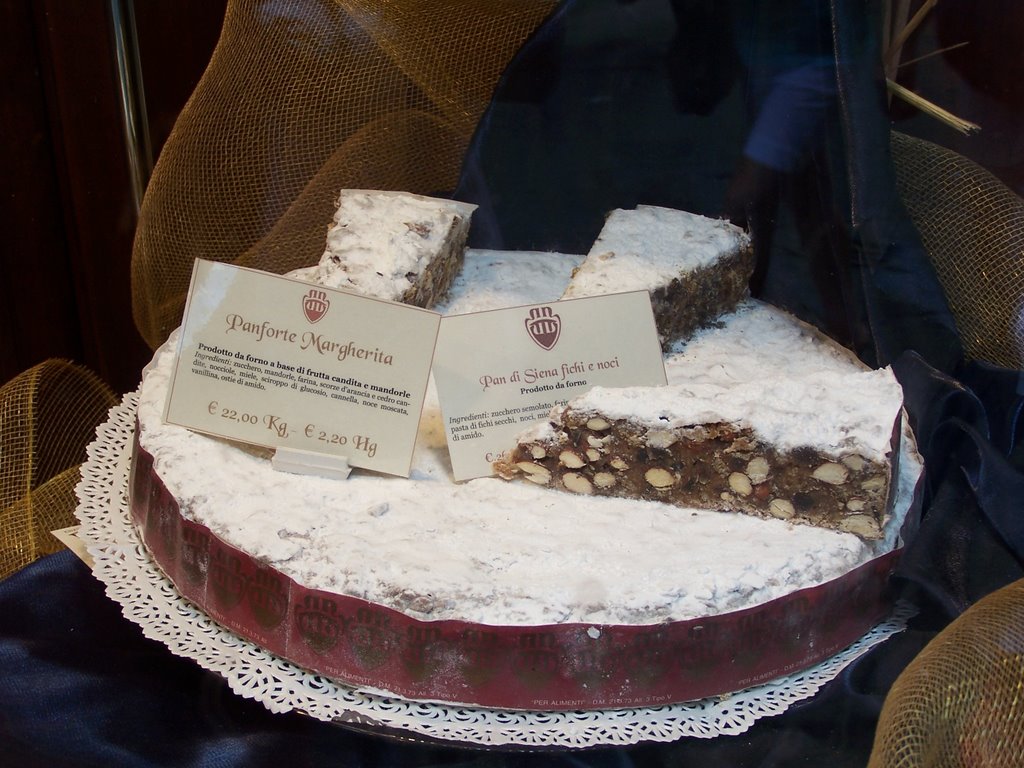
Monday, September 18, 2006

Apicius: The Culinary Institute of Florence


The entrance to Apicius, via Guelfa 85 in Florence, is slightly recessed from the street. I check in ahead of schedule and I am issued a pack of recipes for my classes and an apron with the name of the institution and a crown of fruits and vegetables printed across the top.

Apicius was an ancient Roman chef and the Culinary Institute of Florence is dedicated to his tradition. The décor is soft colors, light sandstone brick walls and modern modular seating. I am introduced to Roberto, my chef instructor who leads me to a bright galley kitchen that opens up onto a small patio. Our subject is Regional Italian Cuisine and we will be covering dishes from Milan, Lombardia, Rome and Sicily. I quickly learn that Roberto was born in Australia, but his parents were both from Sicily. He looks a bit like a pirate, with bearded stubble, hair in a pony tail and chef’s hat slung back over his head. He is friendly, athletic and full of information.

We begin by preparing a beef stock to use with several of the dishes. I dice the onions too small and they brown too quickly. Roberto is quick to remind me that vegetables should be cut evenly to cook evenly.

While the stock is simmering, we turn to Crostini di Polenta. Roberto teaches me different ways to flavor the yellow grain which will serve as the base for our crostini appetizer. Along the way, he peppers the conversation with Italian food lore. In “the old days,” polenta was used as the base for many savory meat dishes because it was portable, and easily cooked with water. It comes from the Northern regions like Milan that grow maize, while dishes like risotto became prevalent in regions that were favorable to rice. I clean chubby porcini mushrooms and learn to cut cap and stem lengthwise with the grain so they will not disintegrate. We peel tomatoes and sauté them with the mushrooms and olive oil for a topping for the polenta. The corn mash is pressed into a loaf pan and left to cool.

Saltimbocca in Roman Style is tender veal pounded thin, topped with fresh sage and layered with prosciutto. It is assembled quickly and put in the refrigerator for final preparation. Roberto has spent years working in professional kitchens and offers advice on ingredient preparation and timing the elements of a meal in phases, to assure final presentation of hot food.

Roberto simmers onions, oil and just a touch of wine for a saffron risotto. I notice that he’s not vigorously stirring the broth as I’ve always assumed one should do. In fact, he’s just letting it simmer off to the side, and explains that after the initial combination of ingredients, it is better to let risotto simmer gently so as not to release too much starch from the rice. He promises me it will be creamier, and that I’ll notice the difference.

Cannoli Siciliani is a southern Italian confection. We mix together dough that is moistened with Marsala wine and lard. It doesn’t quite hold together at first, but after a bit of rhythmic kneading from Roberto, it becomes smooth and pliable. I roll the dough into thin disks that are wrapped around metal tubes and dropped into hot oil. We remove the metal forms. For the filling, ricotta cheese is whisked together with shaved chocolate, candied orange peel, crushed pistachio nuts and just a hint of cinnamon. I pipe the filling into the golden pastry tunnels which now look remarkably like what I’ve seen in the top Italian bakeries.

For the final steps, the veal is sautéed briefly in oil and wine. The polenta is sliced into rectangles and deep fried in oil until it is bronze and crisp. We top the rectangles with the mushrooms and tomatoes and eat the crostini as the rest of the meal is completed. The taste is like the sun caressing the earth.

The food is plated and we sit down to eat in the dining area with a glass of red wine. The salt and sage of the veal indeed pops on the tongue, which is the translation for the name of the recipe. The risotto is creamy gold, you can taste the layers of cheese, wine and broth, and each tender pearl of rice is evident on the palate. The cannoli completes our cook’s tour of Italy – crisp pastry complements cheese and cinnamon for a sweet Sicilian holiday.

The meal is “buono” but I need exercise after such a feast. For the afternoon, I visit San Lorenzo, which was the parish church of the Medici family, Santa Maria Novella, with its mysterious Green Cloister painted with ancient biblical frescos, and Palazzo Medici Riccardi, the flamboyant palace home of the Medici for 100 years.

© 2006 T.W. Barritt All Rights Reserved

Sunday, September 17, 2006

Venus on the Half-Shell and Pizza at Ponte Vecchio

I’m standing in the Piazza Della Signoria at 9:00 a.m. when the doors to the Pallazzo Vechhio swing open. This is the “Old Palace” built in 1322 which still serves as Florence’s town hall. It looks like a small fortress on the outside, but inside are palatial rooms decorated in grand style for Duke Cosimo I.

After that, it is a short walk to the Uffizi which was originally built as a suite of offices for Duke Cosimo’s staff. The Medici family turned the Uffizi into an art gallery, and it is now one of the oldest art museums in the world. People line up at the Uffizi like they’re selling tickets for a Beatles reunion. It just proves art appreciation is not dead. Of course, it doesn’t hurt if you’ve got the greatest Renaissance art collection in the world. Fortunately, I’ve shelled out the extra cash for an advanced ticket, and the speed of entry is worth the price of admission.

I check out the gallery maps and make tracks to the Botticelli exhibit hall. I’ve probably had a crush on Botticelli’s “Venus” since high school art history class, and there she is, big as life in all her flowing golden hair and naked splendor. Here in Italy, the Roman Goddess of Love is an icon, and her face even graces the 10 cent Euro coin. If I were in charge, I would have given her the more prestigious 2 Euro coin. Botticelli’s colors are brilliant, even after more than 500 years, and the sweet-faced Venus looks serene as she is whisked across the Aegean Sea on an open clam shell by the winds, and sent into the arms of waiting nymphs.

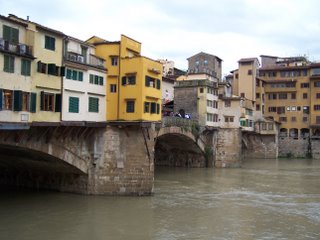
Once you’re inside the gate, one can, and should, spend hours exploring the Uffizi. I emerge in late afternoon and head towards the Ponte Vechhio or Old Bridge that crosses the Arno River. It is the oldest bridge in Florence, built in 1345. Once it was home to goldsmiths and now is the place of business for jewelry dealers. The bridge is crowded with tourists seeking bargains, but I’m in search of an early dinner. I settle on “Golden View Open Bar Ristorante.” (http://www.goldenviewopenbar.com/) True, the name is hardly authentic Italian, but the dining room riverside view of the Ponte Vechhio is unmatched. Even as rain pours down, the mustard colored medieval workshops clustered along the bridge are radiant.

I order Chianti and Pizza Fiorentino which is adorned with mushrooms, proscuitto and Tuscan salami. The crust is thin and crisp, and the earthy mushrooms and salty ham do a bit of a Tuscan love dance on my palate. I conclude the meal with a Calzone Goloso, which I’m certain is dedicated to the Goddess of Love. It is a pastry calzone, stuffed with mascarpone cheese, covered in chocolate Grenache and sprinkled with pine nuts. The waiter gives me an after-dinner cordial on the house, a potent golden Limoncello, perhaps as a tribute to the goldsmiths of the Ponte Vecchio.

© 2006 T.W. Barritt All Rights Reserved
Saturday, September 16, 2006

Escapade in Florence

Day One in Florence is full of flavor – medieval prisons, Renaissance masters, domed cathedrals, sheltered cloisters, rustic pasta and the best ice cream in Italy.

Using my most reliable form of transportation, I set out on foot for the Bargello, built in 1255 as the town hall for Florence. In the 16th century, it became a prison, and some notorious Florentine criminals were executed in the court yard. Today, it’s been handed over to the arts and is home to a collection of Renaissance sculpture, where there are a number of pieces by Michelangelo and Donatello. There’s an outdoor sculpture garden of classic figures that makes an interesting contrast to the infamy of the court yard.

Next, I head to Bar Vivoli on Via Isola delle Stinche to investigate the rumor that one can get the best ice cream there, not only in Italy, but the world. Is it hyperbole? Is it story perpetrated by the proprietor? There is, in fact, some truth to the tale. You might almost miss Vivoli if you’re not looking for it. There is a small neon sign above the door, and inside it has the trappings of a traditional ice cream parlor like wooden paneling and marble countertops. But, behind the glass freezer cases, Vivoli does keep a Renaissance treasure. A number of tourists have ducked in to avoid a few raindrops and are placing orders. There are several rows of hotel pans hand packed with deep chocolate tones, and pink, yellow and green varieties. I notice that there is not a single ice crystal marring the velvety mounds. I select Crema gelato for 2.5 Euros which I learn is Vivoli’s most-requested flavor. I let the first spoonful dissolve on my tongue. It is cold, smooth and luxurious, with strong flavors of pure cream and fresh eggs. I make a resolution to return each day during my visit to sample a different flavor.

My next stop is the Gothic church Santa Croce, where one can find the tombs of Galileo and Michelangelo. There are two quiet cloisters and some interesting frescos. Since I’m not on my usual exercise routine, I then decide to climb the 463 steps to the top of the dome of Santa Maria del Fiore, the cathedral, or Duomo, of Florence. It is the tallest building in Florence, and the journey up is a work out. The reward is expansive views of the surrounding city and the Tuscan hills beyond.

I visit the cathedral museum. All of the key sculptures that once adorned the outside of the building are now housed here to protect them from the elements. The actual cathedral now has copies. I gaze at the Evangelists, The Virgin Mary and other Biblical luminaries who stare back at me with a slight look of detachment. There is also Michelangelo’s Pieta, which he actually intended for his tombstone, and used his self-portrait for the face of Nichodemas.

It is now dinnertime, the rain is constant and I am ravenous. Since it has been a sculpture day, I take a seat at a restaurant called Le Botteghe di Donatello, and order a serving of Tuscan Bread Soup and Spaghetti with Fresh Lobster. The soup is a thick, hearty stew of soaked bread, flavored with beans and vegetables. The pasta is brought to the table on a large platter, and there are actually pieces of whole lobster – in the crimson shell – scattered over the mound of spaghetti. There is a chucky tomato sauce which is seasoned with olive oil, garlic and red pepper, and it is a dramatic contrast to the sweet lobster meat. It looks like a challenge, but I manage to finish each strand of spaghetti and extract every piece of succulent lobster flesh from those shells.

© 2006 T.W. Barritt All Rights Reserved

The Food of La Varenne

Thursday, September 15, 2006: We are assembled in the kitchen at La Varenne for our final master class with Anne Willan. We watch transfixed as Chef Randall simmers half-cut apples in butter and sugar until they are the color of mahogany for Tart Tartin, the French upside down apple cake. With elegant, precise motions, Ann demonstrates the preparation of the classic French pastry dough to top, or “bottom” the Tart Tartin – pate brise.

We divide into teams to prepare the lunch menu and several of us take on the individual spinach soufflés. We chopped spinach and onion extremely fine and whip egg whites into snowy, stiff peaks in enormous copper bowls using whisks with handles as long as flag polls. We fold the eggs whites into the spinach mixture, creating a billowy light-emerald froth. We watch the individual soufflés puff high in the oven, developing that distinctive stovepipe shape.

Over lunch, Anne mentions that the soufflés taste “just the way they’re supposed to.” It is high praise, indeed, for a group of aspiring gourmands. As we linger over lunch, she tells us stories of the classic French chefs – La Varenne, who created the great French cookbook, the famous Escoffier, who named his signature dishes after celebrities and Julia Child’s misadventures on live TV.

In the evening, we meet in the salon at 7:00 for our final toast and are each given a diploma – the Certificat Culinaire. Shortly thereafter we depart for nearby Joigny for dinner at the three-star restaurant La Cote St. Jacques. The meal is a supreme theatrical production, with exquisite crystal, one-of-a-kind china, more service staff than I can count, and about a dozen different food masterpieces from the tiny to the decadent. The standouts include a dark black pudding – sliced in medallions over mashed potatoes and apples – that is as delicate as a mousse, escargot with woody chanterelle mushrooms, tiny gnocchi and parsley cream, and a Burgundy chicken, cooked in a crock wrapped in pastry dough to seal in the moisture and flavor. Once cooked, the chicken is dressed with petite zucchini, potatoes and carrots cut the size of small pearls and a light champagne cream sauce. It is exquisite in its simplicity.

It has been an extraordinary week in Burgundy, learning from a culinary legend, eating fine food and cooking and dining with a memorable cast of characters. It is hard to leave the French countryside, but Florence beckons.

© 2006 T.W. Barritt All Rights Reserved

The Soul of Chablis


Wednesday, September 13, 2006: Forget anything you think you know about the generic term “Chablis.” The real story is an age-old tale of a product that springs from the Earth.

We are standing with our guide in a Grand Cru Chardonnay vineyard on the side of a hill that faces the small village of Chablis in France. There are only 2,600 residents in Chablis, but they are caretakers of an ancient tradition. The vineyards surround the village. While one might find a grand chateau at the center of a vineyard in Bordeaux, here the village and the farmers are at the heart of wine making in Burgundy.

The carefully-trimmed Grand Cru Chardonnay grape vines run sharply up the slope in a slight diagonal pattern. I see a patchwork of shades of luminous green in the mid-morning sun as my eyes follow the layers of hills and valleys. Chablis Grand Cru is a strictly controlled appellation and the grapes produced in this small area are considered some of the best in the world. There are only seven Grand Cru areas that produce grapes of this caliber.

The Grand Cru grapes cling close to the hill, where they extract their essence. Here in Chablis, the vines are grown in dense plots on rocky, challenging terrain. There is chalky, white gravel and fossils in the soil as it was once an ocean bed. Our shoes are dusted with white pigment. The vines are clipped low regularly, and the grapes hang close to the soil. The vintners intentionally stress the vines, forcing all the energy of the plant into the grape.

The wine is a product of its environment. The grapes absorb the essence of the earth, the sun and the weather. The flavor of minerals in the soil and the sweetness of the sun are concentrated in the small gem-like grapes. There is minimal aging in barrels. Most of the work of flavor development happens on the vine during the growing season. No two vintages are alike, as the character of any harvest is wholly dependent on the weather of the growing season.

Back in town at the winery, we taste 2005 Chardonnay Chablis from the tank and use a long glass tube called a “wine thief” to extract wine directly from the barrel. There are wonderful flavors of citrus, sunshine, honey and mysterious mineral sensations signaling the origin of this classic French wine.

© 2006 T.W. Barritt All Rights Reserved

Wednesday, September 13, 2006

Croissants and Baguettes

Tuesday, September 12, 2006: It is quite warm for mid-September in Burgundy, but we are squeezed into a small, ramshackle and stifling hot room which houses the 17th century brick oven at Chateau du Fey. The oven fire was started this morning and is now well over 400 degrees.

Monsieur C is a spry and amusing young French gentleman, who is both a Master Boulanger and a Master Artisan Patissier. He is wearing a bright white baker’s coat and an enthusiastic smile. He begins our session by demonstrating the art of folding croissant dough and shaping it into the traditional spiral pattern. We learn that some boulangeries use margarine for croissants, which is thought by some to offer a lighter density. Croissants made with butter are rolled straight, and those made with margarine are formed into moon-shaped crescents.

His nimble fingers work quickly to roll the cushiony dough. It is a speed gained from experience. He typically starts work at 2:00 a.m. and prepares five hundred croissants a day in a nine-door oven on his premise in a nearby village. As Monsieur C works, orange embers glow inside the brick oven, and we feel a blast of oppressive heat each time he lifts the latch on the metal door.

Monsieur C explains that bread actually requires the simplest of ingredients. One needs only four items – flour, yeast, salt and water. Yet the results can be deliciously complex. He specializes in special dark breads and country loaves. We are invited to roll croissants and pains au chocolat, and to shape and slice hatch marks in baguettes. He sends batch after batch into the oven arranged on a craggy wooden baking paddle with a long handle that keeps him a safe distance from the heat. He teaches us to knock on the bread and listen for the correct sound to assess if the loaf is fully baked.

We return to the main house at the conclusion of the demonstration. The students of La Varenne bring a wicker basket layered with hearty multi-grain loaves, baguettes, croissants and pains au chocolat to the entry hall of the chateau where we sample the results.

I tear a piece off the end of a puffy croissant. The crust is a lustrous gold, and the inner spirals are sunny yellow. There is just a seductive hint of smoky wood flavor that melds with the overwhelming taste of warm melted butter as the tender flakes dissolve in my mouth. And, I suspect that I can taste a bit of Monsieur C’s joie de vivre, as well.

© 2006 T.W. Barritt All Rights Reserved

Cooking at La Varenne, Burgundy

Monday Afternoon, September 11, 2006: By 4:00 p.m we are assembled in the kitchen of La Varenne to begin a master class with Anne Willan. We are each covered with a white La Varenne smock apron. For me, this is akin to working with culinary royalty and it is mesmerizing to watch Anne and her colleague chef Randall demonstrate a variety of French dishes from the Burgundy valley. As they work with different tools and demonstrate preparation of each dish, they are a bit like the maestro conducting a symphony.

Anne and Randall walk us through an historic Michelin map developed by Monsieur Curnonsky, known as the “Prince des Gastronomes.” The diagram depicts the location all of the star restaurants and classic dishes found across the country of France in black type. The cluster of type in Burgundy is dark black. Why is Burgundy so famous for food? Anne says it is the ingredients, all of which have strict requirements for production. Chef Randall points out that Burgundy is known for the Holy Trinity of bread, wine and cheese, which really does explain why French food can be a religious experience.

After demonstrating several techniques, Anne withdraws and we are assembled into teams to prepare the evening meal. My partner from Canada and I agree to prepare the main dish. We walk to the garden with Chef Randall and pluck long, sun-drenched green and purple sage leaves from the herb garden. Shortly, I am pounding escallops of veal with a huge, scarred kitchen mallet that looks like it belonged to the Norse gods. Above the entryway to the kitchen, there is a color photograph of Anne, a French chef from the La Varenne professional school and Julia Child clustered around the same counter where we are working. They appear to be smiling down on us.

The final dishes are assembled for presentation and inspection. Ann provides pointers on proper use of plates and color – yellow plates are good for fish, incidentally, and decorative plates can detract – and how to arrange the food to be pleasing to the eye. The class is given a round of bubbly aperitifs and we adjourn to the dining room to enjoy our meal. The tender escallops of veal make for a rustic dish, and the taste of sage infuses the meat. The staff pours a smooth vintage of red Bordeaux with wonderfully intense flavors of mineral and earth, perfect for our French country dinner.

© 2006 T.W. Barritt All Rights Reserved

Market Day In Sens


Monday Morning, September 11, 2006: Following a breakfast of pains au chocolate and baguettes with butter and honey gathered on the estate of Chateau du Fey, we set out for the nearby town of Sens, passing plowed fields, neatly manicured gardens and shuttered cottages with lace curtains. Sens sits on the river L’yonne and was once a major ecclesiastical center. The primary structure is La Cathedrale Saint Etienne de Sens, a soaring house of worship with bright red doors and formidable hinges, ornate stained glass and flocks of pigeons. Construction began around the year 1130. While there is hardly a soul within the cathedral, there is great activity across the plaza.

Our first stop is the covered market where local fruits, vegetables, meat and fish are sold on Monday and Friday. We are told that market day is, in fact, a social event in the village and women even dress up to meet and chat with friends as they select fresh produce for the week. We step into the domed marketplace and people are everywhere, carefully examining fresh produce, many engaged in lively and intense conversations. It is clear to see that agriculture, food and produce is a communal event in the Burgundy valley.

The produce is perfection – ropes of garlic roasted the color of caramel, white and red radishes neatly stacked, earthy mushrooms, tiny lentils and piles and piles of curly bright green lettuce. There are neat stalls labeled with numbers and proprietor names, and I am fascinated by the selection of meats and poultry offered by the butchers. There is rabbit, duck, chickens from the Burgundy valley, sausage, terrines of many varieties and chicken aspic, a traditional French dish which is a rectangular loaf of golden gelatin surrounding fleshy chunks of chicken.

Lunch at a nearby bistro is reminiscent of my classes at the French Culinary Institute. It is classic traditional French country food served in the authentic setting and emphasizing local ingredients. There is a composed salad of marinated vegetables, tender duck confit with mushrooms and a magnificent Frasier Cake adorned with a ring of strawberries and raspberries and topped with pretty pink marzipan.

© 2006 T.W. Barritt All Rights Reserved

Sunday, September 10, 2006

Dinner at Chateau du Fey

Sunday, September 10, 2006: I have arrived in the Burgundy Valley of France. Our minibus crawls up the driveway, and we are greeted at the door of Chateau du Fey by Anne Willan, noted cookbook author, food historian and founder of the prestigious professional school, Ecole de Cuisine La Varenne.

I’ve seen Anne on television numerous times, and I look forward to a week of learning from someone of her distinction. We only have a few minutes to drop our bags, and we are led off on an historic tour of the 17th century chateau. This is a working estate, and all the trees and plants are chosen to be edible. There is a chef on staff, several country dogs, and a number of students from La Varenne who are there to gain “the French experience.” We learn about the history of the estate, and stroll past age-old trees and hunting grounds where wild boars still wander. Along the way, we examine what is reported to be one of the deepest wells in the country, view a brick oven bakery and the ancient wine press that was once used by the estate.
Even the gardens are rich in history. In the herb garden, I take note of a pot of greenery labeled, “Julia Child’s Mint.” Anne takes us through the sprawling vegetable garden where we pluck raspberries and sample fresh peaches from the trees. She tells us the fruits taste better when they are “warmed by the sun.”

After completing the tour we are led to the subterranean stone wine cellar where we are given a talk on French cheeses by a local fromager. He teaches us about the origin of classic French cheeses, the different styles of cheese, and I learn that Roquefort is actually a combination of bread mold and cheese, and is described by the French as “parsley cheese” because the green flecks in the cheese resemble the herb. He serves us Roquefort that is buttery and sharply salty and seems to last forever on the tongue.

Back in the Chateau, the staff lays out a buffet magnifique on the rustic table in the entry hall, created with produce from the region or the garden of the estate. There is a vegetable tarte and a mushroom tarte, fresh pork from the local area, and cherry tomatoes from the garden adorned with sweet tarragon. We drink the local red wine from the Burgundy region, which is soft and full and converse over candlelight in the dining room as darkness falls outside. Finally, Anne leads us back to the parlor where we sample what she calls “sticky drinks” to conclude the evening.

© 2006 T.W. Barritt All Rights Reserved

Saturday, September 09, 2006

Preview of Florence

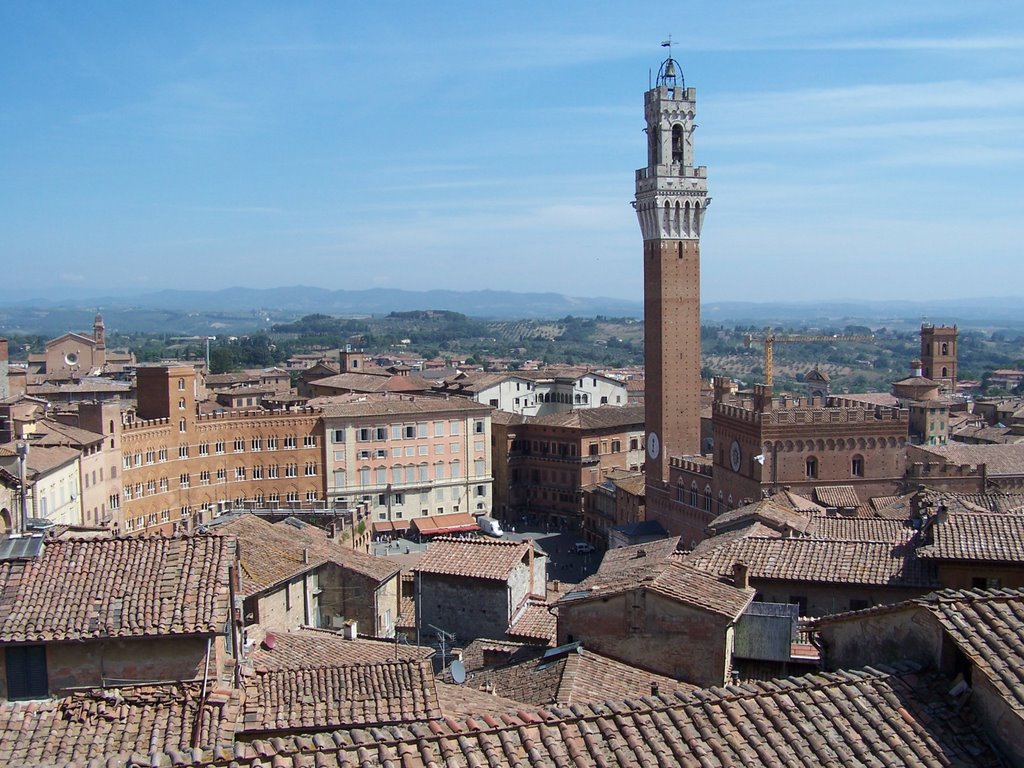
There is a brisk breeze blowing through the streets of Florence and people are everywhere. I quickly scope out the Eastern part of the city in the late afternoon, and discover that there are medieval treasures around every corner. Just steps from the hotel is the Piazza della Signoria, where a copy of Michelangelo’s David stands, and the Loggia dei Lanzi built in 1382, which is an outdoor sculpture garden filled with classic Roman statues. I walk past the Duomo, the tallest structure in the city, where the sound of steeple bells ring through the piazza.

In the evening, I dine at the Brunello Lounge at the Hotel Bernini Palace, and the food is the type of artistry typical of the Florentines, or as my server tells me, “Just like a painting.” I enjoy a white prosciutto, full of fat, which melts like butter on the tongue. Then there are quenelles of soft goat cheese flecked with briny green olives with dried tomatoes, Tagliatelle pasta with porcini mushrooms and shavings of parmesan, and a wild berry crepe for dessert.

The beauty of Florence will have to wait for another week thought, as my next destination is Chateau du Fey in the Burgundy valley of France.

© 2006 T.W. Barritt All Rights Reserved

Buon Viaggio


September 9, 2006: We visit the ceramic center of Deruta in the morning and by early afternoon have arrived in Florence, near the end of our culinary adventure. I must say goodbye to Anne who is tall and elegant, Joyce who is brimming with superlatives, Gary who stirs the pot and Jessica who is the only public relations person I’ve ever cooked with, although I've known many who like to eat. As Joyce would say, it is an “amazing” experience to meet new people and begin to cook together and I will never forget our journey through Bologna and Tuscany and the exceptional meals we shared together. I wish you all Buon Viaggio and great food for a lifetime!

Most important, we all owe a debt of gratitude to our gentleman driver Romano who took such good care of us, and of course our host and instructor, Mary Beth Clark. She has been our interpreter, our translator and our culinary guide and has given us a great gift of herself, her love of food and the regions of Emilia-Romagna and Tuscany. It has been an unforgettable experience. Grazie, Mary Beth!!

© 2006 T.W. Barritt All Rights Reserved

Baking in Siena


Friday, September 8, 2006: The medieval town of Siena sizzles under the bright sun. The streets resemble narrow alleyways that wind to the top of the hill. Siena experienced years of growth between 1260 and 1348. Near the center of town is Il Campo, the clam-shell shaped town square where the famous horse races are held each year.

I spend several hours exploring the Duomo, a gothic masterpiece cathedral begun in 1136. The marble floor of the Duomo is only uncovered once a year during September and October, and for once I am in the right place at the right time. The marble inlay floor is like a gold and black tapestry which depicts 56 scenes that illustrate the history of mankind. I visit the Crypt, only discovered in 1999, where there are beautifully colored frescos that might have remained a secret for eternity.

I move on to investigate two foods that are special to Siena. In a small shop near the Duomo, I find Panforte Margherita a thin, flat torte of golden paste enriched with molasses, nuts, citron and spices. The confection dates to the middle ages. It is chewy and spicy, similar to dense fruit cake or date bread. I walk back beyond the Duomo and stop at Nannini, a famous bakery in Siena. Tourists have lined up to sip afternoon espresso. A gentleman ahead of me on line purchases more than 60 Euro worth of pastries, that are wrapped carefully in cream-colored paper and tied with a red ribbon. There, I sample Ricciarrelli, a clam-shaped golden cookie, slightly larger than the French Madeleine, soft and cake-like and dusted with powered sugar. It is tender, crumbly and sweet – a perfect treat to top my visit to Siena.

© 2006 T.W. Barritt All Rights Reserved

The Glorious Grape

Thursday, September 7, 2006: It is harvest time in Tuscany and the wine grapes hang fat and heavy on the vine. There are gently rolling hills bursting with Chianti grapes, Sangiovese grapes and fruit I’ve never heard of before, such as Foglia Tonda. I set out for a morning walk in the vineyards, admiring the plump clusters of fruit glistening in the late summer sunshine. The dark grapes are deep purple in hue, accented with shades of blueberry, amethyst, cobalt, and black. It’s like watching a dazzling kaleidoscope as the rays of the sun dance on the skin of the fruit. There are perfect clusters of green grapes and lovely pink garnet grapes use for lighter varieties.

The grapes of Tuscany are a revered source of food and drink. The vintner produces a spicy, intense reserve Brunello. I learn from the staff that there is no Brunello grape. The wine is made from 100 percent Sangiovese grosso, and must meet very specific and lengthy aging requirements before it can be dubbed a Brunello.

Out in the vineyards, workers are gathering the grapes into red tubs. On the hill beneath the villa, grapes are removed from the stems by machines, pressed through a crusher, and left to ferment in steel tanks. Nothing is wasted. Even the remaining skins from the grapes are distilled and used to make Grappa.

In the Osteria on the estate, the chef uses wine grapes as a garnish, a color accent, in reduction sauces and as a sweet surprise in pasty. One member of the staff teaches us to prepare sweet cake dough for dessert that is studded with dark grapes and anise. Thin slivers of veal are sautéed in butter and stock and dressed in a ruby-red reduction sauce of balsamic vinegar and wine grapes. Risotto is bathed in Brunello, turning a shade of rosy pink. The meal is an exuberant celebration of the vineyard.

At the end of our evening banquet, the table looks like a post-modern work of art, with wine bottles and decanters littered across the table, and more than a dozen, deep round glasses with just a hint of violet residue in the bottom. We marvel at the brilliant full Tuscan moon as we return to the villa to retire for the night.

© 2006 T.W. Barritt All Rights Reserved

Tuscan Culinary Journal


Wednesday Afternoon, September 6, 2006: We dine on a lunch of grilled vegetables and meats at a local restaurant, where the fire of the open brick oven permeates the food. Our driver then takes us deep into the countryside where we pass fields of sunflowers that have dried up from the summer heat and look like monks with heads bowed in prayer. There are hills upon hills, pheasants dashing through the fields and mustard colored villas with brightly-painted shutters. By late afternoon we pull onto a gravel road that runs alongside grape vines that are weighted with blue-black grapes awaiting harvest.

This is a 16th century Tuscan estate owned by a woman vintner who produces award-winning Italian wines. The business has been passed down from mother to daughter. She hires primarily women to produce her wines and is a pioneer in the region. The villa is an ancient structure of tawny brick, terra cotta tile and smart green shutters. Apple and pear trees dot the landscape, and there are groves of tall, stately Cyprus trees. By the pool, one can look out deep into the straw-colored valley of Tuscany where medieval fortresses cap distant hilltops.

At 5:30 we meet at the osteria for our cooking class, and are introduced to our chef instructor – a woman raised in Rome who is self taught. She is quiet and serious, but on occasion, will burst into a sunny smile. She teaches us to make a variety of pizzas, hearty Tuscan bean soup, salad and a creamy chocolate ricotta pie with bronze crust. Olive oil flows with each dish. The food is simple and robust, all featuring ingredients from the region.

Before the meal is served, we take our glasses of light, fruity white wine and watch a spectacular fiery sunset over the hills of Tuscany. We dine al fresco on the patio with the hill-top village of Trequanda beyond us, which was once inhabited by the Etruscans. We drink rich Chianti and toast our arrival in the country.

© 2006 T.W. Barritt All Rights Reserved

The Master of Parmigiano-Reggiano

Wednesday Morning, September 6, 2006 – We are greeted at the door of the production factory by a tall, friendly Italian gentleman with dark hair, chiseled features and taut muscles. He bears a striking resemblance to a stone statue of a Roman deity one might find in a piazza. He is, in fact a deity of the land. He is the cheese master at a Parmigiano-Reggiano production center, a short drive from Bologna.

Dressed in a long, plastic white apron, he offers a welcoming handshake and ushers us into the production center. Much like the seven labors of Hercules, the Master of Parmigiano-Reggiano must endure multiple labors to produce a cheese that meets the rigorous standards of the agricultural region. Inside the tiled production facility it is moist and humid. Using a process that began hundreds of years ago, the staff brings in the morning and evening milk from the cows, which is then heated. Massive copper vats are filled with the hot, milky brew and the cheese master and his assistants work rapidly, dragging large sheets of white muslin through the soup collecting the pale white solids that have accumulated in the tanks. At this point, the curds are flavorless. The cheese master then presses the solids firmly into round plastic molds which are left to dry for several days.

The large disks of cheese are cured for many days in a vat of salt water, about the size of a basketball court. A large mechanical system of hooks and open shelving is used to submerge the cheese in the salt water baths.

The cheese is stamped with a unique serial number and date, stored, and over time the rind begins to take on its distinctive copper patina. We are allowed a glimpse in the warehouse where hundreds and hundreds of rounds of cheese are stacked floor to ceiling and for months will age and season to perfect ripeness.

A staff member pulls a hefty round of cheese from the shelf and slices open the disk with a knife that looks like a large surgical tool. The deep amber rind is pulled away and we get our first look at the result of the cheese master’s labors. Inside, the cheese is wheat colored with a soft, quartz-like texture. We pull off large chunks from the wheel by hand, and take a bite. The Parmigiano-Reggiano pops on the tongue and offers many dimensions. It is sometimes crunchy then smooth. Creamy and then salty. There are dry mineral undertones and flavors of toasted bread. And, it is fresher than anything of its kind I’ve ever sampled at home. It is certainly the food of gods and a Herculean effort from the Master of Parmigiano-Reggiano.

© 2006 T.W. Barritt All Rights Reserved

Tuesday, September 05, 2006

Bologna Culinary Journal

Tuesday, September 5, 2006: This is a story about pasta on the table. Thin pasta, thick pasta, gnocchi and lasagna noodles. It is the story of a skill that was once passed from one generation to another, but someday might be forgotten.

I watch as a tiny, compact woman with steel-gray hair, kind eyes and formidable hands rhythmically cracks eggs into a well of flour in the center of a wooden board. She plunges her hands into the pool and carefully and methodically she works the bright orange yolks and flour into a sticky paste and then a firm, pillow-like dough.

Our instructor explains that this woman of Bologna practices what could be a dying art. More and more Italian families now eat fresh pasta made by machine. The craft of pasta by hand is too time-intensive for most. The woman tells us in Italian that her daughter doesn’t make pasta, but sometimes, her son and grandchildren will attempt it. She has been perfecting her craft for more than two decades and learned it from her own grandmother.

The first batch of dough is now soft and pliable, the color of golden sunflowers. She sprinkles just a touch of flour on the board – always the right amount – to soak up any excess moisture. The wooden board absorbs the rest. She takes a long rolling pin – the length of a yardstick – in hand. It is beveled smooth by years of use. She possesses the skills of an athlete, a musician and a surgeon, rolling with speed and precision, keeping perfect tempo, carefully assessing the dough, shifting it, applying varying pressure to the rolling pin until the pasta is the desired thinness. I am given the chance to try my hand at rolling. She gives my work a friendly nod of approval, but fingers conditioned by years at a keyboard can not possibly produce the same quality results. Eventually, the plump pillow of dough is transformed into a long thin sheet, the texture of smooth leather, but the weight of a fine fabric – extremely light and almost translucent.

She makes a second batch, this time adding spinach, massaging the green leaves and eggs into the flour. The bottle-green sheets of pasta are sliced into large rectangles for lasagna. Finally, she manipulates potatoes that have been pressed through a ricer, eggs and flour into gnocchi. She rolls the dough into long strands of rope and cuts off small rectangles. She teaches us how to get that distinctive gnocchi shape by pushing the individual rectangles down the tines of a fork.

The final presentation of the gnocchi is perfumed with sage, and is all the more satisfying for the history and artistry it imparts. And now, she has passed on the tradition of hand made pasta to me, a mere visitor in her homeland.

© 2006 T.W. Barritt All Rights Reserved


Bologna Culinary Journal – Monday, September 4, 2006: I rise just before 7 a.m. and prepare for the day. It doesn’t take long, since my choices of attire are still limited. It is a short walk down the street to the Piazza Maggiore, an enormous open square lined by churches and palazzos and guarded by Neptune’s Fountain. At 8 a.m. Bologna is still a sleepy Northern town, with just a few pedestrians and pigeons in the piazza.

I return to the lobby of the Hotel Roma where I meet our host and instructor Mary Beth Clark, a charming and gracious woman who is the founder of the International Cooking School of Italian Food and Wine. She will be our gastronomic guide through the week. I am joined by a selection of fellow Americans hailing from Washington DC, Charlotte, NC and Los Angeles, CA.

Mary Beth leads us across the Piazza, and through a narrow passage and we begin exploring the food markets of Bologna. We stop first at a cheese shop. Bowls of creamy white cheeses, some soft and some with curds, and large golden disks of Parmigiano-Reggiano are clustered in glass cases. Slabs of pink prosciutto, which must be cured for at least 300 days, are strung together and hung from the ceiling. We visit fruit stands where the aroma smells like a heavenly orchard and watch butchers at work swiftly dissecting whole chickens. We even pause to inspect the wares of a purveyor of horse meat. Around every corner there is something for the eyes to savor, as we watch the artisanal craftsman of Bologna’s food market begin a new day.

Our next stop is an historic palazzo just minutes away from the market where we will work for the next several hours. Mary Beth leads class in the professional kitchen and we are joined by an Italian chef, an assistant and a valet who attends to our every need. Throughout the day we learn about typical ingredients, scents and flavors of the Italian kitchen. Intoxicating aromas of seafood, fresh rosemary, red wine, olive oil and chocolate and hazelnut fill the air. The yolks of the perfect brown eggs are deep orange, likely due to hens fed a diet of corn and sunflower seeds.

The staff carefully demonstrates the culinary techniques of Italy and we all take a hand in the process. While most of the instructors speak little or no English, by watching and observing their handling of the food, I begin to understand them. I am discovering there is, in fact, an international language of food, and it is one of passion, instinct and mutual reverence.

By mid-afternoon, we sit down to an extravagant luncheon at the palazzo around a beautifully set table decorated by our valet with luscious ripe summer fruits – peaches, plumbs, strawberries and red currants. There are four courses with perfect wine pairings. The food is sumptuous, the wine flows freely and we enjoy learning more about each other over an exceptional meal.

One last biscotti accompanied by a lovely sparkling rose wine, and it is time to conclude. After a brief stop at the hotel, where I learn my luggage has been delivered, I spend the remainder of the day with camera in hand exploring the medieval city of Bologna, which by late afternoon has become a bustling metropolis jammed with people and motor bikes. Warm sunshine bathes the piazzas. I walk to the nearby Bascilica di Saint Stefano, which was built during the period XII – XVII. The ancient stone holy place was formed from four Romanesque churches and has a stately, two-level cloister where I spend some quiet time reflecting on the events and aromas of the day.

Darkness falls, and I take a seat at one of the cafes on Piazza Maggiore and order a glass of vino rossa (the two words I actually know how to say in Italian). I sip my wine and watch as tourists eating gelato, students, lovers, beggars, adventurers and philosophers wander by enjoying the warm summer night. A bulging three-quarter moon peaks into the piazza, illuminating the fortress-like exterior of Basilica di San Petronio, much as it has done for centuries.

© 2006 T.W. Barritt All Rights Reserved


Bologna at Last – Sunday, September 3, 2006: That’s what the poster on the wall proclaims as I exit the shuttle bus and entered the airport terminal to claim my luggage – which hasn’t arrived with me. But, this journey is about food, and not travel disasters, so enough on that story.

There is an enormous, glowing half moon in the sky as my taxi driver speeds me to the Hotel Roma in the historic district of Bologna. We quickly cut through some routine residential areas, and enter the narrow streets of the ancient city. It is very late on a Sunday evening, but there are people about, some on motorbikes. There is stone, and brick, and a large tower up on the hill that I need to learn more about.

My fellow class mates at the International Cooking School of Italian Food and Wine have long since gone to dinner, but my host has arranged for the hotel to provide a cold buffet for me. Once settled in the room with my meager belongings, I feast on salty prosciutto, fresh mozzarella, bread, green salad and white wine. After the drama of my journey, it tastes superb and feels very welcoming.

Tomorrow morning, we meet for a tour of Bologna’s food market and our first cooking class of traditional Italian and nuova cuisine.

© 2006 T.W. Barritt All Rights Reserved

Sunday, September 03, 2006

The Road to the Italian Kitchen: So far, the journey to Bologna has all personality of a grease fire in the kitchen. As one might expect, the culinary standard of the dinner on my flight from New York to Paris was nothing short of alarming. I had high hopes when the flight attendants actually passed out printed menus in the coach section. These were roundly dashed when the meal was presented – a tiny sliver of chicken sitting in sweet potato soup and shellacked with something billed as chipotle sauce. This was washed down with a fine California Shiraz called “Fish Eye,” no year of vintage provided.

Not long after, a poor gentleman in the cabin suffers a small stroke. This forces the captain to make an emergency medical landing in Dublin, Ireland, where we are seriously delayed awaiting refueling. Upon arrival in Paris Charles De Gaul, I miss my connection to Bologna by about two-and-a-half minutes, and the next flight is not until after 8:00 p.m. I have been told that I attract crises. I’m beginning to believe that urban legend …

So, how to kill seven hours in the airport waiting for the best Italian food of my life? Food, or perhaps high end toiletries are the only options, so I head for the only restaurant in sight, “France Café.” I’ve got to hand it to the Parisians. Even their fast food has a wholesome, rustic quality. I order a baguette mixte, jambon et frommage (that’s ham and cheese to the rest of us) and a glass of vin rouge. The baguette is crunchy and the ham smoky and tender. Even the wine is far superior to last night’s juice. Keep in mind, that I’m sitting in an airport, so all these comparisons are subject to jet lag and hallucination.

I finish off my airport café dejuener with a tarte au pomme and café au lait. The individual tarte is nicely topped with caramelized apple slices, and the café au lait is strong, bitter and frothy. Meanwhile, the world is checking their luggage before my very eyes.

I probably won’t make it in time for dinner at the top restaurant in Bologna. I’m keeping my fingers crossed that they offer takeout.

© 2006 T.W. Barritt All Rights Reserved

Friday, September 01, 2006

Exit Corporate America, Enter Emilia-Romagna: Call it what you will – sabbatical, hiatus, or time-off for good behavior. No matter the phrase, here are the facts. For the next seven weeks I’m on leave from corporate America, and diving toque first into the tastes, aromas and textures of the global culinary kitchen. The first stop on my gastronomic odyssey is the International Cooking School of Italian Food and Wine in Bologna, the capital city of the Emilia-Romagna region. Bologna was established by the Etruscans in about 534 BC, and Emilia-Romagna is a rich agricultural region that produces tomatoes, onions, cereal crops, Parmigiano-Reggiano and Lambrusco and Sangiovese wines. La Cucina Italiana! At the moment, it still seems like a distant dream, but it’s just a jet ride away. Next stop, the ancient city and food of Bologna!

© 2006 T.W. Barritt All Rights Reserved

Thursday, August 31, 2006

Remembrance of Cakes Past


Mom opens the small manila envelope and slips a slightly faded photograph into my hand. “Do you remember this?” she asks. “I thought you might want to write about it.”

I pull out my reading glasses to take a closer look, and examine the photo of a 9-by-13 sheet cake. At the top, scripted in pale blue icing are the dates, 1932 – May 14th – 1983.

Mom studies my reaction, looking for a sign of recognition, and decides to jog my memory. “You made the cake for Grandma and Grandpa’s 51st wedding anniversary.” Indeed, on the back of the photo is Mom’s inscription: May 14th, 1983 – Anniversary Cake for Hilda & Steve Ernst – made by T. – 51 years married.

I see a bouquet of tiny blue and pink wildflowers, gathered together with a wavy pink ribbon. Not a bad effort for an amateur. I recall that it was actually one of the later cakes in my repertoire, and I had actually first cut my teeth on cake decorating in elementary school.

The memories come back to me, years before The Cake Doctor, The Cake Bible, Baking with Julia, the Magnolia Bakery or Martha Stewart’s Baking Handbook. I remember exploring Mom’s bookshelf and discovering a simple black and white volume on cake decorating. I was captivated by the photos of butter cream roses and scallop shell boarders. Mom had actually taken a cake decorating course years before and had all the tips and pastry bags stored away. We pulled them out, cleaned them all in hot soapy water, and looked them over. There were tips for rose petals, tiny blossoms and even branches with perfectly-shaped conical leaves.

In no time, Mom had connected me with Mrs. Becker, a pastry pro at our local church who gave me a lesson. Soon, I was whipping up celebration cakes for wedding anniversaries, birthdays and holidays. All this, before sixth grade graduation. Sometimes, the cakes were overly sweet, and sometimes, the colors a bit garish, but it was the start of creativity in the kitchen and a lifelong love of “le gateaux.”

If Mom hadn’t signed up for that first cake decorating course, I might never have paged through that text book and developed a taste for luscious layers.

Thanks, Mom, for the sweet inspiration!

© 2006 T.W. Barritt All Rights Reserved

Wednesday, August 30, 2006

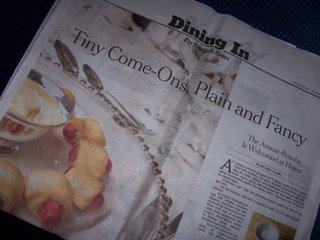
Devouring The New York Times – August 30, 2006: Florence Fabricant wraps up a frank discussion of the return of pigs-in-a-blanket as the chic new appetizer in this week’s “Dining In” section.

For those of us born in suburban U.S.A., pigs-in-a-blanket is our ethnic food, and fabulous Flo champions the little wiener in Tiny Come-Ons, Plain and Fancy: The Kings of the Cocktail Hour Once Again.

I have fond memories of the summer of ‘79 when I worked as a waiter at a local country club, snarfing handfuls of the little quilted darlings before I ever left the kitchen to pass the silver platter. The dry cleaners could never quite get the grease stain out of my polyester uniform jacket pocket, where I stowed the illicit goods.

Now, nearly three decades later, this little piggy is popping up all over town, from Wall Street to Lincoln Center. It may be wrapped in puff pastry and dusted with poppy seeds, or disguised as chorizo cloaked in phyllo, but there’s no mistaking the news – from wedding receptions to memorial services, the best guilty pleasure on the planet has gone legitimate. And, as one seasoned cocktail party pro notes, the pastry is “a good blotter for alcohol!" I say, “To oink, or not to oink? There is no question!” Culinary Types Rating: Hallelujah!!!

© 2006 T.W. Barritt All Rights Reserved

Saturday, August 26, 2006

Dining with Pierpont Morgan and the Dutch Masters: Another hectic week concludes and I look for a few hours of sanctuary in one of New York’s fine museums. I turn the corner onto Madison Avenue and East 36th Street and step into old New York a century ago. There, the Morgan Library & Museum sits in regal splendor on a quiet tree-lined street.

A storm is stirring as I enter the glass atrium on Madison Avenue that connects several historic buildings on the block between 36th and 37th Street. Between 1902 and 1906 the financier Pierpont Morgan commissioned the architect Charles F. McKim to build a Renaissance-style library adjacent to his Murray Hill townhouse to hold his extensive collection of books, manuscripts, letters, artwork and artifacts. It is now a jewel box of a museum. I first discovered The Morgan more than 20 years ago when I visited the charming exhibit of Sir John Tenniel drawings titled, Lewis Carroll and Alice. Tonight, the program is Celebrating Rembrandt: Etchings from the Morgan in honor of the artist’s 400th birthday. There is also, From Rembrandt to van Gogh: Three Centuries of Dutch Drawings.

I slip down a marble hallway to a quiet gallery, lined with 50 Rembrandt etchings purchased by Morgan exactly 100 years ago. There is honey-colored parchment matted and hung in gilded frames – etchings that depict human wisdom and frailty, nature’s wrath, and the fury of God. Rembrandt worked in minute detail, sometimes on surface area the size of postage stamps, to render country scenes, portraits and Biblical epics.

The artist's precision hatch marks and wiry squiggles weave darkness and light into deep emotional intensity. I notice an older man chuckling near a tiny etching. It is about two inches square, titled The Monk in the Cornfield, and depicts a man of the cloth ravishing a milkmaid. On the other side of the room is From Rembrandt to van Gogh: Three Centuries of Dutch Drawings, a collection from the 17th through the 19th century with a lovely selection of drawings depicting nobility and pastoral scenes.

One can work up an appetite viewing the great masters, so I secure a table at the Morgan Dining Room. Executive Chef Charlene Shade offers a menu inspired by early 20th century New York City cuisine. I take a seat in what is, in fact, the original private dining room of the Morgan family and order several dishes. It is a small and somewhat understated cream-colored space with Grecian columns lining the glass entry way.

I start with a glass of Oyster Bay Sauvignon Blanc from Marlborough, New Zealand, 2005 which has a deeply tart grapefruit finish. My appetizer is English Pea and Lobster Soup. The puree is light and frothy, a glistening sea foam green, and it tastes as though the peas were just snapped from the shell. Several thick chunks of lobster are afloat at the center of the potage. On the side is a square loaf of dense, multi-grain bread sprinkled with oats.

The staff is attentive, and my server decides I have been waiting too long and brings me a second, complimentary glass of the Sauvignon Blanc. Shortly thereafter, I am presented with a Fricassee of Organic Chicken with Spring Vegetables and Wild Mushrooms. The dish looks as lively and colorful as a Dutch still life. It is goodness and simplicity – a summertime serenade from the farm and the vegetable garden. Juicy morsels of chicken are perched high on the plate atop a wild nest of pencil thin asparagus, perfect peas, deep green lima beans and earthy-scented miniature mushrooms dressed in a luscious light cream sauce. Tarragon, tinged with purple is sprinkled about.

The meal concludes with a plate inspired by the exhibition From Rembrandt to van Gogh: Dutch Drawings from the Morgan. A white, ceramic platter offers a selection of artisanal Dutch Cheeses: Gouda Robusto, Prima Donna and Roomano with Walnut Raisin Bread, Flatbread and Plum Jam. The Dutch cheese is crumbly, with a yeasty tang that complements the rich plum jam. I top it off with a Bonny Doon, Muscat Vin de Glacière, California, 2004 that tastes like the nectar of grapes just plucked from the vine.

Indeed, this Friday night getaway has been a work of art. I pay the bill and make a brief visit to Mr. Morgan’s crimson study and his library complete with secret doors and passage ways. By 8:30 p.m., I step out again onto Madison Avenue and slide into the crush of humanity heading west on 34th Street. http://www.themorgan.org/index.html

© 2006 T.W. Barritt All Rights Reserved

Wednesday, August 23, 2006

Devouring the New York Times – Wednesday, August 23, 2006: Writer Julia Moskin serves up a sensual seaside feast with “A Passion for Mussels” in this week’s “Dining Out” edition. Moskin travels to the remote island in western France called Ile de Re, where gleaming black mussels are the signature summer dish. She chronicles a ritual similar to the New England clambake where fat, sweet mussels are arranged in a pattern of concentric circles on the beach and surrounded by pine needles or grape vines that are ignited. Shortly after, the smoky muscles are served on crusty bread with butter. It’s all so earthy, provocative and so French. The photo of mussels roasting on an open fire is salacious, and Moskin’s prose will have you aching to slurp a bit of their briny, plump flesh. As an added bonus, the section is packed with the flavors of summer, and you’ll find tempting recipes for a Cubano sandwich, Butterscotch Peaches and Asian Seafood Risotto. It is an absolutely yummy summer treat. Culinary Types Rating – Savory Dish.

© 2006 T.W. Barritt All Rights Reserved

Tuesday, August 22, 2006

The Making of the French Chef: My Life in France, by Julia Child with Alex Prud’homme, is a fascinating glimpse into the formative years of a culinary pioneer. Through first-person narrative gleaned from Child’s personal letters and recollections of her years with husband Paul Child in France in the 1950s, the reader is swept into a charming and delicious world of discovery.

Much has been made of the book as an account of Julia’s love affair with husband Paul, but throughout the story, Paul is often a secondary character. What really stands out are those characteristics that made Julia Child a culinary icon – her tireless curiosity in the kitchen, the research and schooling at Le Cordon Bleu, the constant testing and re-testing of recipes in her small Parisian kitchen to create the perfect dish, the wisdom she gained from shopkeepers and fish mongers and what she calls an “awakening of the senses,” evident in her joyous response to a tender sole meuniere or steaming bouillabaisse a la marseillaise. The reader can imagine Julia’s world blossoming as she finds her true calling in the cuisine of France. And, the meticulous, almost driven manner in which she created the classic “Mastering the Art of French Cooking” is an intriguing look behind the curtain. There is a growing realization of how much time, thought and care went into the choice of each recipe, ingredient and word found in that seminal volume.

Child’s transformation came somewhat later in life. At the age of 41, she bemoans a “lack of worldliness” which is ironic, given her now-legendary status in the international culinary world. For those of us who seek new challenges in life, particularly in the kitchen, Julia Child is, and will always be, an inspiration.

© 2006 T.W. Barritt All Rights Reserved

Friday, August 18, 2006

Opera Alfresco: I’ve logged eight thousand miles this week in business travel, so when the lunch whistle blows, I am in desperate need of an escape from the office. At exactly 12:23 p.m., I lock down the computer screen and walk briskly down Sixth Avenue to Bryant Park, for “Afternoon Arias with City Opera Artists.”

Despite years in Manhattan, I’ve spent little time in Bryant Park (http://www.bryantpark.org/). The history is fascinating. George Washington’s troops crossed the site of the park in 1776 as they fled the Battle of Long Island, and Union troops held drills there during the Civil War. In 1853, New York hosted its first “world’s fair” on the site in a building called the Crystal Palace, which stood there until it burned down in 1858.

Today, Bryant Park looks like a Georges Seurat painting. There are picnickers camped out on blankets, children frolicking on the grass, and well-heeled executives wandering the perimeter. There are even one or two grand dames with parasol in hand.

At the West end of the lawn, a large stage is set where WQXR evening host, Midge Woolsey is presiding over a lunchtime performance of City Opera artists. As I stand at the edge of the lawn drinking in the production I learn from the commentary that City Opera was founded by Mayor LaGuardia as the opera for the people. So, free performances in the park are a natural. The voices of the performers soar into the sky with the birds, with selections from La Boheme, Carmen and even a lively rendition of “Poor Wandering One” from The Pirates of Penzance.

Regardless of the hefty serving of culture, I am starving, and it’s a prime opportunity to sample the fare at ‘wichcraft, one of three olive-colored pavilions that serve sandwiches, coffee, pastry and ice cream in Bryant Park (http://www.wichcraftnyc.com/). New York Magazine recently profiled ‘wichcraft as one of its 101 Best Cheap Eats in New York. I join the queue and place an order with one of the orange-clad employees for chicken salad, walnuts, roasted tomatoes, pickled red onions, and frisee on multigrain bread, perhaps the longest list of ingredients and condiments for a single sandwich, ever.

I find a spot to stand on the North end of the lawn and munch on my sandwich. I listen as the passion flares on stage and I rapidly develop a tragic love affair with my sandwich which is vanishing quickly. The flavorful chicken takes center stage, the roasted tomatoes add a subtle dramatic note and the frisee a touch of comic relief, all surrounded by the artistry of artisanal multi-grain bread.

For the finale, I harmonize with a chocolate cupcake with cream filling, which evokes memories of the classic Hostess Cupcake. It is Devil’s Food Chocolate, to be exact. How appropriate, as the Devil has just possessed the stage for a classic scene from Faust, that concludes the Afternoon Arias.

© 2006 T.W. Barritt All Rights Reserved

Thursday, August 17, 2006

Market Square, Helsinki

Just before check-out time, I venture out into the city on foot and pay one more visit to Market Square in Helsinki’s historic centre by the harbor. The open cobble stone square has been transformed into a bustling food bazaar. Red peaked tents are staked in orderly rows, and merchants are selling fresh-picked produce of all varieties.

My eye is attracted by bright patches of color reminiscent of an artist’s palate, but this is nature’s paint box -- crimson raspberries, azure blueberries and glistening ruby strawberries. The exuberant harvest of Finland’s berry season is evident. Jewel-like berries are piled into small peaks in large wooden trays, or placed in orderly rows of cardboard boxes.

A blonde woman beneath a tent is holding a large scoop. She greets me warmly and offers a taste of her produce. A perfect strawberry melts on my tongue into sweet nectar and a fat blueberry bursts between my teeth, offering deep indigo tones of flavor. The purity is like nothing I’ve had at home.

The amount of produce is astonishing. Besides fields of summer berries, there are potatoes, carrots, peppers, bundles of turnips and tomatoes. Boat merchants are selling hauls of fresh fish off the back of their vessels.

I walk along the waterfront toward Old Market Hall and peer inside. There are rows of individual polished wooden stalls, bursting with local goods. I linger over beautifully rustic artisanal breads, earthy red slabs of reindeer fillet and elaborate pastries made with more sumptuous summer berries.

Everywhere I’ve gone in Helsinki, I have sensed a genuine pride in the purity and goodness of what comes from the land and the sea, and I resolve to bring that sensibility home to my own table.

© 2006 T.W. Barritt All Rights Reserved

Wednesday, August 16, 2006

Savoy Restaurant, Helskini

Work is concluded, and my host makes arrangements for us to dine at Savoy, a restaurant located just off of Esplanade Park. An elevator whisks us up to the eighth floor where we emerge on a wood and glass dining room of smooth lines and contours created by the noted designer Alvar Aalto. There is a wrap-around picture window that overlooks Helsinki, with brilliant views of the ocean and Helsinki Cathedral reaching into the sky.

My host has advised me that August is crayfish season and with any luck, we may witness a crayfish party, a traditional summer festivity in Finland. Sure enough, there is a group of approximately 20 people seated on the terrace all wearing cloth crayfish bibs, digging into platters of crustaceans, gulping vodka and singing Finnish drinking songs.

There is something deeply appealing about a communal celebration of the bounty of the sea, and we must participate in this late summer ritual. We order a tasting platter of five crayfish each, and my host graciously instructs me in proper use of the knife, and the appropriate method for dismembering and eating the little creatures.

The plump crayfish are dazzling neon-red, speckled with hints of gold. The shells are delightfully soft and they taste briny, sweet and fresh, as if they’d been scooped from the ocean just moments ago. The traditional preparation is uncomplicated, accenting the inherent beauty of the dish. My host explains that crayfish are simmered in water seasoned with salt, sugar and dill. I can taste the tangy essence of the dill in the succulent flesh. The crayfish are presented with a large shock of dill at the center of the platter. You use the small nail-file shaped knife to remove the flesh from the claws and tail. You can even scoop out a tender morsel from the shell called crayfish butter. The juicy morsels are piled on top of buttered toast sprinkled with chopped dill and then consumed. The more adventurous diners wash down the nautical delicacy with ice-cold vodka. Our friends on the terrace have been at it for some time, and their host is getting their attention with a cow bell and leading them in rousing renditions of Finnish drinking songs - all this against the back drop of sunset on the Helsinki skyline. The entire spectacle is a feast for the eyes, and the crayfish literally dance on the palate.

My host is a native of Helsinki, and shares much delightful conversation with me about the culture and history of the capital city. My entrée continues the theme of traditional Nordic fare. I am treated to Reindeer T-bone steak, dressed in a delicate béarnaise sauce and red wine reduction. The steak is thick, rich, tender and earthy with a wild and exotic finish.

The end of the summer is also berry season in Finland, and our feast is capped by bowls filled with fresh strawberries, juicy blueberries and tart red and white currants that have been soaked in summer sunshine. They are topped with a flourish of creamy vanilla ice cream and a perfect violet blossom.

It is a deeply satisfying meal, rich in the culture and heritage of the people of Finland and their abundant resources.

© 2006 T.W. Barritt All Rights Reserved

Tuesday, August 15, 2006


Culinary Dispatch - Helsinki, Finland: One body should not be in so many time zones in so short a period of time, but here I am playing "Beat the Body Clock" on business in Northern Europe.

I have settled in Helsinki for a couple of days of work. On day one, after an overnight flight, arrival and meetings, I am over caffeinated and in desperate need of fresh air. So I set off by food from the hotel to find the Historic Centre of Helsinki. While I can not pronounce the name of a single street, the map serves me well, and soon I am standing on the edge of the massive, sun-drenched Senate Square, the home to Helsinki Cathedral built in 1852 (top photo). (It is here I must point out that the only time I seem to be directionally challenged is when I am traveling with my colleague, Splint McCullough.)

I learn a few historic facts while on foot. Helsinki was founded in 1550 at the mouth of the Vantaa River but moved to its current location in the mid-17th century. Russia conquered Finland in 1809, and its influence can be seen in much of the city. Finland became independent in 1917 with Helsinki as its capital.

It is a fine summer evening with a gentle, warm breeze moving off the ocean. There are wisps of pearly gray clouds in the sky. The city is comprised of a series of small hills, and many of the public areas are paved with coral-colored brick. Residents are physically fit, with joggers and bikers everywhere. As I walk along Esplanade Park, I pick up the sounds of an outdoor band playing music by ABBA. Seagulls are perched in various spots observing the rhythms of the city in a detached manner. Cafe patrons sit facing the street with a similar detachment.

Naturally, I am drawn to the food lore of the city. I stop briefly at Old Market Hall (bottom photo) a haven for food enthusiasts since 1889. Today it houses bakeries, butchers, delis and specialty shops. Later, I pass the Kappeli Restaurant on Esplanade Park, built in the 1860's near a spot where herdsmen would sell milk in market stalls. The word Kappeli actually refers to the term herdsman or pastor's stall or chapel.

At dinner, I sample a local dish indigenous to the agricultural region of Lapland, Bread Cheese and Cloudberry Jam, or Leipajuostoa Ja Lakkahilloa in the native tongue. The bread cheese is a wedge of dense, farm cheese, much like bread, and similar in consistency to cheese cake. It is accompanied by a selection of rich, savory rye breads and topped with a large dollop of cloudberry jam, a sweet, honey-colored paste flecked with crunchy amber seeds. Cloudberries are in season in June and July. The sweetness of the jam marries beautifully with the tart and acidic flavor of the cheese.

In Finland, the phrase is not bon apetite, rather, it is hyvaa ruokahalua!

Meanwhile, it is well after 9:00 p.m. and the sun shows no sign of setting.

© 2006 T.W. Barritt All Rights Reserved

Saturday, August 12, 2006

Locally Grown


Locally Grown: It is a stunning summer Saturday in August. The temperature is barely 75 degrees, a gentle breeze is blowing, and there are just a few hints of wispy clouds in the big blue sky. The dog days are gone, and what’s left is deliciously sun-drenched and intoxicating.

I decide to play hooky from a number of obligations and jump in the car, headed for the North Fork of Long Island. No doubt summer, produce and grape vines are exploding on the East End.

I encounter little traffic and I’m soon sailing along Sound Avenue, a winding country road dotted with third and fourth generation farm stands and slightly newer wineries. My first stop is the Martha Clara Vineyards in Riverhead which is actually owned by the Entenmann family of crumb cake lore (http://www.marthaclaravineyards.com/). The legend goes that Martha Clara was an Entenmann's employee who dreamed up the plastic window on the cake box, and married the boss. She was rewarded with marital bliss, sticky buns for breakfast for the rest of her life, and they named the vineyard after her. I cozy up to the tasting bar and sample four lovely vintages – a 2004 Riesling, a 2004 Chardonnay, a 2002 Merlot and a 2002 Cabernet Franc. The Chardonnay is smooth and spicy and I pick up a bottle before leaving the gift shop.

Further east in Peconic, I pull into Sang Lee Farms. Mr. Lee is a purveyor of heirloom tomatoes and there are baskets to choose from. I marvel at tomatoes the color of buttercups, plums, moss and tangerines and purchase several pounds worth.

Parking proves challenging in the harbor resort of Greenport, so I return west on Route 25 where I discover “Barb’s Veggies,” a ramshackle farm stand on the edge of the Osprey Dominion Vineyard. According to the placard, Barb’s motto is “Git R’ Done,” and she looks like she’s weathered a number of tough seasons but her fresh peaches fill the warm air with sweet perfume. I pick up six plump ones and an ear of corn for another night.

At Bedell Cellars I relax on their impeccably spotless deck overlooking rows and rows of lush green grape vines. There, I sip a tart 2005 Rose the color of pink carnations and enjoy the cool breezes that caress the vineyard.

On the Main Road in Cutchoge, I stop at Cutchoge Green and take a tour of “The Old House” built in 1649, and said to be the oldest English-style frame house in New York State. It is on the National Historic Register. A friendly gentleman in a straw hat named Jim takes me on a tour. The kitchen has a massive open hearth and there are period cast iron kitchen tools in abundance. Jim also takes me across the green to an 1840 one-room school house that has a 13-star American flag from the Revolution, and the 1704 Wickham Farmhouse. The owners of these homes were the original settlers who farmed the land that has spawned my bounty of fruits and vegetables.

Back at home, I create a colorful savory tart from the tomatoes. The flavor of the tomatoes deepens and intensifies as they roast in the oven. Barb’s peaches are transformed into a silky, nectar-drenched oatmeal crisp. I dine on the deck enjoying the fruits of the season and watch the clouds turn coral and pearl gray against the sky, thinking that this is exactly what summer is all about.


North Fork Farm Stand Tomato Tart

Ingredients
Two small yellow heirloom tomatoes
Two small orange heirloom tomatoes
Two small red heirloom tomatoes
One cup Fontina cheese
One clove garlic
One pastry crust rolled out to a 10 inch circle
Coarse Salt and Freshly Ground Pepper
Olive Oil
Four Fresh Basil Leaves


Line a cookie sheet with parchment paper and place an 8 inch tart ring in the center. Drape the pastry crust over the tart ring, working it into the corners. Trim the edges.

Fill the pastry crust with the grated cheese (reserve ¼ for topping) and crush the clove of garlic over the cheese. Season with coarse salt and freshly ground pepper.

Slice the tomatoes about ¼ inch thick and layer them over the cheese in a circular pattern. Sprinkle with salt and pepper and drizzle with olive oil.

Bake in a 425 degree oven for 20 minutes. Reduce temperature to 400 degree and sprinkle with remaining cheese. Bake for an additional 20 minutes or until cheese is melted and golden brown.

Let cool 10 minutes. Remove tart ring and transfer to serving platter. Sprinkle with fresh sliced basil and serve.

I paired the North Fork Farm Stand Tomato Tart with the Martha Clara Vineyards 2004 Chardonnay – described as offering “intense heady aromas of perfume and fresh cut flowers intermingled with candied citrus and orange blossoms.”


Barb’s Git R’ Done Peach Oatmeal Crisp

Ingredients
Two fresh farm stand peaches
Two tablespoons butter
One tablespoon flour
One and ½ tablespoons old fashioned rolled oats
One tablespoon dark brown sugar


Butter a 1 and ½ cup oven proof casserole. Peel and slice the peaches and place them in the casserole. Cut one tablespoon of butter into small pieces and combine with the peaches.

Combine the flour, oats and dark brown sugar and combine with the remaining butter, cut into small pieces. Sprinkle mixture on top of the peaches.

Bake at 350 degrees for 30 minutes. Let cool slightly before serving.

© 2006 T.W. Barritt All Rights Reserved

Friday, August 11, 2006

Culinary Dispatch – Richland, Washington: It’s our last night in the Tri-Cities. Splint McCullough and I have wrapped up our Pacific Northwest assignment, and we’re in search of nourishment. We leave the hotel with a copy of the Tri-Cities answer to Michelin in hand, “Your Guide to Local Dining,” a 17-page stapled Xerox copy of every conceivable eatery within a six minute radius.

In the spirit of Lewis and Clark, Splint and I head east on the recommendation of the hotel desk manager. She’s added a star, in pen, next to the listing for T.S. Cattle Co. noting that the last time she ate there – twenty years ago – it was a pretty good meal. But since Splint is a true carnivore, he assumes we’ll be treated to excellent aged beef.

One quick detour later (getting lost seems to be a way of life in the Tri-Cities) we arrive at the parking lot of T.S. Cattle Co. It looks a bit like an abandoned road house, with a couple of decrepit pickup trucks outside. The Co. has clearly lost some of its 1986 appeal. Splint says, “I think not,” and we make a quick left out of the parking lot.

Our next stop is Cavanaugh’s Landing. It has a bright, appealing multi-colored sign, the parking lot is clean, and the shrubbery well manicured. But, the lobby has that strange hotel smell, and there is absolutely no one in the restaurant. “Not a good endorsement for the menu,” Splint notes, and we return to the rental to continue our culinary expedition. We decide to skip the Old Country Buffet, which looks like a renovated supermarket, and Splint refuses to get within a quarter mile of Roy’s Western Smorgy.

We decide to explore west of the hotel. Finding the right restaurant has become a mission. Splint nixes Sterling’s Famous Steak, Seafood and Salad Bar (“Too much like a diner.”) and Casa Mia (“Not in the mood for Italian.”). After a brief pass by Dax’s Bar and Grill, a dangerous looking powder blue cinder block structure, we are desperate, and decide that Mexican cuisine is our safest choice.

We park the rental and enter 3 Margaritas – Family Mexican Restaurant. It is fiesta time! We are seated at a window booth. There are bright colors everywhere and the ambient noise is deafening. There is a lariat and saddle on one wall and a large mural of three parrots behind Splint’s head. For some reason I’m inspired to order a Blueberry Margarita which resembles a frozen dessert on steroids. Splint orders a Cuervo Gold Margarita. He glances toward the floor and says, “I’m curious the last time this rug was cleaned?”

There is much activity. Every few minutes, a large group of wait staff carry a birthday cake and a giant sombrero out to some lucky diner on the floor and sing "Happy Birthday" both in Spanish and English. Splint calls his wife, Blanche on the cell phone. She suggests we should pretend it’s my birthday and take plenty of photographs.

Our entrees arrive and there is ample food. Splint has chosen the house specialty, Carnitas Fahita Style with sirloin beef. I’ve chosen the chicken version. Splint rolls a fahita the size of a Cuban cigar. He takes a bite and announces, “I’m very happy.”

Ditto for me. The chicken is succulent, the rice nicely seasoned, and the guacamole incredibly fresh. It meets with Splint’s approval as well. “I’m very picky about my guac,” he says.

Splint has clearly entered the fiesta zone. He orders a second Cuervo Gold Margarita, which means that collectively, we have ordered 3 Margaritas and must be considered charter members of the club.

“Who ever thought we’d find authentic Mexican in one of the states that’s furthest from?” Splint asks rhetorically.

As we leave the restaurant lobby, I look for a card, but oddly enough, all I can find is a stack for “Lightning’s Carpet Cleaning.” Splint expresses hope that the rug at 3 Margaritas will soon get a makeover.

© 2006 T.W. Barritt All Rights Reserved

Thursday, August 10, 2006


Culinary Dispatch – Kennewick, Washington: Splint McCullough and I have finally made it to the Pacific Northwest. There’s not much further you can go. We have landed in what is locally referred to as “The Tri-Cities” which includes Kennewick, Pasco and Richland, Washington. A quick look through the phone book and I manage to pick up some local lore. The Tri-Cities actually enjoy “nearly 200 sun-filled days a year.” The Columbia River runs through it. Lewis and Clark set up camp in Pasco in 1805. There’s a booming wine region. And, on a slightly more explosive note, nearby Hanford was the site of the top secret Manhattan Project, which produced plutonium for the atomic bomb, used in World War II. Who knew?

Splint and I have traveled to the four corners of the Tri-Cities. In less than 24 hours we’ve gotten lost no less than three times. They don’t seem to have much use for street signs here. This morning, we were off among the tumbleweeds, when we should have been kicking off a meeting, and this evening, we found ourselves on the wrong side of the tracks near a Burger King and a Rite Aid, when we were looking for a seafood restaurant on the banks of the Columbia River.

Our search for dinner starts inauspiciously. Anthony’s, a seafood place recommended by a gentleman on our incoming flight had a small fire in the morning and they are closed. The young woman who turns us away hungry suggests we try Cedars, so we hop in the rental and try to make sense of her sketchy directions.

Several wrong turns later, I give up on maps, revert to instinct and decide that a seafood restaurant must be near water. We follow the sign to “Marina” and Cedars appears on the horizon. Splint dubs me the new Magellan.

Cedars has a handsome exterior that is covered with, you guessed it, cedar shingles. There’s a spacious outdoor deck which flanks the Columbia. Inside are wood beams, rafters, and potted ferns. We opt for indoor seating and kick off the meal with a glass of Preston Sauvignon Blanc 2004 bottled in Pasco, Washington. It’s our first taste of the local vintage and it’s surprisingly good. The Sauvignon Blanc is free of the grassier notes found in the New Zealand variety. It’s clean, Green Apple crisp and smooth, with just a hint of American Oak.

Splint selects the salad bar, which he dubs “cafeteria basic.” I do better with the clam chowder which is thick and stew-like with big chunks of clam and a splash of sherry. We split the Mesquite Smoked Rainbow Trout and Cheese appetizer. It’s a do-it-yourself sandwich. You take a crostini and layer cream cheese with parmesan, capers, a dash of fresh lemon juice and top with a slice of rich and mellow smoky rainbow trout. The combination of flavors is sublime.

Our entrees are less inspired. I try the King Salmon with lemon, butter caper sauce. It is serviceable, but I’m a bit capered-out at this point, and the sauce seems a tad oily. Splint pronounces his Mahi Mahi to be dry and the tropical fruit salsa bland. However, he gives an enthusiastic thumbs-up to his baked potato with everything on it. According to Splint, the medley of bacon and chives is far more interesting than the medley of fruit and salsa.

While the main entrees are routine, they are more than filling so dessert is skipped. The salmon-pink sunset over the Columbia River is a far better end to the meal for a couple of hard-core New Yorkers with no sense of direction. Check out Cedars at www.cedarsrest.com

© 2006 T.W. Barritt All Rights Reserved

Wednesday, August 09, 2006

Culinary Dispatch -Naperville, Illinois: I'm traveling the great U.S.A. again with my colleague Splint McCullough and we've stopped in Naperville, Illinois, founded in 1831.

I hear rumors that there's an historic pioneer village called Naper Settlement nearby, but Splint and I are unlikely to take in the local culture as we're scheduled to spend much of our visit at a corporate park.

Our accommodations are austere (why did I get the handicapped-equipped room on the first floor??) situated just off highly-traveled Illinois Route 88. Yet we quickly discover a bright spot. We are located about thirty feet from a Cracker Barrel Old Country Store, and agree on a breakfast pilgrimage. The pioneer spirit lives in Naperville, Illinois!

It is just after half-past six in the morning when Splint and I enter the roadside shrine, the auto noise and exhaust fumes from Route 88 still assaulting our ears and nostrils. A step over the threshold and we are transported to another era of porch rockers and penny candy. The store is packed with Americana and even in the heat of early August, there are merchandise displays for Halloween and Christmas. It is, after all, never too early to start holiday shopping. We move towards the dining room and Splint points out a vintage advertisement for "Domolite, the Easy-to-Sew Plastic Fabric." You've gotta love those space-age innovations! We look ahead and there is an immediate sense of comfort, as there is comfort food just ahead.

We are seated. Splint orders grapefruit juice and I order orange juice with coffee. Splint vows he will not go overboard and promptly orders three pecan-studded pancakes smothered in creamy butter that are the size of hub caps. Splint caresses the mini bottle of maple syrup and nearly squeals with delight. "They heat the syrup!" he gasps. "It's little touches like that! This place gets it done!"

My utensils could be cleaner, so I return them to the server for a fresh set and take note of our surroundings. At this hour, there are just a few patrons and Splint and I are probably the only ones below retirement age. Country music wafts through the air mingling with the aroma of flapjacks. We might as well be in an Adirondack lodge. The walls are adorned with fishing pole and tackle, a rifle, rolling pins, snow shoes and antique portraits of Naperville forefathers. A rustic getaway just minutes from downtown Chicago! Splint notes that the eyes on a photograph of a gentleman from a previous century seem to be following us ...

I've ordered "Eggs-in-the-Basket," (a bargain at $5.89) a classic breakfast item where a farm fresh egg is nestled in a hole cut in the center of a slab of sourdough bread and fried to perfection. My platter has two "baskets" neatly framed by three slices of bacon and a generous scoop of hash brown casserole, a sinful mash of crunchy hash browns and melted cheddar cheese. I slice into crisp, tart sourdough and golden yolk drenches the bread on my fork delivering a mouthful of morning sunshine. For just a moment, I'm certain I can hear a rooster signaling the start of a new day.

Shortly after, I have nearly licked my plate clean and Splint's pancakes are nothing by a sweet, nutty memory. We leave the Cracker Barrel Country Store to start our work day and I notice a small chalk board out of the corner of my eye announcing that it is only 140 days until Christmas.

© 2006 T.W. Barritt All Rights Reserved

Wednesday, August 02, 2006

Devouring the New York Times – Wednesday, August 2, 2006: The “Escape” Section Meets “Dining Out” today with a bucolic tribute to the summer produce of the rural tri-state area. “Welcome to the Country: Road Trips that Follow the Food” serves up the basic premise that Whole Foods has embraced Mr. Green Jeans and they are friends. In fact, fresh gourmet ingredients that typically might only be found on the island of Manhattan can now be purchased in the exotic lands of Long Beach Island or Columbia County. The cream of the crop food writers of Dining Out, including Julia Moskin, Marian Burros, Florence Fabricant and Kim Severson provide solid tips on restaurants and farm stand fare in Columbia County, Long Beach Island, Litchfield County and the North Fork of Long Island. Each piece reflects the unique character and flavor of the region, be it the seafood of the Jersey Shore or the homemade pies of upstate New York. Tuck this one in the glove compartment for those hungry country weekend getaways. Culinary Types Rating: Savory Dish.

© 2006 T.W. Barritt All Rights Reserved