Showing posts with label Quick and Easy. Show all posts

Thursday, October 08, 2009

Potatoes! Sweet!

The harvest at Restoration Farm has taken on an autumnal hue. Heaps of sweet potatoes shine like burnished copper nuggets in the mid-morning sun.

How to prepare? Savory or sweet?

Sweet Potato Walnut Bread is a hearty autumn treat, scented with whole wheat, cinnamon and earthy walnuts. The sugars in the grated sweet potato caramelize as the bread bakes, creating a luscious sticky-toffee quality.

Sweet Potato Walnut Bread

(Adapted from “From Asparagus to Zucchini: A Guide to Cooking Farm-Fresh Seasonal Produce” by the Madison Area CSA Coalition)

1 cup unbleached flour
1 cup whole wheat flour
2 cups sugar
2 teaspoons cinnamon
1 teaspoon baking powder
¼ teaspoon salt
¾ cups vegetable oil
3 large eggs
1 teaspoon vanilla extract
3 cups grated sweet potato
1 cup chopped walnuts

Preheat oven to 350 degrees. Grease a 9-by-5-inch loaf pan. Sift flours, sugar, cinnamon, baking soda, baking powder and salt together in a mixing bowl. Combine oil, eggs, and vanilla in a separate bowl and mix well. Stir grated sweet potatoes into wet mixture. Combine wet ingredients with flour mixture. Stir in walnuts until just combined. Spread batter in loaf pan. Bake until wooden skewer inserted in center comes out dry, about 1 hour and 20 minutes. Let stand on a rack for 15 minutes. Use a sharp knife along the edges of the pan to release the bread and continue to cool.

In the fields, there are signs that the growing season at Restoration Farm is drawing to a close …


©2009 T.W. Barritt All Rights Reserved

Sunday, August 05, 2007

Summertime and The Cooking is Easy


It’s August, the thermometer’s been sweating it out in the 90s in New York City, and my culinary muse is taking things slow. While I’m usually an “over-achiever” in the kitchen, right now I’m quite content to wander the Farmers Market in Rockefeller Center, admire the succulent summer produce, and concoct some simple menus that allow for plenty of time to prop up my feet and enjoy a glass or two of New Zealand Sauvignon Blanc, lush with notes of herbs and citrus.

The Everyday Food “Great Food Fast” cookbook is a fantastic resource for the summertime chef who is looking for more time to dip his toes in a cool mountain stream, literally or figuratively. Broccoli, Chickpea and Cherry Tomato Salad assembles in minutes. The broccoli can even be steamed in the microwave, and the colors are as bright and inviting as a farm stand on a country road.


Roasted Salmon with Lemon Relish from Everyday Food pairs glossy pink salmon with intensely-sweet raisins, tart lemon zest and crunchy pine nuts. Aromas of lemon and fruity olive oil tickle the nose.


A colleague shares tomatoes, garlic and leafy basil from his garden. The tomatoes are full of savory juices and the basil tempts me with smells of licorice. I turn it all into summer pasta garnished with the raw chopped vegetables, herbs and a splash of olive oil.


The baskets of peaches at the greenmarket catch my eye immediately. The pinkish-amber fruit would make a scrumptious pie, but that just feels too strenuous. Instead, visions of peach ice cream dance through my lazy head. The peaches are soaked with sweet nectar and the recipe is simple, requiring no stove-top cooking. Just cold, crisp, sweet peaches and cream.


Summer produce is sublime and just one embellishment can be miraculous. Such is the case with the sensual combination of strawberries and balsamic vinegar. I use the exquisite Balsamic Vinegar “A La Fig” from O&CO Mediterranean Food Merchant in New York’s Grand Central Terminal. The drops of balsamic splash onto the fruit and are thick, like mahogany syrup. The liquid coats the strawberries with a dark glossy sheen until they are almost an iridescent claret color. The dessert is tangy and almost hot, with notes of smoke and black pepper and sunny-sweet floral strawberries.


Although I’ve managed to cut my kitchen time considerably, my often demanding “to-do list” is effortless – listen to classic music at the botanical gardens, feel the summer breezes, watch the clouds dance across the evening sky and admire the sunset. Ambition can wait for a while. It’s summer.

©2007 T.W. Barritt All Rights Reserved

Sunday, June 10, 2007

Double-Good Macaroni and Cheese

“Double” is always good, right?

Twice the quantity. Twice the value. Twice the payoff. Twice the results.

Double Play. Double Header. Double Feature. Double Scoop. Daily Double.

Double or Nothing. Double Entendre. Double Indemnity. Double Agent. Double Life. Double Cross.

Okay, maybe I should stop now.

But, consider a double helping of cheese? How can that be bad?

By special request, I present Double-Good Macaroni and Cheese, perhaps my favorite dish of all time. Mom probably clipped the recipe for Double-Good Macaroni and Cheese from a women’s magazine when I was in high school. For those of us who grew up on suburban Long Island, smack in the center of the Casserole Corridor, Double-Good Macaroni and Cheese was ambrosia and truly the food of the gods.

For my brothers and me, it was perhaps our most requested meal, and one that I often helped prepare in my formative years. Double-Good Macaroni and Cheese meant an unusual combination of two kinds of cheese. We loved the way the sharp golden cheddar cheese contrasted the firm, creamy white curds of cottage cheese, of all things. A touch of grated onion gave the dish some unexpected bite and sour cream added extra tang. In the days before low-carb diets were invented, it was like heaven multiplied by two. We were fascinated by the way our engineer Dad cut the toothsome casserole into geometrically-precise squares, much like a slice of lasagna. As I recall, he also sliced cartoon ice cream into neat rectangles, a habit acquired by having to dole out economically-equal portions for a family of six.

At a recent reunion of the entire family, Mom prepared Double-Good Macaroni and Cheese knowing quite well that it would fill our stomachs and feed our appetites for nostalgia. And, she made two pans-full! We all did a double-take!


For a pot luck dinner party a while back, I embellished the classic casserole with crunchy Panko breadcrumbs (top photo). When it comes to fine culinary techniques and comfort food, I am rumored to maintain a double identity.

Now, let’s look at the possible historic connections, because you know I love old stories, and you must know that Macaroni and Cheese is just brimming with history.

Many people don’t know that Thomas Jefferson, our gourmet president, introduced a macaroni machine to the United States in the late 18th century. This has led to the perception by many that the inventive Jefferson created the Macaroni and Cheese dish. While this fact is often debated among culinary scholars, there are a number of recipes for the dish attributed to Jefferson and thought to have been served at his hilltop Virginia home, Monticello.

The famous – and some might say infamous – Kraft Macaroni and Cheese Dinner was introduced by the food manufacturer in 1937. The deluxe version with the can of Velveeta cheese sauce included was a convenient one-pot dinner and considered fine dining during my university days.

We must also review the crucial historic impact of double-ness. Actress Patty Duke played identical cousins on American TV in the 1960s that were double-the-trouble, and suburban sorceress Samantha would often prepare a double martini for husband Darrin on “Bewitched” usually after her mother Endora had turned him into a mule. Let’s not forget Sam’s wacky twin cousin Serena. When they were together, people thought they were seeing double.

Not a lot of people can make references to macaroni and cheese, Thomas Jefferson, Patty Duke and “Bewitched” work together in the same context.

But, enough of all this double-talk. Don’t we get plenty of that all week? You want the recipe, right?

Double-Good Macaroni and Cheese

Bake at 350 degrees Fahrenheit for 45 minutes.
Makes 8 servings.

Ingredients
8 ounces uncooked elbow macaroni
1 container (1 pound) cream-style cottage cheese
¾ cup dairy sour cream
1 egg slightly beaten
1 teaspoon salt
1/8 teaspoon pepper
2 teaspoons grated onion
1 package (8 ounces) sharp Cheddar Cheese, shredded

Cook macaroni following label directions. Drain.
Combine cottage cheese, sour cream, egg, salt, pepper, onion and cheddar cheese in a large bowl; mix lightly until blended; fold in macaroni.
Spoon into greased 9x9x2 baking dish.
Bake in moderate oven at 350 degrees Fahrenheit for 45 minutes or until bubbly.

©2007 T.W. Barritt All Rights Reserved

Saturday, March 17, 2007

Whodunit?? Canada’s Nanaimo Bar:

The last item on the menu provided to me by Jill for the American-Canadian Cooking Project on March 18th is the Nanaimo Bar. I kick off my investigation and all roads immediately lead to the City of Nanaimo on Vancouver Island in British Columbia, incorporated in 1874. If you’ve not heard of this port city in Western Canada, an interesting piece of trivia is that my favorite jazz singer, Diana Krall was born there.

It is also the birthplace of the legendary Nanaimo Bar, a no-bake layered treat consisting of chocolate, graham wafer crumbs, nuts, coconut, butter, cream and melted semi-sweet chocolate. Now here’s a recipe I can get excited about. Growing up on suburban Long Island, no-bake treats were part of our DNA. From Wheaties Ting-A-Lings to Kix Comets, we earned our cavities on these and other no-fuss sugar bombs from the pages of the Betty Crocker Boy’s and Girls Cookbook.

I quickly discover that while the Nanaimo Bar’s pedigree is clear, its origin is another one of those “shrouded in mystery” stories. There are any number of sugary tales on how the Nanaimo Bar came about. One source claims it emerged in the 1930s, and there’s a story that a ladies auxiliary in Nanaimo found a version of the recipe in the Vancouver Sun, where it was called “chocolate fridge cake” and renamed their version the Nanaimo Bar. But, no one has been able to locate the recipe in the newspaper’s archives. The city of Nanaimo suggests the theory that these bars were sent by miners families to work sites to brighten their day, and presumably to provide a high-energy boost. Either way, the recipe seemed to propagate in local cookbooks and through recipe swaps and became particularly popular in the 1950s. The city of Nanaimo held a contest in 1986 to find the definitive Nanaimo Bar. Local resident Joyce Hardcastle submitted the winning recipe, which is available on the city website as the
Official Nanaimo Bar Recipe, and also distributed in brochures and on tea towels. Nanaimo Bars can be found in local cafes and coffeehouses throughout the Pacific Northwest.

There are also all kinds of recipe variations with some suggest flavoring the middle layer of butter cream with mint, and even tinting it green (Holy Saint Patrick’s Day!!!) .

I may never find the truth, but since I’m a bit of a traditionalist, I choose a recipe called “The Original Nanaimo Bar,” If you want proof that this is the original – proof that will hold up in court – you’ll have to look elsewhere. In fact, the recipe looks suspiciously like Joyce Hardcastle’s recipe, so I abandon any hope of historic accuracy and forge ahead.
The process is simple. The bottom layer consists of chocolate, cookie crumbs, chopped almonds and coconut. I’m a little dubious about mixing an egg into melted butter and Dutch cocoa, but the result is a thick glossy dollop of chocolate Grenache that is mixed with the dry ingredients and spread in a 8 x 8 pan.


The next layer is nothing more than butter cream icing! I do a little happy dance and spread the sweet fluffy layer across the pan.


The final step requires melted butter and semi-sweet chocolate combined and cooled which is then spread on top. At this point, the calorie count must be astronomical, but I guess those Canadians need fuel to survive the harsh winters.

I give the spatula the requisite lick and pop the pan into the fridge to chill. It may be time to put my feet up. Right now, Jill is hauling eight pounds of clams across the city of Ottawa to prepare her New England Clam Chowder for the American Feast. Here in New York, the research is complete, and nearly all the recipes are assembled for the Canadian Feast on Sunday.

©2007 T.W. Barritt All Rights Reserved

Saturday, November 11, 2006


Polenta Express:

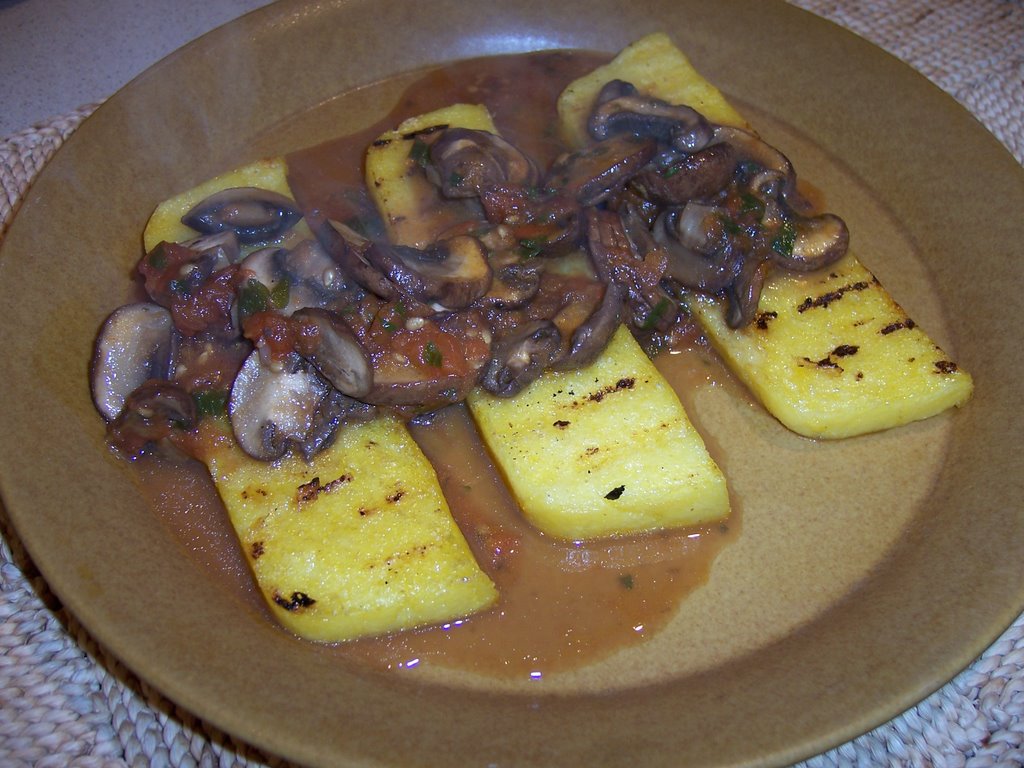
Polenta is an excellent base for all kinds of dishes, and nothing could be faster than quick-cook polenta – except perhaps quick-cook couscous!

I cooked up a batch this morning, which I purchased in an Italian deli, and left it to chill in the refrigerator, pressed into a loaf-shaped pan. Around dinner time, it slices nicely into rectangular crostini, which I toasted, crispy in a grill pan.

The crostini is adorned with a ragu of tomato, mushroom, garlic and parsley sautéed in extra-virgin olive oil and butter. The deep, savory woodiness of the mushrooms and sweetness of the tomatoes mingles with the toasted corn meal like a brilliant autumn day. Imagine the golden sun dipping down to kiss the shaded forest and you’ll have a sense of the pleasures of this quick and satisfying dish.

© 2006 T.W. Barritt All Rights Reserved