He says that over time, members realize that every year is not the same, and if they’ve stuck with it, they become “forever people.”
 The team at Restoration Farm: (l-r) Caroline Fanning, Ada Fanning Holmes, Dan Holmes, Tricia Hardgrove and Jessica Graves
“You start to hear them talking about craving greens in the spring,” says Dan. “Their body starts to react to local eating and that’s really neat.”
As a team, Caroline and Dan bring different perspectives to their work, including what is planted, and what will appeal to people in the kitchen.
“Dan and I are always arguing about this in the fields,” says Caroline. “I’m a big proponent of different colors and he’s a big proponent of whatever is most nutritious or supposedly what tastes the best regardless of color, and we go back and forth.”
After an abundant first season, 2009 brought some significant obstacles, including cool, wet weather, and an early blight that decimated the tomato crop. They are pleased with the variety of greens that have come from the field, and met a goal of offering more lettuce throughout the season. They estimate that more than one hundred varieties of vegetables are planted at Restoration Farm.
They all agree that it is crucial to talk frequently with members, share perspectives and build an understanding of all of the factors that contribute to the successes and disappointments that occur in farming.
“I think it’s important that we’re here at distribution as often as possible to talk to people so that the members understands that we’re on their side,” says Caroline. “We’re all in the same boat, but I think if we weren’t here sharing our pain and their pain about the season, it would take on more of a dichotomous relationship. They need to know we’re doing whatever we can to minimize the problems.”
At this point, intern Tricia Hardgrove chimes in. “When you make a commitment to eating locally, you’re more tied to nature,” she says. “You’re more tied to the weather and that’s one thing that I’ve learned working here. They try to exert as much control over it as possible, but so much is out of your control. It’s dependent on the weather, it’s dependent on countless factors.”
“It puts so much pressure on to do right by all those people who put so much faith in you,” says Caroline. “And, then you combine that with a hard year where you did everything you could but you couldn’t get the rain to stop, and you couldn’t stop the tomato blight. This is why it’s important to get to meet the members, so they get to know us and understand and know that we do as much as we can to make it as good a season as possible.”
Tricia says CSA members must learn to adjust to the fact that the yield will vary. “I think committing to eating locally, committing to eating organically, people are introduced to that concept, which is so foreign to a lot of us now, because you can just go to the grocery store and get anything.”
“It’s a great question for everybody,” says Dan. “How much is enough – for us, for members, for everybody in this world – how much is enough?”
“Nature never consults anyone,” says Caroline. “People who come here thinking that this is going to replace Whole Foods as their organic food source are probably going to be disappointed. Unless you come into it prepared for the whole experience – all the good and bad – or unless you’re really dedicated to getting fresh food, those are the only things that can compensate for all the inconvenience of being a CSA member. It’s up to the individual whether or not it’s a better trade.”
“You have to pull yourself out of the supermarket mentality,” says Dan. “Much of food has gone the way it has gone because of convenience and price. That’s where we go the other way, and the question is, is that important to people?”
“You can argue that for some people, convenience has shaped much of the way our economy has gone,” says Tricia. “You come here, and you talk to the people that are growing your food, you get to see the baby and you talk to other members. That’s more humanizing than going to an automatic checkout, which isn’t always bad, but I think some people are looking for something more.”
Their winter will be spent in preparation for the growing season ahead, ordering seeds, working through crop rotations and re-registering members.
“I love planning things out,” says Caroline. “It’s like a puzzle, just figuring what to plant where, knowing that you can’t plant the same thing in the same spot, so that takes a lot of time.”
Together, they express a sense of kinship that has emerged at Restoration Farm. They talk warmly about the volunteers who have become part of the fabric of the farm.
“I think there’s this trend that’s happening now, where people are reforming community,” says Tricia. “We’ve lost some of our community over the years, and I think there’s the potential for reformation of that sense of community.”

Dan agrees. “If you find a farm – and your farm is the most local farm – and you decide that’s the place that you’re going to support, it becomes everybody’s farm.”
At this point, the rain is driving hard, although we are protected under the tarp. Caroline mentions that it reminds her of the infamous wet June weather. It’s all part of the cycle and the elements that the community must endure.
Dan offers a final thought before I scamper off to my car in search of a scrub brush to clean my fingernails, a hot shower and some clean clothes.
“I traveled a lot when I was younger in hopes of finding a real culture,” he says. “Now, when I look back on that and my thirst for that, it’s such a great feeling to now be at Restoration Farm. I really don’t have much aspiration to travel any more, because I feel like I want to be here working with my people. I could actually stand outside myself and imagine somebody wanting to travel to Restoration Farm and see this culture because we have great people here.”
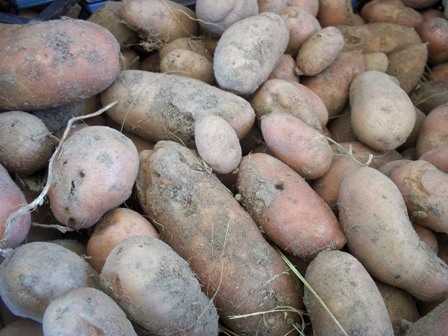
Every dish - and ingredient - has a story behind it. This rustic, layered “cake” or torta of potato slices, seasoned with olives, onions, fontina cheese and rosemary makes good use of the red potatoes harvested with Dan and the team at Restoration Farm.
 Torta with Red Potatoes from Restoration Farm (Makes 8 Generous Wedges)
(Adapted from Martha Stewart Living and healthypotato.com)
6 medium red potatoes (about 2 ¼ pounds)
Three tablespoons olive oil
Two medium onions, peeled and sliced
One clove garlic, minced
Two tablespoons fresh rosemary
Salt and freshly ground pepper
½ cup kalamata olives, pitted and chopped
½ cup grated fontina cheese
Three roasted red bell peppers, sliced thin
1. Scrub potatoes, place in a steamer and steam for 35 minutes until tender. Let cool and slice.
2. Over medium heat, sauté onion and garlic in one tablespoon of oil, stirring frequently, about 20 minutes. Reduce heat to low, and add rosemary, salt and pepper. Cook for 5 minutes more and remove from heat. Add olives, reserving about a tablespoon for the top.
3. Spray a 9-inch springform pan with cooking spray. Wrap bottom in foil and place on a rimmed baking sheet. Arrange 1/3 of potato slices in overlapping circles, covering the bottom. Brush with olive oil and season with salt and pepper. Layer ½ of the peppers and ½ of the cheese. Arrange a second layer of potatoes, brush with oil and season, and spread the onion mixture over the top. Cover with remaining potatoes, brush with oil and season, add remaining peppers and remaining cheese. Sprinkle reserved olives over top.
4. Bake for 45 - 50 minutes in a 375 degree oven, tenting the top with foil after 30 minutes.
5. Let cool to room temperature, remove form, and slide onto serving plate.

©2009 T.W. Barritt All Rights Reserved