Sunday, June 24, 2012

The Promise of Beets Fulfilled and the Summer Solstice at Restoration Farm


The cycle of life at Restoration Farm stretches throughout the year and is shifting and evolving each day.    Humans work the land, chickens forage and fertilize the fields and seeds interact with sun, soil and water resulting in food.  There is a short slumber, and the process begins again.
Tiny black seeds planted in the short, cold days of February have delivered on their incredible promise.   Bunches of fat purple beets crowned with brilliant leafy greens await us at the distribution tent.   I planted those beet seeds last winter in the greenhouse.   A simple action sparked a natural process and has generated nourishment for the community of members. 
The first beets of the summer are a true gift from the farm – rich, earthy and deeply satisfying.    Typically, I love to roast fresh beets, but this first bunch – with which I feel an intimate connection – is best experienced in its natural state.   I grate the beets raw into this robust magenta-colored Beet, Carrot and Quinoa Salad (recipe found here). The salad offers a landscape of colors, textures, and crunch – bright orange and burgundy with scoops of diced apples, raisins, almonds and pumpkin seeds.   
In the sun-drenched fields of Restoration Farm, the annual ritual of the Summer Solstice Pot Luck occurs again. Folklore says the Solstice initiates a season of fertility, and plants are believed to acquire healing powers on the longest day of the year. 
Part of the fun of this event is sampling the variety of dishes made by members with ingredients grown at the farm, so I bring the Beet, Carrot and Quinoa Salad as my contribution to the communal banquet.   You feel a real sense of vitality when so many members gather in the field for a meal and a real connection to the food grown here.
The sharing of this summer meal - with its bright, vibrant vegetables and crisp greens - will only happen once before the season gradually begins to fade into another.   But, for a brief moment we all revel in the smiles, flavors and magic of a Midsummer Night at Restoration Farm. 
©2012 T.W. Barritt All Rights Reserved  

Sunday, June 17, 2012

Strawberries As Nature Intended


The strawberry patch at Restoration Farm is damp with the remnants of an early morning rain.   But, that doesn’t stop several of us from tugging up our cuffs and wading in to pick.   When it comes to freshly picked strawberries, you can’t let a little moisture hold you back.
It is like a treasure hunt.  Broad green leaves conceal most of the berries.   You have to lift the protective netting and then forage a bit with your hands until you find the prize.   Adults relish the satisfaction of plucking a perfect, glistening red strawberry and adding it to the basket.   Children think it’s the best game ever.    
But, be careful.    The strawberry patch is teaming with life.   One sharp-eyed forager spots a garden snake slithering through the underbrush with a small toad in its mouth.    This news sends another friend scurrying from the patch.   It’s all a far greater adventure than navigating the produce aisle to locate monstrous strawberries wrapped in clear plastic.  
Each year, the crop of strawberries seems to develop its own set of flavors and characteristics.   Some have been tart, and others dripping with juice.   These taste sweet and clean, evoking a refreshing spring rain shower.   They demand to be treated simply, celebrating that pure strawberry essence.    I choose a recipe from Jacques Pepin’s Essential Pepin -- where sliced strawberries are dressed with a dollop of sour cream and sprinkled with a dash of brown sugar – just enough embellishment to highlight the natural beauty of the strawberries.  
©2012 T.W. Barritt All Rights Reserved  

Sunday, June 10, 2012

Crisp and Tender – The First Greens of Restoration Farm


You come to expect an abundance of greens at the start of the growing season at Restoration Farm.   In late spring, the produce should be like the weather – brisk, full of vitality – and very, very green. 
The first distribution of the 2012 growing season means salads and greens will be the menu item of choice for some time to come.   If one tires of lettuce, there is a bounty of arugula, mizuna and bok choy to enjoy. 
The ubiquitous and super-nutritious kale is in fine form and in the field, hearty Swiss Chard is reaching towards the sky.  
As always, the farm is a busy place on weekends, and on this day, the fields resemble a lush, romantic landscape painting.  Head Grower Dan Holmes is working the tractor, and chatting with CSA members from his perch atop the vehicle. 
A cow from the historic village has wandered over for a visit.
We all greet the first distribution of the season with great anticipation.  The first greens of Restoration Farm are abundant, but precious, and not to be taken for granted.  The chance to eat these healthful and tender green shoots – just hours old – is a rare pleasure, and I celebrate the inauguration of the 2012 season with salads of freshly picked spinach leaves, adorned with red onion, mandarin oranges and sunflower seeds.   
Eating the bright and vivacious salad is just like tasting the potential of the youthful growing season with each forkful. 
©2012 T.W. Barritt All Rights Reserved  

Sunday, June 03, 2012

Tasting the Heart, Soul and Soil of Hudson Valley Cheese


Can a taste of artisanal cheese transport you to the place where it was produced?  What can you learn about a cheese maker from a style of cheese, the way the animals are tended or the types of ingredients used?

A while back, I had the chance to visit several Hudson Valley cheese makers and explore the idea of “terroir.”  Loosely translated as "taste of the soil," the word refers to the “sense of place” one might taste in a wine produced in a distinct location, and the concept of terroir is becoming more prevalent in conversations about farmstead cheese.  I found cheese makers more than willing to discuss the merits of cheese and terroir and passionate about their role in defining the character of small-batch cheese in the Hudson Valley.  
Rory Chase and Peter Destler, the founders of The Amazing Real Live Food Co. in Pine Plains, New York founded their creamery on a commitment to serve delicious, restorative “vittles” for their friends and neighbors in the Hudson Valley.  They source their milk from 50 registered Holstein cows that graze in rolling pastures reminiscent of a Norman Rockwell illustration. 
Rory and Peter are clearly dedicated to their mission and their French-style artisanal and probiotic cheeses delight the senses.  
Rory becomes visibly animated as he inhales the “mushroomy” aromas in their aging room, and offers me delicious samples of fresh and aged cheeses.  
Joyce Henion – owner of Acorn Hill Farm in Walker Valley, New York – produces fresh, clean-tasting goat cheeses in the former garage of her split-level home, which she converted into a fully equipped creamery.  
Joyce’s fascination with Nubian goats inspired her vocation as a cheese maker.  
Acorn Hill Farm is a very different locale.  Joyce’s goats browse a wooded area of rocky terrain.  She manages the herd organically and knows each goat by name.  
If you taste the cheese of Rory and Peter or Joyce, you will savor two very different stories, but both are characteristic of the vital cheese making community in the Hudson Valley.  Read more about cheese terroir in my story “A Sense of Place” published in the Spring 2012 “Bread and Cheese” issue of the magazine, Edible Hudson Valley.   
©2012 T.W. Barritt All Rights Reserved   

Sunday, May 27, 2012

Cultivating Life at Restoration Farm


The sun rises on a singularly bright and clear spring day, and the gates of Restoration Farm swing open welcoming members old and new.  It is the start of the 2012 growing season.  
Everywhere you look, the hands of dedicated volunteers have been at work cultivating life at the seven-acre farm.   Volunteers are always encouraged, as working outdoors promotes the health of the farm community and the health of the individual. 
The area surrounding the herb garden has been expanded, and a map board has been added to help members navigate the fields.   The herb gardens are already lush with greenery, and picnic tables have been added to encourage community. 
Head Growers Dan Holmes and Caroline Fanning bring us up to date on the continuing evolution of the farm.  They lead a procession down the path toward the fields.  
Our first stop is a new area where Glenn Aldridge is crafting an edible forest garden.  
It is playfully nicknamed “Voodoo Garden,” as Glenn is looking to create a bit of magic with the landscape and edible varieties.   He has already planted red currants, horseradish and Asian pears, perennials that flourish in the forest and provide tasty forage.  The plants will be ornamental and edible so they provide beauty and nourishment.  
We emerge on the fields and a warm and lively perfume dances in the air, a sweet mélange of soil, manure, pollen and fresh greens. 
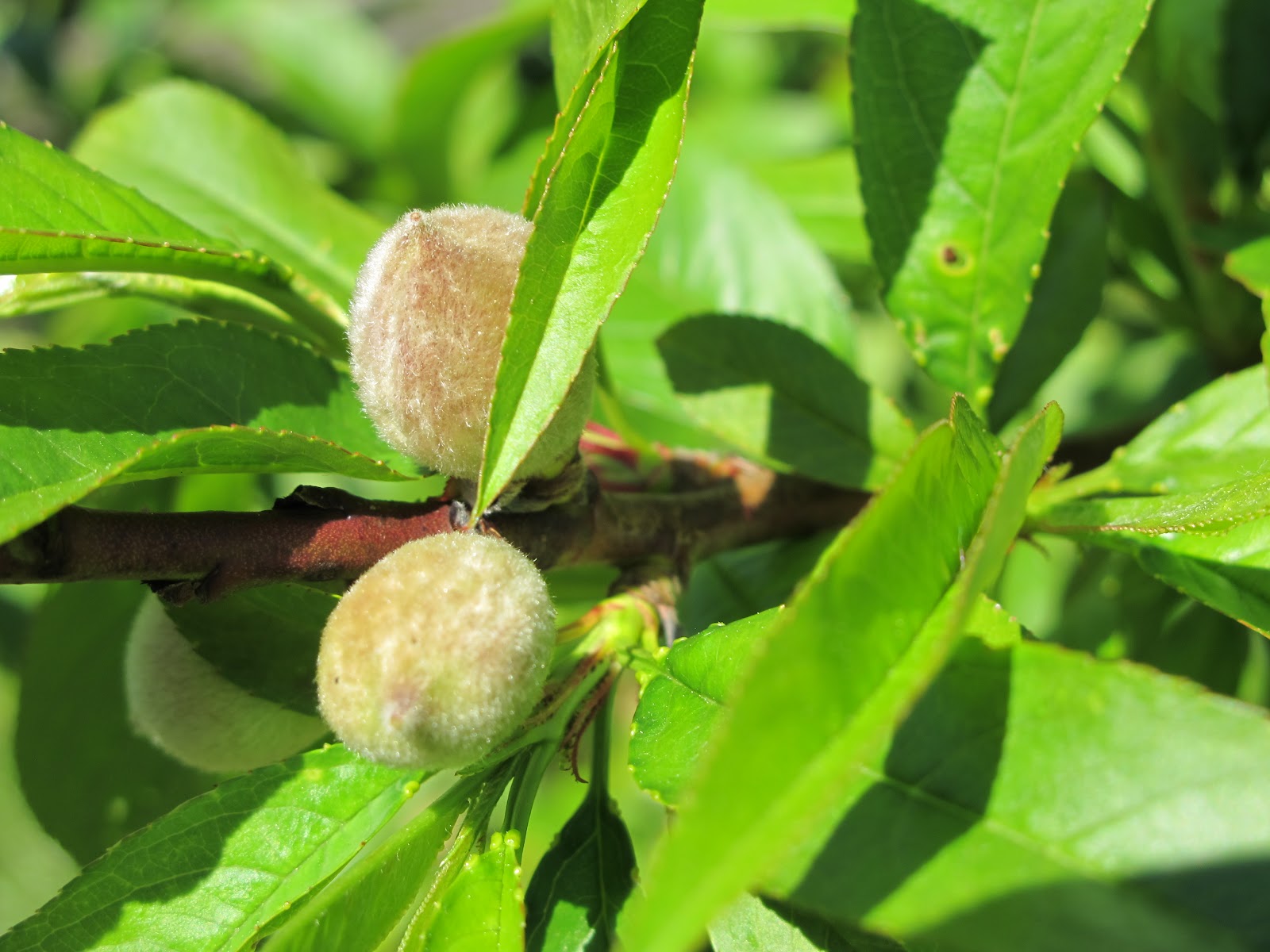
Peach trees, planted three seasons ago by Glenn show signs of bearing fruit.  
Sprightly red lettuce is popping out of the soil.  The first distribution in June will hopefully include heaps of fresh, tender greens. 
We stop where heritage meat birds are free-ranging.   The first batch of chicks arrived in February and will be ready for our tables at the end of May.  This is a different type of bird than last season.  They take longer to mature and are leaner and more flavorful.   Caroline says the integration of chickens into a vegetable operation is a puzzle that they embrace and are still working to solve.   Dan reminds us that “eating is an agricultural act,” and that we need to open our palates to new experiences.  We’ll have opportunities to learn recipes that take advantage of the distinctive flavor and texture of these special breeds.  
At Apple Trace – the line of eight heirloom apple trees planted in memory of my Dad – what were just bare twigs weeks ago, are now clustered with small leaves.    
I hear from a reliable source that my friend George Garbarini has kept the saplings at Apple Trace well watered during the recent drought.  
The old Hewlett Apple Orchard, which we worked so hard to prune back in March, is filled with nicely shaped, mature trees.  Compared to the young saplings at Apple Trace, these are old characters.  The spring flower blossoms have fallen, giving way to the potential for apples this summer.
Donna Sinetar’s flock of laying hens has grown in number.  While Donna’s “girls” still don’t lay enough eggs for the entire CSA membership, there are enough to sell them through an honor system at the distribution area and they are in great demand.   
The strawberry patch is a blanket of white blossoms, promising bright, juicy red berries in just a few weeks. 
Another team of volunteers is building a trellis of netting to protect the blueberry bushes from hungry birds. 
Back at the distribution tent, we enjoy a banquet of homespun sweets baked by longtime member, Lulu McCue.  
A group of smaller hands engage in a touch of creativity, splashing farm carts with paint and adding color to the landscape of Restoration Farm.    


And so, another season begins again – marked by a community of members cultivating life from the soil and nurturing the growth of each other.


©2012 T.W. Barritt All Rights Reserved