Showing posts with label Local Harvest. Show all posts

Sunday, July 29, 2012

Heritage Meat Birds at Restoration Farm – Go You Chicken Fat Go!


When I was in elementary school, we exercised in gym class to a 45 rpm vinyl record (I’m dating myself.  It was life before CDs and iPods) called "The Chicken Fat Song."

It was a snappy workout tune written by Meredith Wilson and sung by “Music Man” actor Robert Preston.   The record was sent to hundreds of U.S. schools as part of a youth fitness initiative launched during President Kennedy's administration.   Preston shouted out moves like Touch down every morning – ten times! followed by the refrain Go you chicken fat, go away! Go you chicken fat go!   Now, some years later I still can’t that song out of my head. 

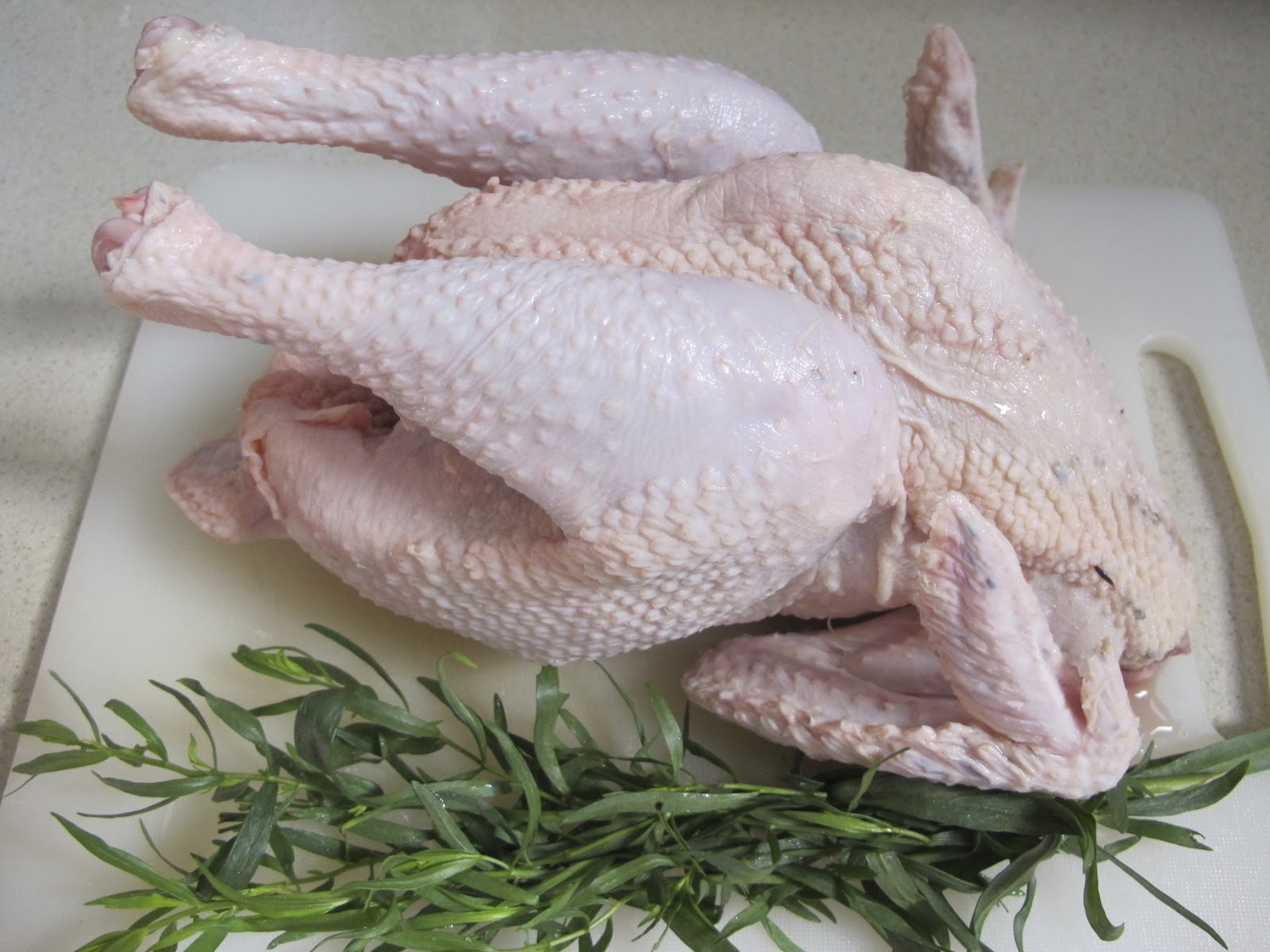
I was reminded of that catchy tune when my first heritage chicken was recently harvested at Restoration Farm.   Long and lean, the chicken is physically different than your average supermarket variety and there's almost no chicken fat at all.   I could almost hear Robert Preston’s bellowing voice in the kitchen singing, Go you chicken fat go! as I cleaned and trussed the bird.
In fact, the chicken fat was chased away in the fields of Restoration Farm.   The 2012 heritage meat birds are male free-range chickens that exercise and forage in the field.  They are breeds that once were more commonly raised, and need to be preserved – breeds that include Delaware, White Orpingtons, New Hampshires and Speckled Sussex.  They develop sleek, athletic bodies, quite unlike last season’s mostly grain-fed Cornish broilers bred to quickly put on the pounds.  They take longer to mature – up to twelve weeks versus the quick six-week maturation of a Cornish broiler.   The diet and activity of these heritage breeds is said to result in a more healthful and flavorful bird.  

One must do a bit of reading before cooking a heritage chicken.   The slim bird must be cooked at a lower temperature to assure a moist and tender breast.   At typical cooking temperatures for chicken, one could easily cook that farm fresh flavor right out of a heritage meat bird. 

I go straight to the master, Julia Child, and select a recipe from "Mastering the Art of French Cooking" called Casserole Roasted Chicken with Tarragon.  Julia’s technique of searing the bird, and then roasting it in a covered Dutch oven at a lower temperature of 325 degrees -- with lots of tarragon from the farm -- keeps the chicken moist and juicy and perfumed with the flavor of the herbs.
Did I notice a difference with my first fresh heritage chicken?   There is less meat, but the flesh did have a richness to it.  It was pronounced delicious by those who consumed it, but I'm not sure I would be able to taste a noticeable difference in a side-by-side comparison with a supermarket chicken.   I hate to admit that it felt a little less-than-bountiful simply due to the size.  It is funny that our society will look down on one who is pleasantly plump, but celebrate thinness in humans, yet when it comes to a chicken we feel a little deprived if the bird is not zaftig.  
Maybe there was a different reason to eat this bird -- a reason that had less to do with chicken fat and plump breasts and more to do with how the chicken was raised.   It is really about a better convergence of farming practices and palette.  Head growers Dan and Caroline believe that chickens can be incorporated into the farm and lead a healthier life prior to harvest.  I was there on the day in February when the birds were first delivered and placed in the brooder. 
The heritage birds truly traversed Restoration Farm in a large open pen.   They consumed grass and flowers and exercised their limbs and became part of the life cycle of the farm.  
The careful tending continued in the kitchen with the choice of recipe, and the stories told about this bird at the table.  The entire process was all more thoughtful and involved than a supermarket purchase.   
Perhaps cooking a heritage chicken is not about filling the belly, but about supporting the cycle of community agriculture and being filled with the total experience, from farm to table.   

©2012 T.W. Barritt All Rights Reserved

Sunday, May 27, 2012

Cultivating Life at Restoration Farm


The sun rises on a singularly bright and clear spring day, and the gates of Restoration Farm swing open welcoming members old and new.  It is the start of the 2012 growing season.  
Everywhere you look, the hands of dedicated volunteers have been at work cultivating life at the seven-acre farm.   Volunteers are always encouraged, as working outdoors promotes the health of the farm community and the health of the individual. 
The area surrounding the herb garden has been expanded, and a map board has been added to help members navigate the fields.   The herb gardens are already lush with greenery, and picnic tables have been added to encourage community. 
Head Growers Dan Holmes and Caroline Fanning bring us up to date on the continuing evolution of the farm.  They lead a procession down the path toward the fields.  
Our first stop is a new area where Glenn Aldridge is crafting an edible forest garden.  
It is playfully nicknamed “Voodoo Garden,” as Glenn is looking to create a bit of magic with the landscape and edible varieties.   He has already planted red currants, horseradish and Asian pears, perennials that flourish in the forest and provide tasty forage.  The plants will be ornamental and edible so they provide beauty and nourishment.  
We emerge on the fields and a warm and lively perfume dances in the air, a sweet mélange of soil, manure, pollen and fresh greens. 
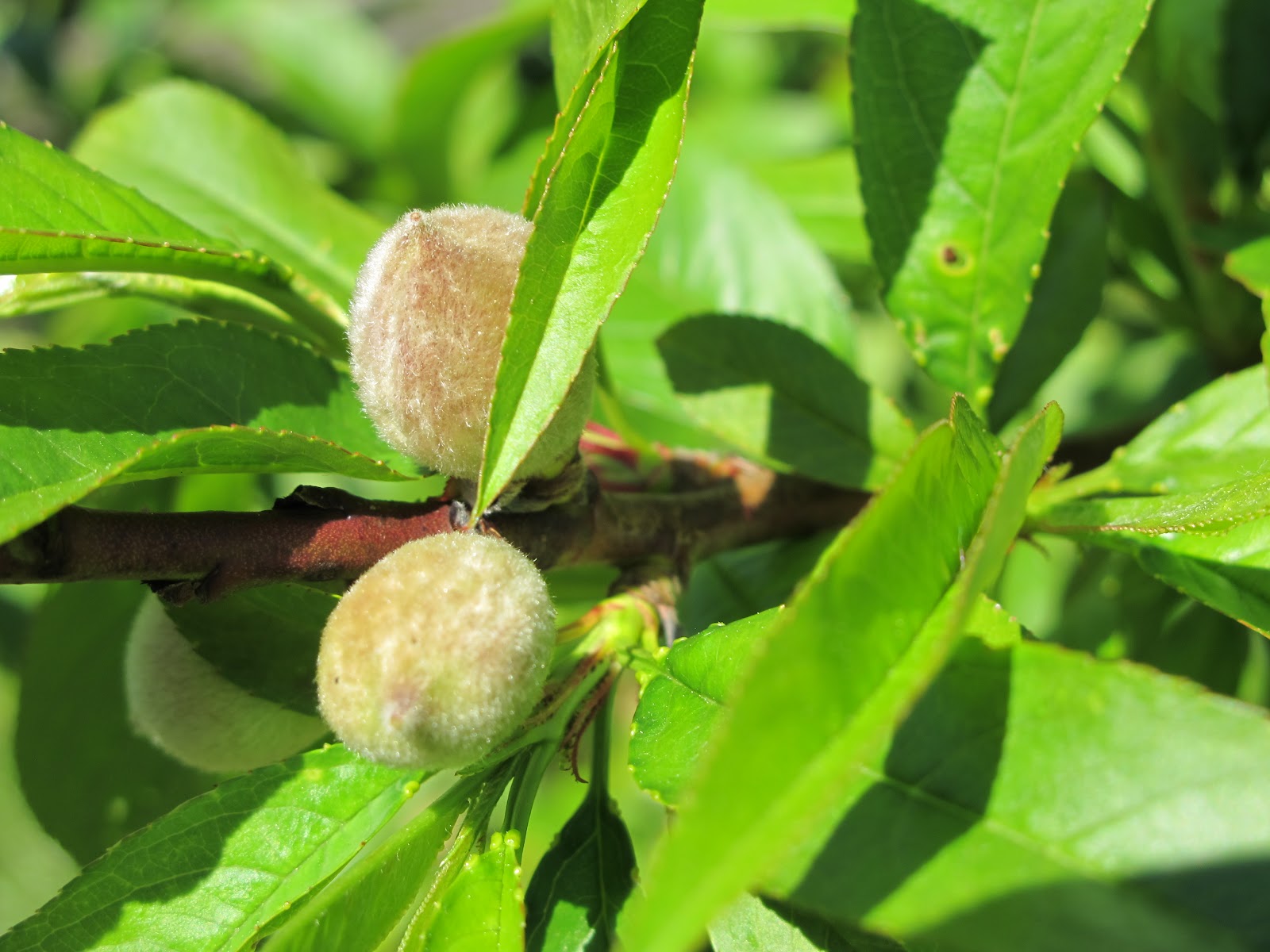
Peach trees, planted three seasons ago by Glenn show signs of bearing fruit.  
Sprightly red lettuce is popping out of the soil.  The first distribution in June will hopefully include heaps of fresh, tender greens. 
We stop where heritage meat birds are free-ranging.   The first batch of chicks arrived in February and will be ready for our tables at the end of May.  This is a different type of bird than last season.  They take longer to mature and are leaner and more flavorful.   Caroline says the integration of chickens into a vegetable operation is a puzzle that they embrace and are still working to solve.   Dan reminds us that “eating is an agricultural act,” and that we need to open our palates to new experiences.  We’ll have opportunities to learn recipes that take advantage of the distinctive flavor and texture of these special breeds.  
At Apple Trace – the line of eight heirloom apple trees planted in memory of my Dad – what were just bare twigs weeks ago, are now clustered with small leaves.    
I hear from a reliable source that my friend George Garbarini has kept the saplings at Apple Trace well watered during the recent drought.  
The old Hewlett Apple Orchard, which we worked so hard to prune back in March, is filled with nicely shaped, mature trees.  Compared to the young saplings at Apple Trace, these are old characters.  The spring flower blossoms have fallen, giving way to the potential for apples this summer.
Donna Sinetar’s flock of laying hens has grown in number.  While Donna’s “girls” still don’t lay enough eggs for the entire CSA membership, there are enough to sell them through an honor system at the distribution area and they are in great demand.   
The strawberry patch is a blanket of white blossoms, promising bright, juicy red berries in just a few weeks. 
Another team of volunteers is building a trellis of netting to protect the blueberry bushes from hungry birds. 
Back at the distribution tent, we enjoy a banquet of homespun sweets baked by longtime member, Lulu McCue.  
A group of smaller hands engage in a touch of creativity, splashing farm carts with paint and adding color to the landscape of Restoration Farm.    


And so, another season begins again – marked by a community of members cultivating life from the soil and nurturing the growth of each other.


©2012 T.W. Barritt All Rights Reserved  

Sunday, October 03, 2010

Green Beans and a Local Food Revolution


Frozen green beans may not be the first ammunition that comes to mind when staging a local food revolution, but for Luc Roels and Jim Hyland (left to right) - the owners of Farm to Table Co-packers in Kingston, New York - frozen vegetables and berries are critical in their arsenal.  


In June, the team opened the food processing facility, Farm to Table Co-packers to pursue a singular goal. They hope to reshape the regional food system in the Hudson Valley.  

For more on the story, check out my article on Farm to Table Co-packers in the Autumn 2010 edition of the quarterly magazine Edible Hudson Valley.

©2010 T.W. Barritt All Rights Reserved

Saturday, December 15, 2007

Barbara Kingsolver's Locally-Grown Miracle


Locally-grown food is all the rage these days. But, beyond a lovely salad or a succulent piece of grass-feed lamb, do you think you could exist for an entire year only on food that you'd grown yourself, or purchased from your neighbors?

Since my neighbor is an electrician, I'd probably starve.

Barbara Kingsolver is the author of a variety of best-selling works of non-fiction and fiction, including The Poisonwood Bible. Her book Animal, Vegetable, Miracle: A Year of Food Life chronicles a family experiment. Kingsolver, her husband and two daughters chose to follow a diet consisting almost exclusively of locally-grown food for an entire year.

Where does your food come from? How much does it cost to get it to your table? How would you handle the challenge of eating locally?

Kingsolver has an edge up on most of us. She lives on a farm in Virginia, located in an agricultural region of Appalachia. In the book, she covers a variety of familiar themes that have gained prominence recently in the press such as industrial faming and the concept of food miles. But unlike Michael Pollan’s The Omnivore’s Dilemma, which at times felt overwhelmingly depressing, Kingsolver manages to weave hope, insight, and practical advice into every chapter. She is thought-provoking and inspiring and sometimes just a wee-bit-preachy, but the food sounds so delicious that it doesn’t really matter much.

The family is able to eat locally with great success, and in some months generates enormous yields. During the summer months they are simply overrun with zucchini. The details of daughter Lily’s home-grown egg business are fascinating, and Kingsolver’s “Vegetannual” – an imaginary plant that sprouts delicate vegetables in the spring and hard-skinned vegetables in autumn is an effective image to reinforce the inherent qualities of seasonal produce. Late in the book, the author does admit to keeping emergency boxes of macaroni & cheese for finicky guests (You go girl!) and while I could have done without the lengthy prose on turkey sex, it does reinforce how deeply involved you can become in the annual rhythms of agriculture. Kingsolver’s descriptions of raising and slaughtering animals for food are sobering but pragmatic. The family plans and strategizes over menus obsessively, and manages to keep freezers stocked with their yields that carry them through the lean winter months. And, they save a boat load of grocery money in the process.

The primary effect of the book is that it does get you thinking hard about food choices, and I am now much more conscious of those tiny labels that identify where my produce was grown. The possibility for change can sometimes seem overwhelming when you stand in the produce aisle and scan the mountains of fruits and vegetables that were shipped from thousands of miles away. Animal, Vegetable, Miracle is less a manifesto, however, and more a handbook for thoughtful food choices. It features a cornucopia of resources woven into the text on sustainable agriculture, food policy, recipes and ways to locate and support farmers markets. There is a companion website which includes a link to an extensive site called Local Harvest. Here I learned there is indeed an organic community supported garden, a sustainable farm, and a restaurant serving local and organic produce not five miles away from my home. So, perhaps the ideal of revolutionizing my diet – even on the primarily urban East Coast – is not that far-fetched.

Just last night, I took note of a report in Time Out New York that a gentleman named Robert LaValva – the co-founder of a nonprofit organization called New Amsterdam Public – is looking to open a public market at the former Fulton Fish Market in New York. The goal is to offer sustainable food sourced from within 500 miles of New York. They’re hosting a prototype event called “Wintermarket” at the South Street Seaport on Sunday, December 16th. We may find that people like Barbara Kingsolver and her family will some day be looked on – not simply as a curiosity – but as pioneers, and their actions may eventually contribute to the fruition of projects like the proposed New Amsterdam Market.

It is possible that one family can foster a miracle.

© 2007 T.W. Barritt All Rights Reserved