Showing posts with label Julia Child. Show all posts

Sunday, July 29, 2012

Heritage Meat Birds at Restoration Farm – Go You Chicken Fat Go!


When I was in elementary school, we exercised in gym class to a 45 rpm vinyl record (I’m dating myself.  It was life before CDs and iPods) called "The Chicken Fat Song."

It was a snappy workout tune written by Meredith Wilson and sung by “Music Man” actor Robert Preston.   The record was sent to hundreds of U.S. schools as part of a youth fitness initiative launched during President Kennedy's administration.   Preston shouted out moves like Touch down every morning – ten times! followed by the refrain Go you chicken fat, go away! Go you chicken fat go!   Now, some years later I still can’t that song out of my head. 

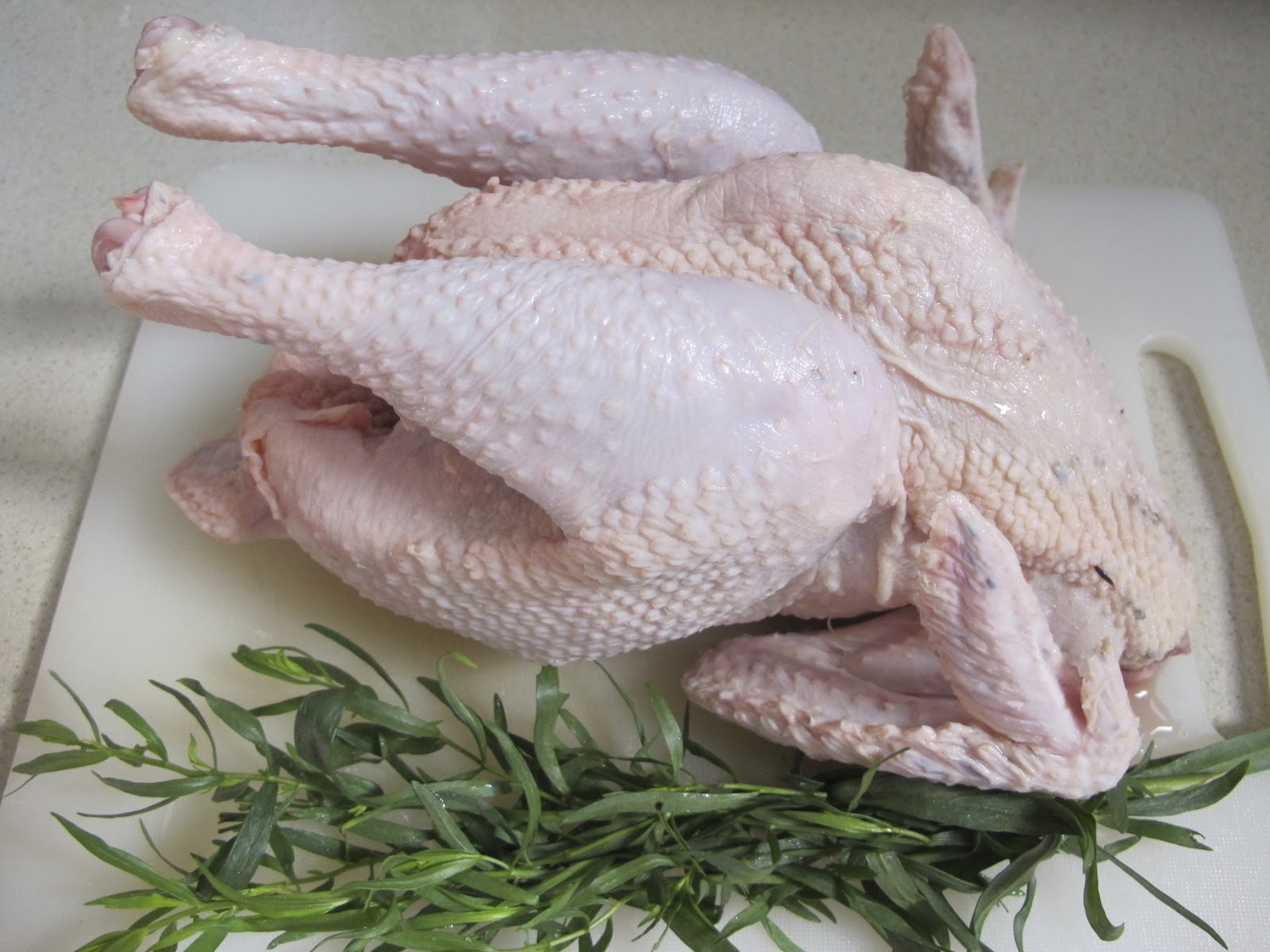
I was reminded of that catchy tune when my first heritage chicken was recently harvested at Restoration Farm.   Long and lean, the chicken is physically different than your average supermarket variety and there's almost no chicken fat at all.   I could almost hear Robert Preston’s bellowing voice in the kitchen singing, Go you chicken fat go! as I cleaned and trussed the bird.
In fact, the chicken fat was chased away in the fields of Restoration Farm.   The 2012 heritage meat birds are male free-range chickens that exercise and forage in the field.  They are breeds that once were more commonly raised, and need to be preserved – breeds that include Delaware, White Orpingtons, New Hampshires and Speckled Sussex.  They develop sleek, athletic bodies, quite unlike last season’s mostly grain-fed Cornish broilers bred to quickly put on the pounds.  They take longer to mature – up to twelve weeks versus the quick six-week maturation of a Cornish broiler.   The diet and activity of these heritage breeds is said to result in a more healthful and flavorful bird.  

One must do a bit of reading before cooking a heritage chicken.   The slim bird must be cooked at a lower temperature to assure a moist and tender breast.   At typical cooking temperatures for chicken, one could easily cook that farm fresh flavor right out of a heritage meat bird. 

I go straight to the master, Julia Child, and select a recipe from "Mastering the Art of French Cooking" called Casserole Roasted Chicken with Tarragon.  Julia’s technique of searing the bird, and then roasting it in a covered Dutch oven at a lower temperature of 325 degrees -- with lots of tarragon from the farm -- keeps the chicken moist and juicy and perfumed with the flavor of the herbs.
Did I notice a difference with my first fresh heritage chicken?   There is less meat, but the flesh did have a richness to it.  It was pronounced delicious by those who consumed it, but I'm not sure I would be able to taste a noticeable difference in a side-by-side comparison with a supermarket chicken.   I hate to admit that it felt a little less-than-bountiful simply due to the size.  It is funny that our society will look down on one who is pleasantly plump, but celebrate thinness in humans, yet when it comes to a chicken we feel a little deprived if the bird is not zaftig.  
Maybe there was a different reason to eat this bird -- a reason that had less to do with chicken fat and plump breasts and more to do with how the chicken was raised.   It is really about a better convergence of farming practices and palette.  Head growers Dan and Caroline believe that chickens can be incorporated into the farm and lead a healthier life prior to harvest.  I was there on the day in February when the birds were first delivered and placed in the brooder. 
The heritage birds truly traversed Restoration Farm in a large open pen.   They consumed grass and flowers and exercised their limbs and became part of the life cycle of the farm.  
The careful tending continued in the kitchen with the choice of recipe, and the stories told about this bird at the table.  The entire process was all more thoughtful and involved than a supermarket purchase.   
Perhaps cooking a heritage chicken is not about filling the belly, but about supporting the cycle of community agriculture and being filled with the total experience, from farm to table.   

©2012 T.W. Barritt All Rights Reserved

Sunday, February 12, 2012

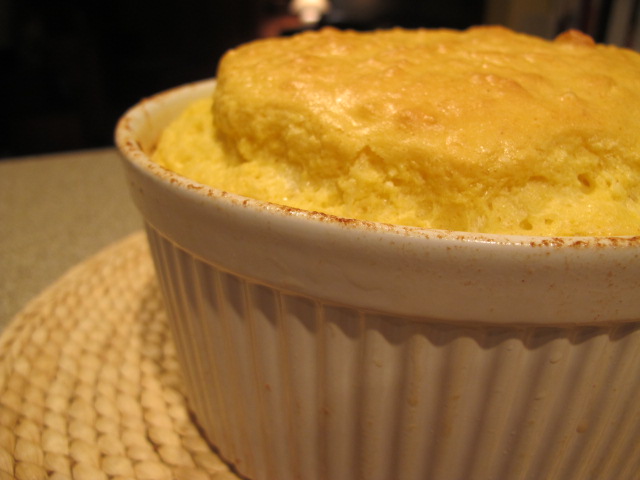
Poof! Julia Child’s Cheese Soufflé

Life’s been complicated lately. No doubt about it. I haven’t had much inspiration, time, or inclination to cook.

So, what was I thinking, getting back into the game this weekend by attempting a Julia Child Gruyere-cheese soufflé? For starters, there were a surplus of eggs in the refrigerator, and this seemed like a good use. But, maybe I was craving a little focus and discipline. Maybe I needed a kitchen project that would not tolerate showmanship, laziness or improvising. Perhaps order, rhythm and following the rules were needed.

One can’t help but appreciate the wisdom that is whisked into a Julia Child recipe. It’s never about short cuts, rushing or instant gratification. It’s all about patience and proper technique rewarded. Here’s my favorite quote from the recipe head note in the collection Julia and Jacques Cooking at Home, where this recipe can be found:

“If you have never made a soufflé before, you may feel that the dramatic rise of a soufflé is depended on skills or a magical touch that is beyond you. But you needn’t hold your breath worrying about what is happening behind the oven door – remember that souffler means “to blow” or “to puff.” When you have made your soufflé mixture properly, as we show you in these recipes it will rise, automatically.”

No magic was needed. I followed Julia’s directions, and I waited patiently for the timer to go off.

That French Chef sure knew a lot about life.

©2012 T.W. Barritt All Rights Reserved
Wednesday, February 06, 2008

A Bird in the Hand with a Dash of Salt and Pepper

I was a fussy child. I did not like bones with my chicken.

This presented a problem. For a family of six on a budget, boneless chicken breasts were rarely an option. Chicken was typically served in pieces, bone-in, Shake ‘n Bake style. After all, we were growing up in the heart of suburban Long Island. I must admit, it was not my favorite meal. I would push the meat around the plate and whine a bit. It was not exactly what you’d describe as quality time at the dinner table.

Mind you, I didn’t dislike chicken – far from it. I longed for those Sunday dinners when my mother would roast a whole chicken, and I could eat the thinly carved breast slices that my dad would fan across the platter. Even then, suburban ingenuity defined the meal. A pop-up button, inserted into the breast of the “Oven Stuffer Roaster” would signal that the bird was done. If we were lucky, there would be bread stuffing as well, usually made with Pepperidge Farm bread crumbs.

As an adult, I clung vehemently to my independence, and my ability to eat boneless chicken breasts no matter the cost. It didn’t matter if the rent money was tight, I would spend the extra cash for boneless chicken breasts.

It was only long after when I started classes at the French Culinary Institute in 2005 did I learn that roasting a whole chicken was considered an epicurean art form.

Indeed, in the memoir, My Life in France, Julia Child muses on the romance of a roasted chicken:

“Oh, those were such fine, fat, full-flavored birds from Bress – one taste, and I realized that I had long ago forgotten what real chicken tasted like.”

The French Chef goes so far as to make roasted chicken a requirement of culinary proficiency: “But my favorite remained the basic roast chicken. What a deceptively simple dish. I had come to believe that one can judge the quality of a cook by his or her roast chicken. Above all, it should taste like chicken: it should be so good that even a perfectly simple, buttery roast should be a delight.”

For some reason, I always found the idea of preparing a roast chicken intimidating. It was our instructor, Chef Candy – in her practical and authoritative way – who got me to relax about roasting. Even the FCI’s signature chicken recipe, Poulet Roti Grand-mere or “Grandmother’s Roast Chicken” inspired thoughts of a simpler life of sensual pleasure. Chef Candy carefully walked us through each step: removing the wishbone, trimming the wings, and trussing the bird so that the breast is plump and cooks evenly. We learned how to trim the leg bone, French style, and cut the breast on a bias.

Maybe it is the dark days of February that demand some homespun warmth, or the somewhat disconcerting feeling that the wonderful, exhilarating time spent learning at the French Culinary Institute is now three years past. Whatever the reason, I have become obsessed with thoughts of trussing and roasting a chicken.


I consult Alice Water’s “The Art of Simple Food,” and the technique could not be more poetic – one chicken, about four pounds, seasoned with salt and pepper. Stuffing the cavity of the bird with bundles of fresh thyme, sage and marjoram perfumes the meat. Waters recommends, if possible, that you season the bird a day or two ahead and refrigerate allowing the salt and pepper to penetrate the meat.

My trussing skills are rusty and several times, the twine slithers from my hands. But, eventually, perseverance pays off and I wrestle the roaster into submission. It is tied into a taut, tidy package and placed in the refrigerator.

On the afternoon of roasting, the chicken must sit out for about an hour before cooking. A chilled bird will not roast evenly. The oven is a searing 400 degrees. The directions are elementary – roast 20 minutes with breast side up, 20 minutes breast side down, and finish roasting 20 minutes up.

The oven sizzles with anticipation, and the chicken breast acquires a lustrous, golden hue. That hot, buttery aroma – so beloved by Julia and now dressed with sprightly herbs – permeates my kitchen.


My carving skills have endured the years and the tender, luscious meat peels from the frame. I French the bone and arrange several pieces on the plate, topped by an amber reduction prepared from pan drippings deglazed with white wine and chicken stock.

Make no bones about it. Accompanied with a glass of white Bordeaux, the roast chicken is a meal of supreme comfort and elegance.

©2008 T.W. Barritt All Rights Reserved

Thursday, April 12, 2007

Julia Lives on DVD!


Did you ever fantasize about cooking side-by-side with a famous chef? Ever wish you could hear a tidbit of kitchen wisdom straight from the lips of a renowned gourmet? We all have our "Food Network" fantasy pairings, which is probably why Iron Chef is so successful.

The DVD series from PBS, "Julia Child! The French Chef" is the real deal, an up-close and personal glimpse of a true artisan at work, not to mention a fascinating view of the earlier days of television, before fancy camera work, editing and special effects.

There's nothing fancy here -- it's just Julia and classic French cooking techniques. The food isn't always picture perfect, but it sure is genuine. The camera work is sometimes erratic, and there are long stretches (that would probably be cut by a production team today) where all you see is Julia's capable hands rythmically massaging butter into brioche dough or beating pate a choux into shape. Sometimes, it's even downright messy. Tell me that isn't true to life! I was captivated by long stretches of Julia using her physical tools, namely her hands. No mixers, no gadgets. Just her hands.

"Julia Child! The French Chef" DVD series is a culinary time capsule for any food lover and an extraordinary personal look at a master at work.

©2007 T.W. Barritt All Rights Reserved