Showing posts with label Caroline Fanning. Show all posts

Sunday, March 17, 2013

Soil, Seeds and Dirty Hands – Sowing Begins at Restoration Farm


This is how the summer harvest begins – palms blackened and dirt clinging to cuticles.  

It is a humble inception and one most never see.   But, assisting with seeding at Restoration Farm has become a regular pre-spring ritual for me.  It’s dirty, but it’s a signal that no matter how uncertain the times, some things remain constant.   Eventually, spring will arrive and seeds, soil, sun and water will produce food.
Seeding is the start of something delicious.   As always, Head Grower Caroline Fanning is scrupulously organized with detailed directions on which flats get which variety of seeds.   
On Saturday, our assignment is to seed 21 flats with beets and scallions.   I like seeding beets, because I enjoy holding those bright purple orbs in June, knowing I played some part in their birth.   The team includes Susan Salem, Donna Sinetar, Judy Stratton and me.     
We use our index fingers to dimple the soil, and then count out seeds one-a-at-a-time into the holes.  It is painstaking work but with a group, the job moves quickly.
Caroline takes us to the greenhouse, where scallions seeded earlier in the month are already sprouting.   There is a smattering of green accenting the flats of soil.  
The flowers at Restoration Farm are a feast for the eyes.  By midsummer, the cutting garden is a canopy of color.  It all starts with seeds, some no bigger than a grain of sand.   We reconvene on Sunday, and this time the team is Donna Sinetar, LuLu McCue and me. We prep the flats again.   After a point, your finger joints can get a little stiff.   You need sharp eyes for seeding microscopic flower seeds, but with focus we complete 28 flats. 
Ada does a pretty good of seeding, too.  Rumor has it she is planting lollipops, which sounds pretty tasty to me!
We conclude the weekend of seeding with a potluck soup and bread lunch.  LuLu is a soup chef extraordinaire, and serves up a rich, delicious lentil soup chock full of legumes, greens and orecchiette pasta and flavored with pancetta.  
It’s paired with a loaf of whole-wheat cottage cheese dill bread from my kitchen.
We can almost taste the fact that spring is just around the corner…  
©2013 T.W. Barritt All Rights Reserved   

Sunday, March 03, 2013

Apple Butter and Adventures in Home Canning


Yes, I can.   I have a can-do attitude about home canning.   Let’s do the can-can in my kitchen.  How about I kick the can around and see what I can come up with?

OK, I’ll knock it off.  But, I have always had a certain fascination with home canning.   Perhaps it is something about those perfect vegetables or luscious jams and spreads preserved – seemingly for years – in glistening glass jars.   A jar of homemade preserves exudes a certain rustic charm.  My farming immersion of the past several years has continued to stoke an interest in canning.  Just how many ways can you preserve all that stuff that pops out of the soil between June and October?  Yes, I’m fascinated, but I’m also fearful.   There seem to be an awful lot of warnings associated with home canning.

So, when Caroline Fanning – head grower at Restoration Farm – suggested a home canning workshop for CSA members, I relished the chance to learn more.  
Caroline walked us through the basics – high acid and low acid foods, boiling-water processing and steam-pressure processing, and sterilization of jars, bands and lids.  We processed jars of apple butter, which were delicious.   Within two hours or so, I’d gained the confidence to strike out on my own. 
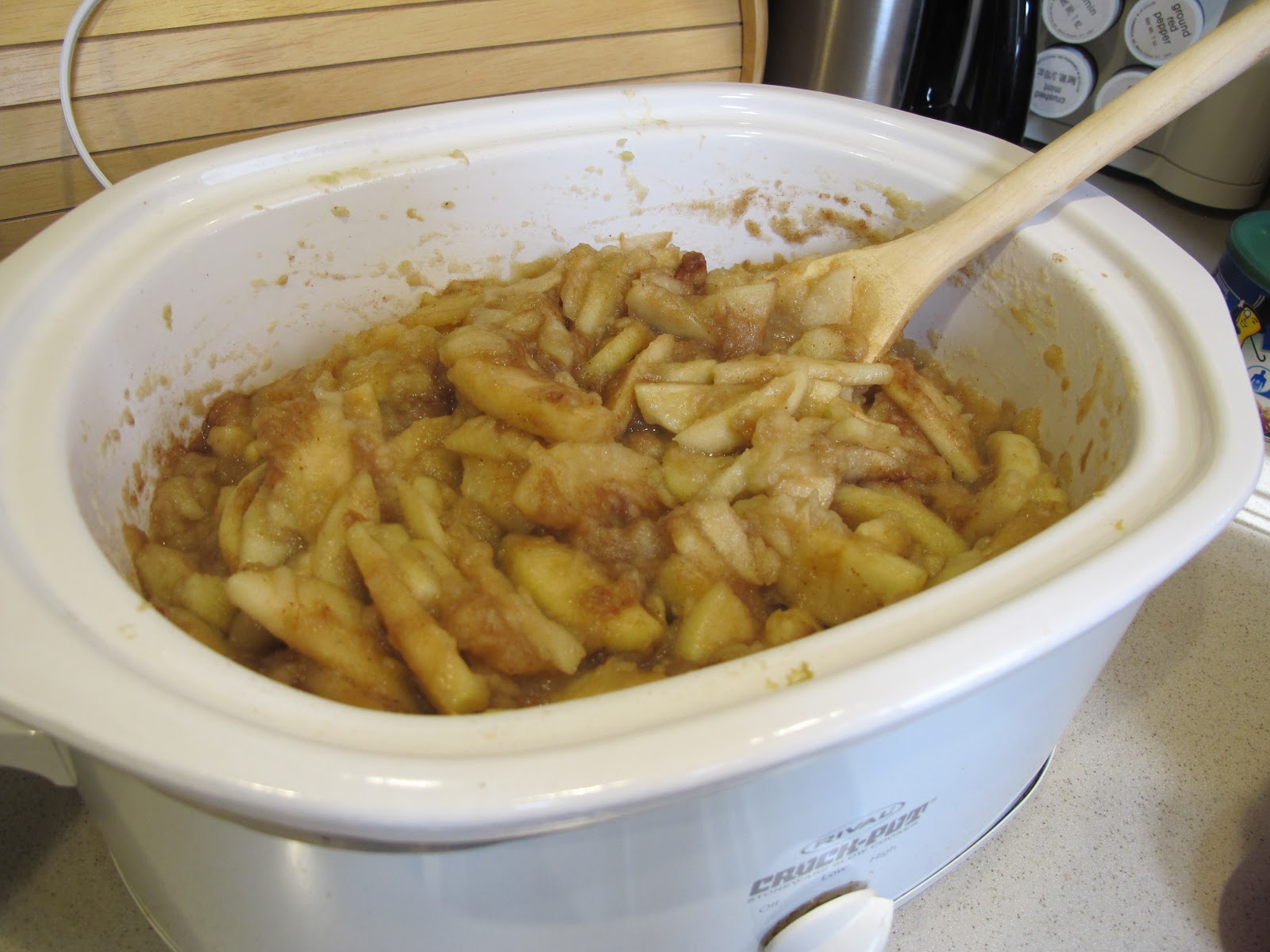
For my maiden voyage, I decide to stick to what I know, and plan to cook up a batch of apple butter.   Caroline had made hers overnight in a slow cooker, which I consider ingenious, yet here’s where I start to encounter some problems.   Every recipe is different, and the one I select contains two cups of cider and a quarter cup of lemon juice.   That’s a lot of liquid, and when I wake up on “canning morning” my diced apple chunks are floating in a lovely cinnamon-scented soup.   It doesn’t come close to “butter,” looks alarmingly un-spreadable and I’m certain it won’t “can” appropriately.  There’s also a lot of sugar in the recipe.   I have a sweet tooth, but I’m not a sugar addict.  Batch #1 is stored in the refrigerator and will make a decent applesauce dessert for the next week or two.  
I go back to Caroline for her recipe.   She demurs that her approach is “not anything worth committing to paper” but I’ve tasted the results already, and it’s good.   Here’s what Caroline recommends:   “I peel, core, and slice enough apples to fill a crockpot (or several crockpots).  Then I set it on low for 8-10 hours, or high for 6-8 hours (I usually do this before going to bed).  After the apples are mushy enough to stir with a spoon, I add a generous sprinkling of cinnamon and a less generous sprinkling of cloves.  It’s very unscientific, but my results are surprisingly uniform.”
I give it a shot.  (For anyone who’s counting, I’ve probably purchased about 10 pounds of apples for round one and two of this little kitchen project.)  I slice up Granny Smith apples, use a teaspoon of roasted Saigon cinnamon, a ¼ teaspoon of cloves and a ¼ teaspoon of roasted ground ginger because I like it.   The apples release some liquid, but the result is much chunkier and spreadable.   The recipe is still sweet, without any added sugar.  Sometimes, art wins over science.  And, the house smells fabulous, too.
With the apple butter bubbling away in the trusty crockpot, it’s time to start the canning process.   From here, it’s relatively simple. First, you have to sterilize the jars, lids and bands in simmering water.   I’m now the proud owner of a boiling-water canner, which is roughly the size of one of those water tanks that sits on top of a typical New York City apartment building.
The hot jars are filled with hot apple butter.   You have to leave a ¼ inch of head space at the top of each half-pint jar, and then you use a magnetic “wand” to lift the lid from a pot of simmering water and place it on the top of the jar.   Then, the band is screwed on lightly.  
The filled jars are submerged in the vat of boiling water and the pot cover is placed on top.  There is steam everywhere.  I can feel my pores opening up.   
The recipe has filled seven half-pint jars.    Not a bad outcome for a first try.   Apple butter is a high-acid food that is processed in a boiling-water canner.  The jars are processed for ten minutes. A temperature of 212° F kills any pathogens.   That’s a plus as I’m a little neurotic about food safety.  
When the ten minutes are up, I remove the cover, and let it sit for five minutes.  Then, each jar is removed from the bath to the counter.   You can hear the lids ping as the vacuum seals are completed.   A concave lid indicates a good vacuum seal. 
The collection of finished jars of apple butter looks impressive.  I’m proud of myself.  I’ve conquered my fear of canning and I’m on the start of a new culinary journey.  If you’re fearful of home canning, just think of me and read the instructions.  And, if you have the ability to observe a friend canning, it is hugely helpful.  It can be done. (Has anyone noticed how often the word “can” appears in the average sentence?)  I can see myself producing some nice blueberry jam after picking out on the East End of Long Island next summer. But, I’m not going to go crazy and start canning everything in sight.   Pickled beets?  I don’t think so. No intervention will be necessary.

The Ball Blue Book Guide to Preserving is an excellent and easy-to-understand resource for anyone who wants to learn the basics of home canning.  

©2013 T.W. Barritt All Rights Reserved

Tuesday, September 08, 2009

The Farmers and a Torta with Red Potatoes from Restoration Farm

I awake early on my scheduled volunteer day at Restoration Farm. It is raining steadily. My first inclination is to return to bed, but I say to myself, This is real farming. Someone still has to harvest, even when it’s raining. Dutifully, I make my way to the farm.

Head grower Dan Holmes puts me to work harvesting turnips and peppers. I like picking peppers. You don’t get dirt under your fingernails. The rain isn’t too bothersome. It’s almost refreshing and even enhances the clean, astringent smell of the peppers. Then, we turn to the potato harvest. Very shortly, I am one with the soil.

Restoration Farm Head Grower Dan Holmes shows off newly harvested red potatoes.

Dan attaches a V-shaped cultivator to the back of the tractor. He maneuvers the tractor over the mound of dirt where the potatoes were sown. The cultivator churns up the soil, and dozens of fleshy, pink potatoes pop out of the earth. The volunteers scatter after the potatoes and gather them into crates. My thighs burn as I lift the heavy crates onto the truck. Before long, we have more than half-a-dozen crates filled with potatoes and I am covered in mud.

As the lunch hour approaches, flats and crates of turnips, peppers, lettuce, chard and potatoes are transported to the distribution tent and placed in the cooler.

Restoration Farm interns Tricia Hardgrove and Jessica Graves set out placemats around a table under the distribution tent and we sit down for lunch joined by Head Grower Caroline Fanning and Dan and Caroline’s baby daughter Ada Fanning Holmes. As raindrops pummel the canvas awning, we talk about the challenges and rewards of organic farming and Community Sponsored Agriculture. As we talk, I realize that the team at Restoration Farm has been a quiet and constant collaborator in my kitchen throughout the growing season.

They are proud of the community they have nurtured, and pleased that the CSA is a size that allows them to get to know members personally. Restoration Farm is the only CSA located in Nassau and there are only about a half-a-dozen farms that still exist in the county. Dan talks of hoping to surprise members throughout the season with new produce and varieties when they arrive at the farm for weekly distribution. But, the patterns of nature are not always consistent and they face challenges of weather conditions and assuring that the combination of crops will deliver a yield that will delight members over many months.

“I was looking at the farm today and trying to think about how much we have to get us to the end of the season,” says Dan. “It’s always the beginning of the season and the end of the season that are the most angst-ridden for me, because in the middle everything is growing so it’s not much of an issue. I want to keep it so that people are excited about coming out for pickup both at the beginning and the end of the season, and that’s when it’s most challenging.”

I ask if they think members understand the nuances of the CSA.

“I think that people are really excited at first to have it, and think it is really neat and awesome, but even after a year, it is interesting to watch people compare last year to this year,” says Dan. “That relativity always comes about. You grasp for something to understand it and the only thing you can grasp is the year before.”

He says that over time, members realize that every year is not the same, and if they’ve stuck with it, they become “forever people.”

The team at Restoration Farm: (l-r) Caroline Fanning, Ada Fanning Holmes, Dan Holmes, Tricia Hardgrove and Jessica Graves

“You start to hear them talking about craving greens in the spring,” says Dan. “Their body starts to react to local eating and that’s really neat.”

As a team, Caroline and Dan bring different perspectives to their work, including what is planted, and what will appeal to people in the kitchen.

“Dan and I are always arguing about this in the fields,” says Caroline. “I’m a big proponent of different colors and he’s a big proponent of whatever is most nutritious or supposedly what tastes the best regardless of color, and we go back and forth.”

After an abundant first season, 2009 brought some significant obstacles, including cool, wet weather, and an early blight that decimated the tomato crop. They are pleased with the variety of greens that have come from the field, and met a goal of offering more lettuce throughout the season. They estimate that more than one hundred varieties of vegetables are planted at Restoration Farm.
They all agree that it is crucial to talk frequently with members, share perspectives and build an understanding of all of the factors that contribute to the successes and disappointments that occur in farming.

“I think it’s important that we’re here at distribution as often as possible to talk to people so that the members understands that we’re on their side,” says Caroline. “We’re all in the same boat, but I think if we weren’t here sharing our pain and their pain about the season, it would take on more of a dichotomous relationship. They need to know we’re doing whatever we can to minimize the problems.”

At this point, intern Tricia Hardgrove chimes in. “When you make a commitment to eating locally, you’re more tied to nature,” she says. “You’re more tied to the weather and that’s one thing that I’ve learned working here. They try to exert as much control over it as possible, but so much is out of your control. It’s dependent on the weather, it’s dependent on countless factors.”

“It puts so much pressure on to do right by all those people who put so much faith in you,” says Caroline. “And, then you combine that with a hard year where you did everything you could but you couldn’t get the rain to stop, and you couldn’t stop the tomato blight. This is why it’s important to get to meet the members, so they get to know us and understand and know that we do as much as we can to make it as good a season as possible.”

Tricia says CSA members must learn to adjust to the fact that the yield will vary. “I think committing to eating locally, committing to eating organically, people are introduced to that concept, which is so foreign to a lot of us now, because you can just go to the grocery store and get anything.”

“It’s a great question for everybody,” says Dan. “How much is enough – for us, for members, for everybody in this world – how much is enough?”

“Nature never consults anyone,” says Caroline. “People who come here thinking that this is going to replace Whole Foods as their organic food source are probably going to be disappointed. Unless you come into it prepared for the whole experience – all the good and bad – or unless you’re really dedicated to getting fresh food, those are the only things that can compensate for all the inconvenience of being a CSA member. It’s up to the individual whether or not it’s a better trade.”

“You have to pull yourself out of the supermarket mentality,” says Dan. “Much of food has gone the way it has gone because of convenience and price. That’s where we go the other way, and the question is, is that important to people?”

“You can argue that for some people, convenience has shaped much of the way our economy has gone,” says Tricia. “You come here, and you talk to the people that are growing your food, you get to see the baby and you talk to other members. That’s more humanizing than going to an automatic checkout, which isn’t always bad, but I think some people are looking for something more.”

Their winter will be spent in preparation for the growing season ahead, ordering seeds, working through crop rotations and re-registering members.

“I love planning things out,” says Caroline. “It’s like a puzzle, just figuring what to plant where, knowing that you can’t plant the same thing in the same spot, so that takes a lot of time.”

Together, they express a sense of kinship that has emerged at Restoration Farm. They talk warmly about the volunteers who have become part of the fabric of the farm.

“I think there’s this trend that’s happening now, where people are reforming community,” says Tricia. “We’ve lost some of our community over the years, and I think there’s the potential for reformation of that sense of community.”

Dan agrees. “If you find a farm – and your farm is the most local farm – and you decide that’s the place that you’re going to support, it becomes everybody’s farm.”

At this point, the rain is driving hard, although we are protected under the tarp. Caroline mentions that it reminds her of the infamous wet June weather. It’s all part of the cycle and the elements that the community must endure.

Dan offers a final thought before I scamper off to my car in search of a scrub brush to clean my fingernails, a hot shower and some clean clothes.

“I traveled a lot when I was younger in hopes of finding a real culture,” he says. “Now, when I look back on that and my thirst for that, it’s such a great feeling to now be at Restoration Farm. I really don’t have much aspiration to travel any more, because I feel like I want to be here working with my people. I could actually stand outside myself and imagine somebody wanting to travel to Restoration Farm and see this culture because we have great people here.”

Every dish - and ingredient - has a story behind it. This rustic, layered “cake” or torta of potato slices, seasoned with olives, onions, fontina cheese and rosemary makes good use of the red potatoes harvested with Dan and the team at Restoration Farm.

Torta with Red Potatoes from Restoration Farm (Makes 8 Generous Wedges)

(Adapted from Martha Stewart Living and healthypotato.com)

6 medium red potatoes (about 2 ¼ pounds)
Three tablespoons olive oil
Two medium onions, peeled and sliced
One clove garlic, minced
Two tablespoons fresh rosemary
Salt and freshly ground pepper
½ cup kalamata olives, pitted and chopped
½ cup grated fontina cheese
Three roasted red bell peppers, sliced thin

1. Scrub potatoes, place in a steamer and steam for 35 minutes until tender. Let cool and slice.

2. Over medium heat, sauté onion and garlic in one tablespoon of oil, stirring frequently, about 20 minutes. Reduce heat to low, and add rosemary, salt and pepper. Cook for 5 minutes more and remove from heat. Add olives, reserving about a tablespoon for the top.

3. Spray a 9-inch springform pan with cooking spray. Wrap bottom in foil and place on a rimmed baking sheet. Arrange 1/3 of potato slices in overlapping circles, covering the bottom. Brush with olive oil and season with salt and pepper. Layer ½ of the peppers and ½ of the cheese. Arrange a second layer of potatoes, brush with oil and season, and spread the onion mixture over the top. Cover with remaining potatoes, brush with oil and season, add remaining peppers and remaining cheese. Sprinkle reserved olives over top.

4. Bake for 45 - 50 minutes in a 375 degree oven, tenting the top with foil after 30 minutes.

5. Let cool to room temperature, remove form, and slide onto serving plate.

©2009 T.W. Barritt All Rights Reserved