Sunday, July 31, 2011

Vive la France in Portland, Oregon

I needed to travel three thousand miles for a decent lunch.

Perhaps you’ve heard that over the past weeks, a diabolical plot has been unfolding that would erase our beloved food trucks from the streets of Manhattan. Some judge dug up a dusty law from the 1950s that says business can’t be transacted when parked at a metered spot in New York City. The lunch pickings have suddenly dried up. If you’re lucky, you might find a postal truck on 52nd Street. Word on the street is that most trucks have been banished to Staten Island to do hard labor. As if the departure of food trucking’s A Team was not injurious enough? Mon Dieu! My only course of action is to join the growing numbers of food truck expatriates.

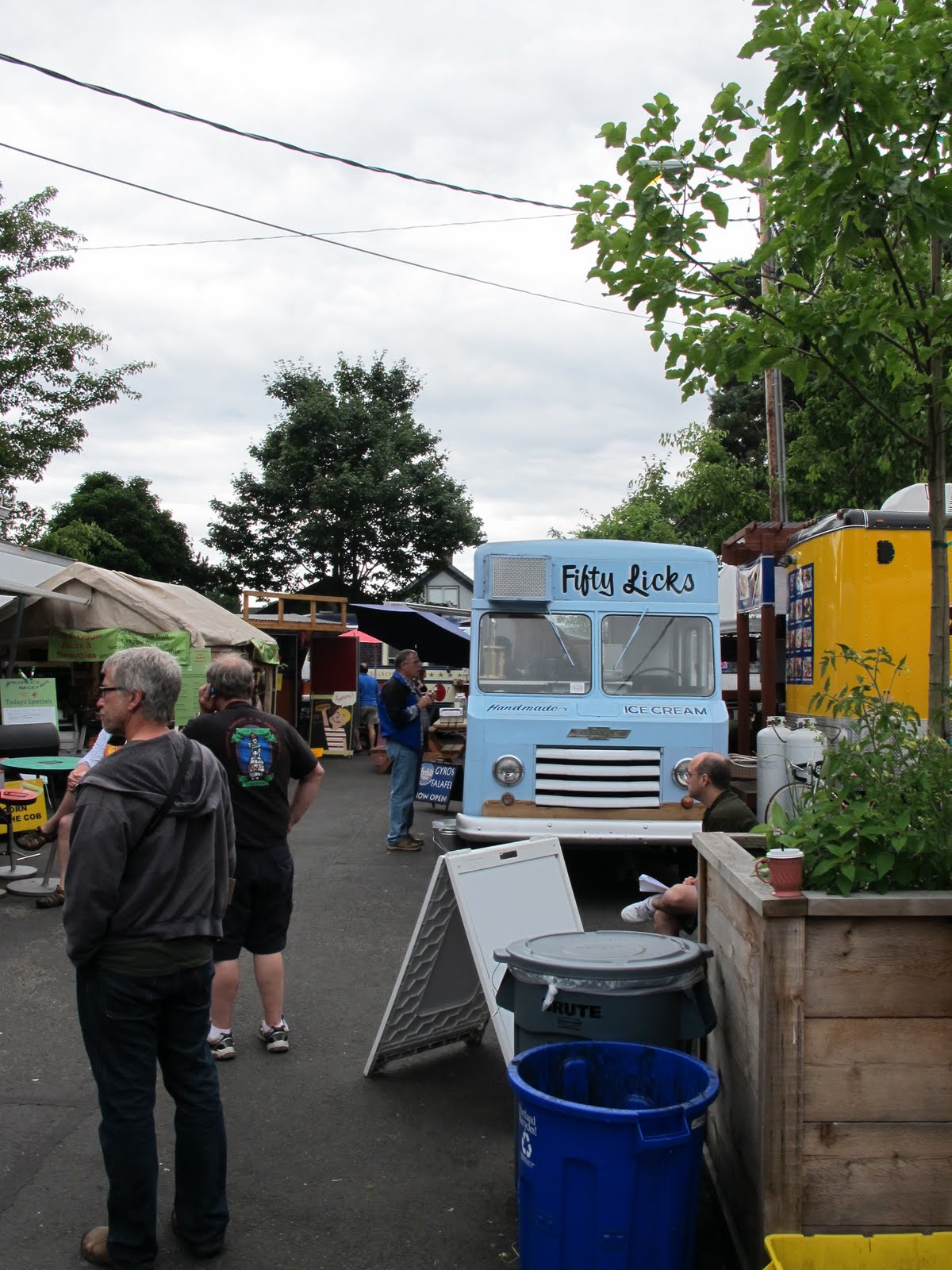
We all find liberation in unusual places. The time is the recent past. The location is Portland, Oregon where mon frère Frédéric resides. It is Bastille Day, and Frédéric has a brilliant idea on how to celebrate. At the lunch hour we find ourselves at Portland’s hot new food cart pod, “Good Food Here” at SE 43rd and Belmont.

For the uninitiated, “pods” are clusters of food carts, where one can dine on international cuisine all day. Once upon a time, I received a personal tour of the Alder Street pod from Brett Burmeister, Portland’s Food Cart Ambassador. On this day, we are joined by ma mere and mon père. The website for the Belmont pod asks the question, “Feeling peckish?” We are indeed, having worked up an appetite strolling at the Japanese gardens across the river. The Belmont pod is a lively selection of vehicles splashed with colorful graphics, along with a collection of tidy picnic tables and even an ATM machine in case your hunger overtakes your wallet. For this food truck starved New Yorker, the pod is like a vision of Mont Saint-Michel rising out of the mist.


Frédéric leads us directly to Crème de la Crème, which is housed in a 1961 Ford B-600 school bus named Charlotte, once used to transport a ballet troupe. Charlotte sat abandoned in a Montana field for 20 years before being resurrected as a mobile dining option. A food cart vehicle with a delicious backstory? I’m already salivating!


The Crème de la Crème menu is a jolie selection of classic French bistro fare.

Frédéric and I start by splitting an order of escargot which is brought to our table (Yes! Table service, too!!) in a ceramic bowl filled with plump mollusks swimming in a rich buttery broth of chunky shallots. Can we talk for a minute about real plates and utensils from a food cart? How civilized! And, the escargot is magnifique!

Ma mere and mon père both order Croque Monsieur - broiled gruyere and béchamel atop a rustic ham sandwich. The enormous sandwich is hot, cheesy and delicious.

Frédéric and I both opt for the Onion Tart, topped with a fried egg and a beet salad on the side. The buttery pastry crust and caramelized onions melt in the mouth. The French, and Portlanders know how to live. Never have I had street food this good.

In keeping with our culinary theme for the day, Frédéric leads us on to dessert where we place our order for orange cognac crème brulee at Sweet Pea’s Brulee. Sweet Pea’s is the first food cart in Portland to focus solely on crème brulee. For a brief moment, I consider applying for a job.

The proprietor allows me to watch as he uses a torch to finish the dessert with the glassy, burnt sugar topping. I can hear the brulee crack amidst the street noise. The custard is rich and silky. It is perhaps the best crème brulee I’ve ever tasted.


My visit to the Pacific Northwest is complete. The food trucks may be retreating from Manhattan, but we’ll always have pods and Paris in Portland.

©2011 T.W. Barritt All Rights Reserved

Sunday, July 24, 2011

Perseverance and Raspberry Hunting at Restoration Farm

After a two-week absence from Restoration Farm, the raspberries seem to be in scarce supply. It is a bit like a treasure hunt. I’m entitled to one quart over a fourteen-day period, but I must dip under thick clusters of leaves and weave my way through thorny bramble with the hope of finding a hidden gem.

As is often said, “seek and ye shall find.” The raspberries are small, and there are few but they are available. At first, it’s like dropping pennies in a bucket. But, I am determined that I will keep searching until I accumulate enough raspberries for a small tart – perhaps the only raspberry tart of the summer.

At times I consider giving up, but I push myself to look a little harder. There will be no tart without a little perseverance. Sometimes, I pass a section that I think I’ve picked clean and discover there is still another raspberry to pluck. Or, has another just now ripened in the heat of the morning sun?

Diligence is rewarded. It takes almost a full hour before I’ve gathered enough raspberries - slightly less than a quart, and just enough for one rustic tart.

These hard earned berries can’t be overdone. So I choose the simplest of tart recipes from Deborah Madison’s “Seasonal Fruit Desserts.” The recipe is called “Lindsey’s Austere Berry Tart” - nothing more than a jammy red raspberries and a buttery shortbread crust.

It probably took more time to pick the raspberries than it takes to eat the tart, but it is worth savoring – a delicious bite of the berry patch.

Meanwhile, the blackberry bushes at Restoration Farm have fruited, and are slowly working their way towards ripening.

©2011 T.W. Barritt All Rights Reserved

Sunday, July 17, 2011

Into Each Life Some Garlic Must Grow

No doubt about it, garlic is pungent. Some might even say, “It stinks.”

I don’t think I truly understood the power of garlic until the first time I cooked up a batch of garlic soup. It was a recipe out of Bon Appetit and probably included 40 cloves of garlic. The soup was creamy, sharp, savory and slightly dangerous, and I’m not exaggerating when I say the memory of that soup stayed with me for days.

Then there was the time my colleague Splint McCullough and I dined on an entire menu of garlic inspired dishes – including garlic ice cream for dessert – at a restaurant in San Francisco. I was sure we’d be labeled as “flammable material” and banned from boarding our flights home.

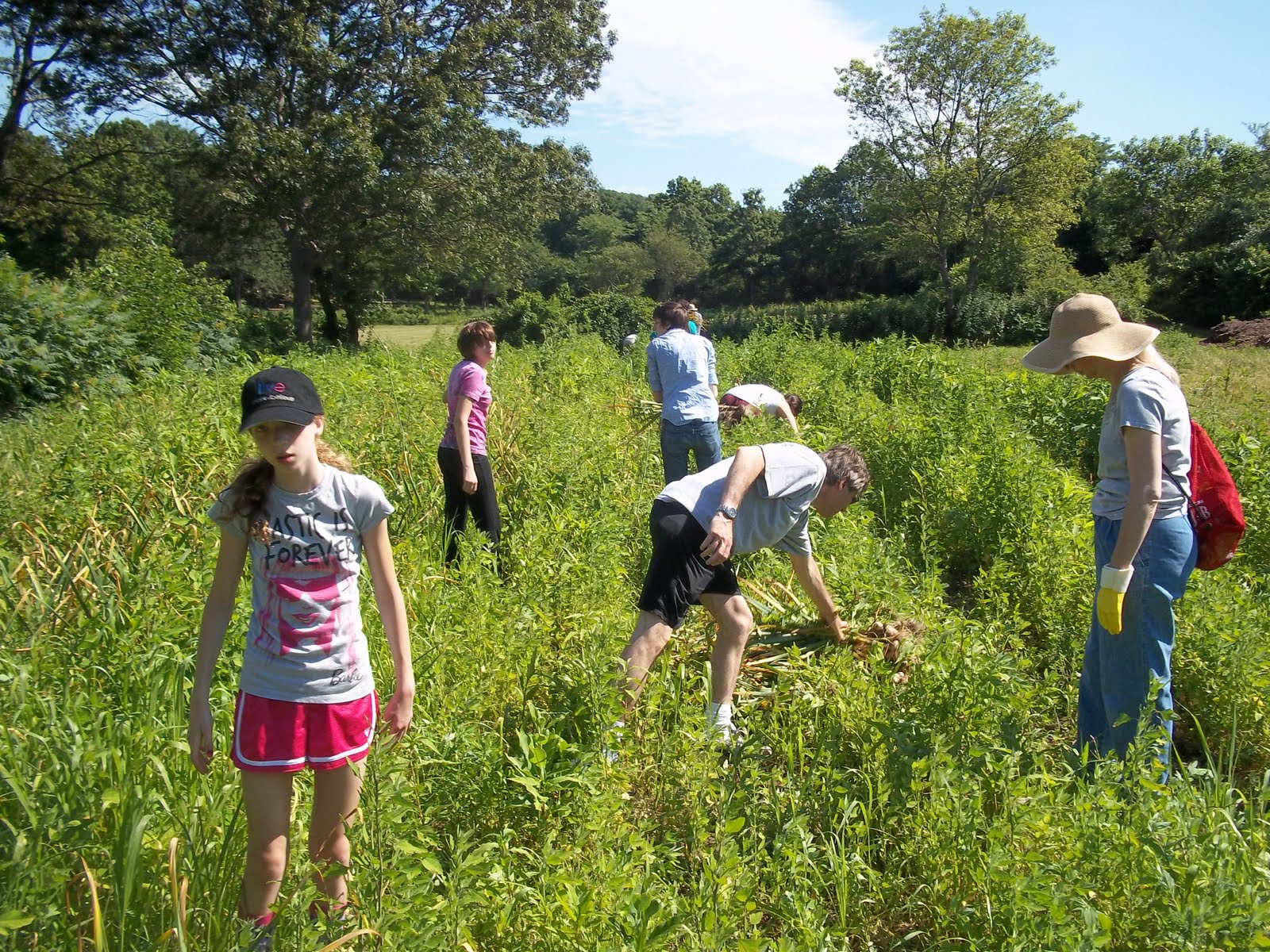
Imagine if you will, the power of an entire field of garlic. This field has a history. Last autumn - as we closed out the 2010 growing season at Restoration Farm - the members of the CSA gathered to plant individual garlic cloves that would incubate throughout the winter. Now, in the heat of July, we enter the cycle again and return to the garlic field at the North end of the historic village to harvest hundreds of heads of the stinking rose.

The sky is blue and the morning heat is starting to blister. The browning stalks of garlic are as high as an elephant’s eye, as are the weeds. We wade into the green morass and start tugging. Sometimes the garlic is hard to find among the weeds, but perseverance pays off. Bulbs pop out of the field. The air smells of garlic, earth and sweat.

The action shifts to the growing fields at the South end of the village. Bulbs of garlic are piled on rustic wooden tables. Several dozen people sort the bulbs into bundles of eight, which are tied with twine. Garlic galore.

The bundles are counted, and transported by wheelbarrow to the Red Barn, now better referred to as the Garlic Barn. The bundles are hung in the rafters of the barn for curing.

It seems we all encounter a bit of garlic in life – events or people that are a bit pungent and overpowering. And then, there are also the weeds. Perhaps you’ve got to be patient, gather a group of friends and just get in there and tug when the time is right. Then, make a sauce and a little ziti. It’ll taste good and you’ll feel better.

©2011 T.W. Barritt All Rights Reserved

Sunday, July 10, 2011

The First Pastured Chicken Comes Home to Roast

I’m not sure I have ever had quite this much information about something I am about to eat. It’s a new experience and I’m taking it day by day.

We get the word one evening via email, from Tricia, the assistant grower at Restoration Farm who is heading up the Hardscrabble Chicken Project. The chickens are ready! She writes:

“I am happy to report that we have not suffered any losses thus far and the chickens are healthy and plump! By the time they are processed they will have been moved daily on pasture for over a month and the pen will be ready for the second batch of birds currently occupying the brooder. So ready your recipes (and don't forget to make use of the herb garden and vegetables)! Thank you again for your support and I look forward to seeing you soon!”

Tricia has followed the principles for raising poultry used by Joel Salatin of Polyface Farm. The chickens are moved each day and dine on the fresh “salad bar” available in the pastures.

I happen to be at the farm shortly before the harvest. Usually, I approach the pen to say hello to “the girls.” From what I can see, they are looking very full-figured from their diet of foraged greens. But, this time I keep my distance. Is it guilt? Does this avoidance officially make me “chicken?” Probably. But, I’ve already decided I will leave the toughest part of the farm-to-table process to the professionals. My job is to cook and eat. (Another CSA member did make a visit to the farm on harvest day, which you can read about here.)

All of the birds are more than four pounds, and at least one tops the scales at six pounds. I’m several days behind schedule, so the remaining birds have been placed in the freezer. I’m a little disappointed that I can’t experience a fresh bird, but it’s still going to be a lot fresher than most. Here’s the scene when I visit Restoration Farm to pick up my share:

I am conflicted on how to best prepare this first taste of farm-raised chicken. At one point, I’ve got piles of cookbooks open as I pour over recipes and preparation techniques.

I become slightly alarmed when I read a passage from Julia Child advising against broiler chickens for certain recipes because they are too young. This makes them unsuitable for long cooking times because the flesh is too tender. I’ve had enough culinary failures lately. It’s been so bad I’m lucky nobody’s told me to pack up my knives and go home. I can’t afford to mess this one up. I consult some top culinary experts. They are unanimous in their opinion - roast that clucker until the skin is super-crispy.

I conclude that the best choice for the inaugural recipe is a tried-and-true basic roast bird, which will allow me to fully assess the flavor. High heat should give me crispy skin and moist, tender meat. I can play with other preparation methods throughout the summer.

The feast is scheduled for a leisurely Sunday afternoon, giving ample time for roasting and relishing of all those succulent “chickeny” aromas. With bird in hand, I stop in the herb garden at Restoration Farm to pluck handfuls of fresh thyme, lemon thyme, oregano and sage that I will use to stuff the cavity and perfume the roasting process.

My broiler chicken is #32, weighing in at 4.84 pounds.

I always get into a bit of a tangle when trussing. But I manage to stuff the cavity with a bouquet of herbs, a head of garlic and several slices of lemon, and even get those legs crossed nicely.

I’ve invited my friend Hal2011, a true epicurean, to join the feast. I tuck the bird into a hot oven and we head out to the deck for cocktails.

I’m using a recipe – or perhaps it’s the philosophy – of Alice Waters, who recommends generously seasoning the chicken with salt and pepper and then roasting 20 minutes breast side up, 20 minutes breast side down, and 20 minutes breast side up again. I add an additional five minutes to each rotation given the size of the bird.

After 25 minutes, I return to the kitchen to flip the bird. Not much action yet. By the second flip, the house is thick with the aroma of roasted chicken, and I hear a lively crackling in the oven. A shiny tint of copper is creeping across the breast. Another 25 minutes and it is time for the final check. The bird is piping hot, bronze and glossy. It is simply gorgeous.

There’s not an excess of juices or a lot of fat. It’s a big, lean bird (I stay lean when I eat salad, too). I use a little white wine to deglaze the pan juices, add some roasted potatoes and asparagus and we are set. I carve up the bird and plate the breasts. We could probably serve four with those breasts, but Hal2011 and I have worked up an appetite lifting cocktails on the deck.

And, what a feast it is – pristine white flesh, tender and buttery, with crackling good skin. It’s a young chicken. The taste is clean and subtle. It doesn’t hit you like a hurricane, but it is supremely satisfying and very, very tasty.

That is the story of my very first hometown chicken - locally grown, tended with care at Restoration Farm and ardently devoured. Simply divine from the farm to my table.

©2011 T.W. Barritt All Rights Reserved

Sunday, July 03, 2011

Culinary Types is Five Years Old!

It’s hard to believe that Culinary Types celebrates its fifth birthday today. This milestone includes more than 450 posts, and more time than I spent in college. It has been an education of a different sort.

From the start, the concept was a simple one – stories about food can be delicious. I’ve learned a lot from hearing, writing and sharing stories over the years. Today I’d like to share five brief stories about food.

Stories about food are the main ingredient at every meal. We tell stories at the farm, at the market, at the stove and at the table. Look at these tomatoes! Remember Tante's Hazelnut Torte, Nana's Apple Cake and the marzipan cake Aunt Elizabeth would bring at Christmas? That first pastured chicken from the farm was worth waiting for! Weren't those fried deviled eggs awesome? The food narrative is part of our collective history and our community. It’s who we are.

Behind every story about food, there’s an individual. Whether it’s the person who plants, picks, cooks or eats the food, people and food are inseparable.

Stories about food bring people together. Lydia, Susan, John and Diane, Sam, Julia, Louise, Anne, Chef Candy, Veronica, Bruce, Dorie, Dan and Caroline, the community at Restoration Farm, Zany, Mad Me-Shell and more. For me, the list of people I’ve come to know is abundant and rich.

Stories about food can inspire new ideas and open doors. I can say without question that the act of writing Culinary Types has transformed my life, and continues to do so each day.

There’s always a new dish, a fresh ingredient that's in season, or another story around the corner and it’s bound to taste even better than the one before. Trust me. It will be delicious.

©2011 T.W. Barritt all Rights Reserved